



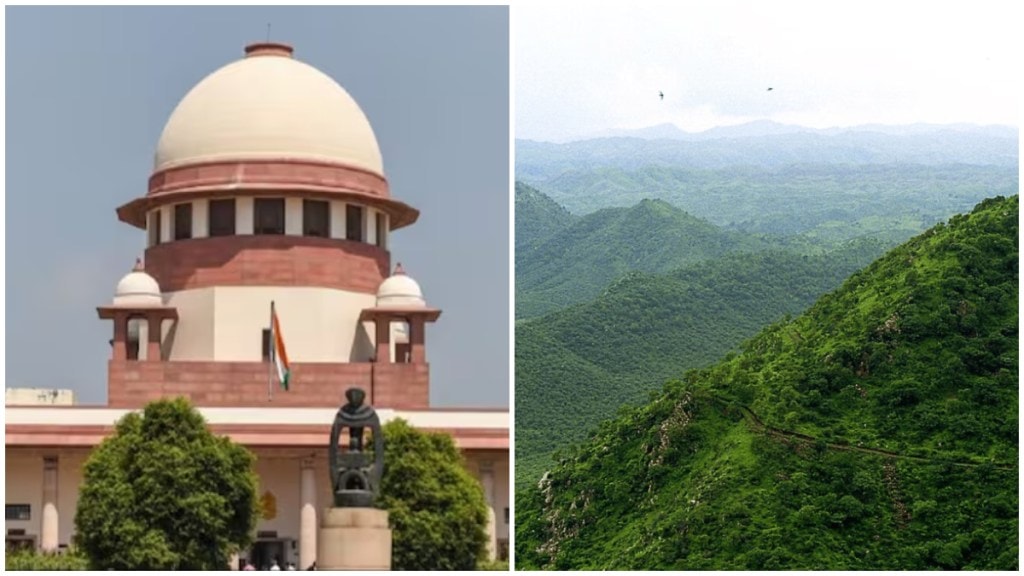
SC hearing on Aravalli Mining LIVE: The Supreme Court is going to take suo motu cognisance of the Aravalli row on Monday. The case, called ‘In Re: Definition of Aravalli Hills and Ranges and Related Issues’, will be heard today by a bench led by CJI Surya Kant, along with Justices JK Maheshwari and AG Masih.
What’s the whole fiasco around Aravalli?
The Aravalli Range is among the oldest mountain chains on Earth which runs for about 650 to 700 kilometres through Delhi, Haryana, Rajasthan and Gujarat. They hills play a vital role in nature by stopping the Thar Desert from spreading eastwards, help recharge groundwater, support many plant and animal species, and reduce dust and pollution, especially in the Delhi-NCR region.
The debate around the Aravallis started when the Centre introduced a new definition of the mountain range. Earlier, the Supreme Court had cleared a definition based on height to decide which landforms should be treated as part of the Aravalli Hills for regulating mining activity. In May 2024, while hearing a case linked to illegal mining in the Aravallis, the court pointed out that different states were using different meanings for the term “Aravalli Hills” or “Aravalli Range”. To address this, it set up a committee to look into the issue.
The committee then suggested that any landform in Aravalli districts that rises 100 metres or more above the surrounding land should be classified as an Aravalli Hill. It also explained that an Aravalli Range would mean two or more such hills located within 500 metres of each other. The distance is to be measured from the outer edge of the lowest contour line on both sides.
Why the outrage?
Environmentalists, researchers, activists and opposition leaders have raised strong objections to the height-based definition of the Aravalli Hills. They say the 100-metre limit leaves out large parts of the lower hills, scrub forests and linked ecosystems. Some estimates suggest more than 90% of these areas, especially in Haryana and Rajasthan, could fall outside protection. Many of these regions are important for the environment but do not rise sharply in height.
Critics warn that this could allow large areas to be opened up for legal mining of stone, sand and minerals, as well as for real estate projects, roads and other construction. They fear it could speed up desert spread, increase dust storms, lower groundwater levels, harm wildlife and sharply worsen air pollution in Delhi. Some have also cautioned that the damage could be severe, as the Aravallis are already weakened by years of illegal mining, stone crushing and encroachment, which have allowed desert sands to move forward.
Government’s response
The Centre, led by Environment Minister Bhupender Yadav, rejected these claims and said the definition is based on science and meant to bring clarity and uniformity. The government argued that different state-level definitions had made it harder to control illegal mining. However, towards the end of December this year, amid growing opposition, the Centre directed states to impose a complete ban on new mining leases in the Aravallis.
Check live updates for the SC hearing here:
SC hearing on Aravalli Hills Today:
Aravalli Hills SC Hearing Live: Why the issue has sparked debate?
The dispute over the Aravalli definition began after a Supreme Court order in November introduced a single, standard definition for the country’s oldest mountain range. Under this new rule, a landform is recognised as an Aravalli hill only if it rises at least 100 metres above the surrounding land. An Aravalli range, in turn, is defined as a group of such hills located within 500 metres of each other.
Many experts, along with the Forest Survey of India, say the height-based rule leaves out a large part of the Aravallis. They warn that more than 90 per cent of the landscape could be excluded, as much of the range consists of old, worn-down ridges and small hills that are lower than 100 metres but still play an important environmental role.
Environmentalists also say the definition breaks the natural continuity of the hills. These lower stretches help stop the Thar Desert from spreading, recharge groundwater in the Delhi-NCR region and provide pathways for wildlife. There are also fears that removing legal protection from these areas could open up large tracts of land for mining and real estate projects. Many of these areas were earlier protected under wider forest or hill categories.
The government argues that the new definition is based on science and will help create clear rules to control illegal mining. However, environmental groups have strongly criticised the move, calling it extremely damaging to the future of the Aravalli range.
Aravalli Hills SC Hearing Live: Jairam Ramesh blames not just mining, but ' but real estate development that is being opened up by the double engine sarkar'
In a post on X, Jairam Ramesh said that as the country waits for the Supreme Court’s next directions on the Aravallis, there is growing proof that the new definition could cause more damage to an ecosystem that is already badly harmed. He said the changes could open the door not only to mining but also to real estate projects, going against the advice of the Forest Survey of India and backed by governments in New Delhi and Jaipur. He also shared a newspaper clipping along with his post.
As the nation awaits the Supreme Court’s latest directives on the Aravallis, here is more evidence of how the new definition of the Aravallis will cause further havoc in an already devastated ecosystem. It is not just mining but real estate development that is being opened up by… pic.twitter.com/itsXUtauVo
Aravalli Hills SC Hearing Live: Water conservationist writes to CJI
Ahead of the Supreme Court hearing, water conservationist Rajendra Singh has written to Chief Justice Surya Kant, raising serious concerns about the November 20 ruling and asking for changes to better protect life and nature across the Aravalli range, a eport by The India Today said. In his letter, Singh said the Aravalli mountains have, for hundreds of years, helped sustain water, land, wildlife and human life. He said the court’s decision was troubling because it splits the Aravalli range into many small parts, weakening the natural link and continuity of the ecosystem.
He warned that the new definition could leave more than 90 per cent of the remaining area open to mining and development. Singh also pointed out that there are no hills rising above 100 metres along the Delhi-Haryana border, which could make the entire stretch vulnerable to mining and construction, and allow the Thar Desert to move closer to Delhi. Singh stressed that the Aravalli is not just a physical structure but a living system of hills and slopes. Over millions of years, winds, rainfall, underground water, traditional water systems, plants, forests and wildlife have shaped the range. He said this rich mix of natural elements is what keeps the Aravallis alive and functioning.
Aravalli Hills SC Hearing Live: What did the committee report say?
While laying down the definition of the Aravalli hills, the committee explained that any landform in notified Aravalli districts that rises 100 metres or more above the surrounding land should be treated as part of the Aravalli Hills. This would also include the full area covered by the lowest contour line of the hill, along with its slopes and related land features, regardless of how steep or gentle they are.
The panel also explained what would qualify as an Aravalli Range. It said a range would consist of two or more Aravalli hills located within 500 metres of each other. The distance would be measured from the outer edge of the lowest contour line of each hill. The land between such hills would be identified by drawing buffer zones based on the shortest distance between their contour lines. All landforms within this space, along with connected features such as smaller hills, slopes and supporting land, would be considered part of the Aravalli Range.
In the judgement, Chief Justice D Y Chandrachud, who wrote the order, said the court had accepted the committee’s recommendations, including a ban on mining in core and strictly protected areas, with limited exceptions mentioned in the report.
Aravalli Hills SC Hearing Live: SC's approved definition of Aravalli Range
The SC on Nov 20 approved a single, common definition for the Aravalli hills and ranges. It also stopped the issue of new mining leases in Aravalli areas across Delhi, Haryana, Rajasthan and Gujarat until expert studies are completed.
The court agreed with the recommendations made by a committee set up by the Ministry of Environment, Forest and Climate Change, saying the move was aimed at safeguarding one of the world’s oldest mountain systems. The committee suggested that “Aravalli Hill” should constitute any landform in notified Aravalli districts that rises at least 100 metres above the surrounding land.
It also said an “Aravalli Range” should be defined as two or more such hills located within 500 metres of one another.
Aravalli Hills SC Hearing Live: SC takes suo motu conginsance of Aravalli case
As controversy continues over the definition of the Aravalli hills, the Supreme Court has taken up the matter on its own by hearing the case today. According to the cause list, the case is expected to be heard by a three-judge vacation bench led by Chief Justice of India Surya Kant, along with Justices JK Maheshwari and Augustine George Masih. The matter has been listed as "In Re: Definition of Aravalli Hills and Ranges and Ancillary Issues".