



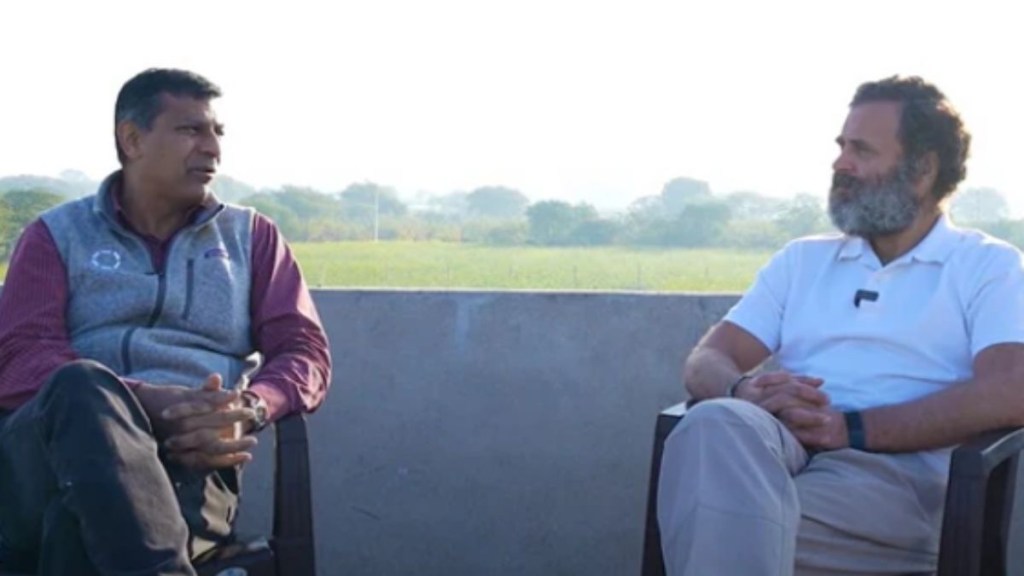
India will be “lucky” if it achieves 5% growth in the next fiscal, former Reserve Bank of India (RBI) governor Raghuram Rajan said on Thursday, warning that FY24 is going to be a much tougher year for the economy than this fiscal.
In a conversation with Congress leader Rahul Gandhi, Rajan suggested that while the current year witnessed a great deal of challenges, including the Ukraine war, given the current hikes in interest rates, global growth will slow down further next year. “India is also going to be hit. India’s interest rates have also gone up (and) Indian exports have been slowing quite a bit,” said Rajan, who had joined the Congress leader in his Bharat Jodo Yatra on Wednesday.
Rajan’s growth projection for India in FY24 is gloomier than that of most independent agencies and multilateral bodies, including the International Monetary Fund (IMF) and World Bank, which have predicted it to be in the range of 5.1% to 6.6%. The IMF has pegged India’s FY24 growth at 6.1% and the World Bank at 6.6%.
Much of India’s inflation, Rajan said, stems from elevated commodity and vegetable prices, and high inflation is going to be “negative” for growth. Retail inflation stayed above the RBI’s tolerance limit of 6% for 10 months before easing to 5.88% in November. Of course, it’s still lower than the price pressure in many countries, including the advanced ones.
The former RBI governor said if the 2022 GDP is compared with the pre-pandemic (2019) level, the growth would be just about 2% a year, which is too low. Asked about the reason for the low growth rate, Rajan said: “Pandemic was part of the problem but we were slowing before the pandemic. We had gone from 9% (growth a year) to 5%. And, we haven’t really generated reforms which will generate growth.”
Commenting on the concentration of wealth with a few industrialists, Rajan said, that issue, too, needs to be addressed. “We can’t be against capitalism. But should be fighting for (fair) competition (in the economy). We should be against monopoly.”
Rajan called for policy formulations for the lower middle class, which was the worst-affected income group during the pandemic. Stressing that income inequality has grown during the pandemic, he said: “The upper middle class has gained because they could work during the pandemic whereas the poor would have to go to factories and the factories were closed during the pandemic.”
“The poorest could get ration (from the government). The rich didn’t suffer any difficulties. Those in between — the lower middle class — had to lose a lot. They lost their jobs. Joblessness went up. Debts went up. We should look at them. Because they have suffered a lot,” Rajan added.
Highlighting that too many small companies in India don’t grow big, he said, they need a path to grow. Many of these small businesses get benefits but once they grow, those incentives are taken away. “So, there is no incentive to grow bigger. Why not say, if you grow bigger, you will get these incentives for five years?” the renowned economist said. At the same time, there should be policy stability.