



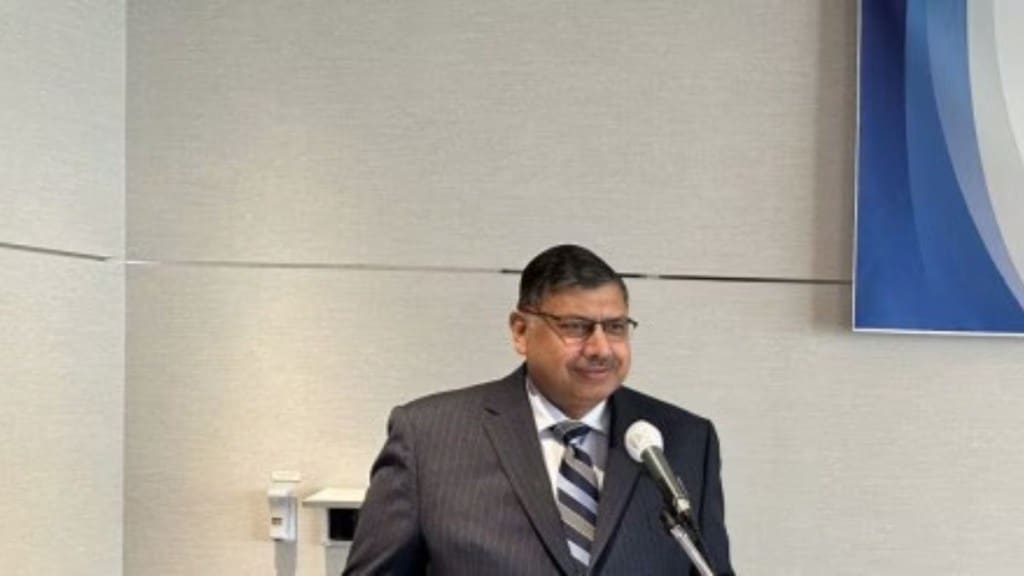
Nagesh Kumar, external member of the Monetary Policy Committee believes that economic activity may have peaked in Q2. He tells Kshipra Petkar that US tariffs is likely to hurt MSME and jobs. Excerpts:
Q. At what point does very low inflation, such as the current 0.3% CPI print, begin to pose risks to growth or financial stability rather than offer policy space?
Inflation has remained benign, with headline CPI falling to 0.3% in October 2025, largely due to lower food prices. Full-year inflation is projected at around 2%, with expectations well anchored. While this provides policy space, inflation at such low levels tends to breach the lower bound of the inflation-targeting framework and signals a demand deficit. In a developing economy like India, this warrants policy support to sustain growth momentum.
Q. FY26 Q2 GDP growth surprised positively at 8.2%, led by manufacturing. What were the key drivers behind this acceleration?
GDP growth in FY26 Q2 surprised on the upside at 8.2%, driven by strong rural consumption and investment, despite a challenging external environment. Growth accelerated for the fourth consecutive quarter and was led by manufacturing, which expanded over 9%, supporting job creation. With H1 growth at 8%, full-year projections have been raised to around 7.3%.
Kumar on recent loss of momentum
Q. However, high-frequency indicators suggest activity may have peaked in Q2. How concerned are you about the recent loss of momentum?
The celebrations of this ‘goldilocks moment’ were tempered by trends for October 2025, which suggest that economic activity may have peaked in Q2. Industrial activity lost momentum in October, reaching a 14-month low. Mining and quarrying contracted, while manufacturing growth slowed sharply to just 1.8%. High-frequency indicators also softened. Manufacturing PMI declined from 59.2 to 56.6, merchandise exports fell 12% year-on-year, and export orders weakened, pulling new orders PMI to a 12-month low. RBI’s Industrial Outlook Surveys similarly point to moderation in business sentiment and expectations.
Q. In this context, how much weight should the MPC place on high-frequency indicators relative to quarterly GDP data when assessing turning points in the business cycle?
Quarterly GDP data provide a reliable picture of past performance, but high-frequency indicators are critical in identifying turning points. When multiple indicators—PMI, IIP, exports, business expectations—move in the same direction, they offer early signals that momentum may be weakening. Therefore, one needs to carefully balance past data with forward-looking indicators while making the assessment.
Q. You have pointed to US tariffs as a growing risk. How significant is their impact on India’s manufacturing sector, especially MSMEs?
Geopolitical uncertainties, including high tariffs imposed by the US and possible delays in resolving them, seem to be hurting the business sentiment. These tariffs are particularly affecting labour-intensive sectors such as textiles and garments, leather goods, gems and jewellery, and processed food products like shrimp, which have high exposure to the US market. These sectors are dominated by MSMEs and account for around 40% of manufacturing employment. As a result, the tariffs have the potential to significantly impact MSMEs and jobs—an issue I had observed at the October 2025 MPC. However, the recent initiatives taken by the government to diversify the export markets are beginning to help as is demonstrated by the November 2025 trends.
Nagesh Kumar on monetary easing
Q. Given slowing momentum and external risks, why did the MPC feel further monetary easing was necessary?
The MPC found a case for supporting growth through demand stimulus to preserve momentum in H2 of the current year. Such support needs to be coordinated across fiscal and monetary policy to be effective. The government has taken several steps, including GST 2.0 reforms, a Rs 25,060-crore Export Promotion Mission, a Rs 20,000-crore credit guarantee scheme, and the notification of new labour codes. On the monetary side, the RBI has reduced the repo rate by 100 basis points over the past year, with transmission to lending and deposit rates now nearly complete. Hence, we all unanimously voted for a fresh 25-basis-point cut