



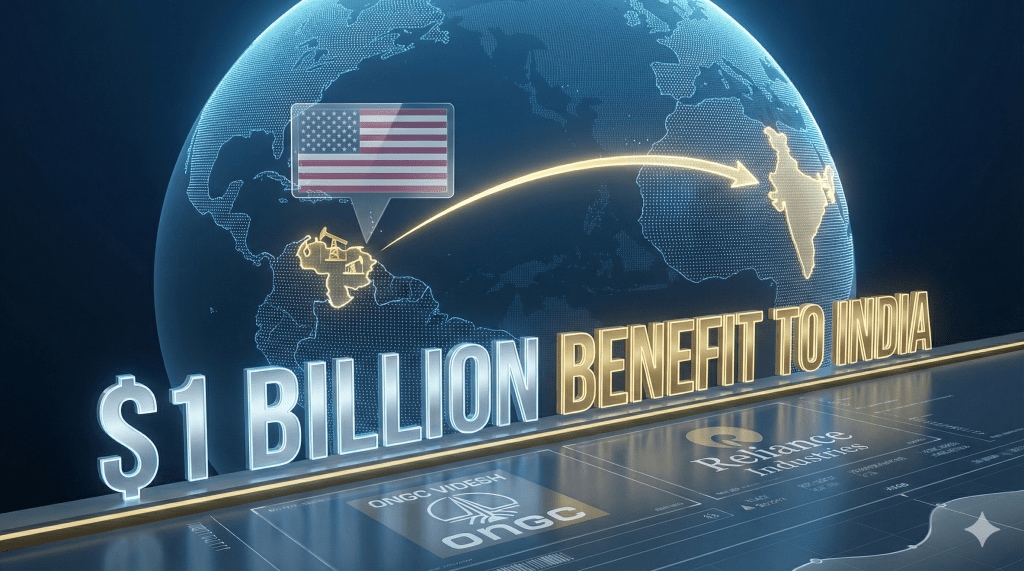
A US-led takeover or restructuring of Venezuela’s oil sector could deliver a direct benefit to India, potentially unlocking USD 1 billion, mainly by unlocking long-pending dues owed to ONGC Videsh. The US takeover also allows multiple Indian refiners such as Reliance Industries, that are well-equipped to process Venezuelan crude, to revive output once sanctions are eased and exports restart at scale, analysts and industry sources told PTI.
Until 2019, India was one of the largest buyers of Venezuelan heavy crude, importing over 4,00,000 barrels per day at peak levels. Indian refiners, especially Reliance, had invested heavily in complex refineries designed to handle heavier grades of Venezuelan oil that can be used to produce diesel.
Oil production by Indian refineries in Venezuela went down for a tumble in 2020, when sweeping US sanctions and rising compliance risks forcibly shut down purchases in 2020. Imports fell to zero, sharply reducing India’s dependence on Venezuela.
However, following the United States’ latest attack on Venezuela where it captured their President Nicolas Maduro and placed the world’s largest oil reserves under American oversight, analysts expect the US government to ease sanctions on oil benefitting Indian players in the region.
How do ONGC and Reliance enter the picture?
ONGC Videsh jointly operates the San Cristobal oilfield in eastern Venezuela. While the field is commercially viable, US sanctions in 2020 blocked the firm from accessing drilling rigs, technology and oilfield services and dividend payments.
These sanctions had also allowed Venezuela to falter from paying USD 536 million in dividends to ONGC Videsh up to 2014. When combined with dues accumulated post 2014, the total amount owed by Venezuela to ONGC comes around $1 billion, officials said.
US President Donald Trump has already stated that, as part of the takeover, major US oil companies would return to Venezuela, which has the world’s largest oil reserves, and refurbish badly degraded oil infrastructure.
Analysts said the US cannot replace all the international companies and will need firms like OVL and Reliance not just for their expertise for dealing with heavier grades of Venezuelan oil but also for the market they bring in.
Once sanctions are eased, OVL is expected to move rigs from its oil fields in Gujarat, to San Cristobal to revive output that has plummeted to 5,000-10,000 barrels per day (bpd) to roughly 80,000-1,00,000 bpd with more wells and better equipment.
Once sanctions are eased, OVL and other Indian firms can also take more fields in Venezuela and revive production from the Carabobo-1 Area – another Venezuelan heavy oilfield with Indian interest. OVL holds 11 per cent interest in Carabobo-1, while Indian Oil Corporation (IOC) and Oil India Ltd (OIL) hold 3.5 per cent stake each.
Where Reliance fits in
For Reliance Industries, the world’s largest operator of complex refining capacity, Venezuelan heavy crude is not a risk, it is an advantage. Along with Nayara Energy, IOC, HPCL-Mittal and MRPL, Reliance can blend heavy Venezuelan crude efficiently, produce higher-value fuels and reduce India’s dependence on any single source, including Russia.
This is crucial as India looks to diversify its crude basket, amid global geopolitical shifts and ongoing India–US trade discussions. According to analysts, a US-led restructuring, following Washington’s takeover of oversight of Venezuela’s oil sector could ease sanctions in phases, restore exports through monitored channels and allow payment of dues from oil revenues.
Larger trade benefits for India
The US takeover might present India with some strategic advantages in geopolitical oil trade. If US sanctions are eased along the lines of experts’ predictions, ONGC would recover its long-stuck money, Reliance will gain supply flexibility, and India will add a new bargaining chip in global oil markets, reducing its dependency on Russian oil amid ongoing US-India trade negotiations.
For India, the world’s third-largest oil importer, renewed Venezuelan exports would offer a strategic alternative to Middle Eastern crude, reduce exposure to geopolitical shocks, and strengthen its hand in price negotiations.
“Indian refiners are structurally configured for Venezuelan heavy crude. If production rises and payments normalise, trade can restart almost immediately,” an oil industry executive told PTI. A revival of Venezuelan output would also dilute China’s dominance in the country’s oil exports and reduce India’s exposure to Middle Eastern supply shocks. For India, the world’s third-largest oil importer, the story is not about going back to Venezuela, but about regaining an option it was forced to abandon.
(With inputs from PTI)