



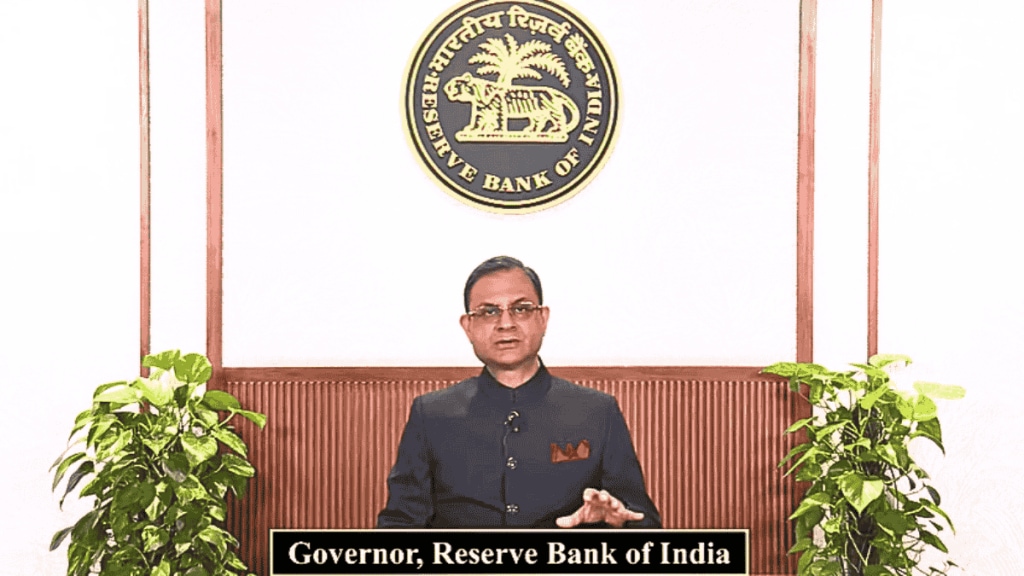
At the post-MPC press conference, RBI Governor Sanjay Malhotra, joined by the four Deputy Governors, explained the implications of the 25 basis point (bps) repo rate cut by addressing concerns about growth, liquidity, and INR stability. Stressing that there will be ample liquidity, especially as long as we are in the rate cut phase, Malhotra highlighted benign inflation trends, with forecasts lowered to 3.9% in Q1 next year. The RBI reiterated its stance of not targeting rupee levels, intervening only to curb volatility, while affirming India’s strong external position with a current account deficit (CAD) near 1% and robust reserves. The focus now shifts to the effective transmission of the rate cut. Edited excerpts:
With inflation forecasts lowered to 3.9% in Q1 next year, does this give the MPC more space to support growth? And what is RBI’s approach to the currency?
Inflation is benign, around 3–3.5% excluding food, and even lower if gold is excluded. While speculation on further rate cuts is premature, the focus now is on transmission of the recent 25 bps repo cut. On the rupee, RBI does not target levels or bands, markets determine prices. RBI only intervenes to reduce excessive volatility. India’s external sector is strong, with CAD around 1% and healthy reserves.
Historically, current account deficit (CAD) of 2% was manageable with capital flows. With flows slowing, is the threshold lower now?
India remains comfortably positioned. CAD is unlikely to rise to 2%. MPC decisions are primarily driven by growth-inflation dynamics, given India’s domestic demand-led economy.
Growth has exceeded RBI forecasts. With GDP now projected at 7.3%, should aspirations move to 8%?
The 7% GDP growth is the baseline aspiration. Having delivered ~8% growth on average over the past 3–4 years, aiming for 8% is realistic.
RBI guv on inflation
Is ultra-low inflation (0.25%) healthy for India?
Certainly not—0.2% is not the right level of inflation. We target 4%, and that’s the level we aim to achieve. Very low readings often reflect volatility and base effects, especially after periods of high food inflation. Underlying inflation is on the lower side, which is why we moved ahead with a rate cut, but our focus remains on maintaining inflation around the target, not near zero.
Are you comfortable with liquidity below 1% of NDTL?
Liquidity is being maintained on the surplus side to support monetary policy transmission. Averages have ranged between 0.6% and 1%, and with recent infusions of Rs 1.5 lakh crore, it will move beyond 1%. The exact number doesn’t matter, what matters is that banks have adequate reserves. Liquidity naturally fluctuates with currency in circulation, forex operations, and reserve changes, I am only giving confidence to the system, to the banking community, that there will be ample liquidity, especially as long as we are in this phase where interest rates have to go down.
You mentioned that further reform moves by the government can help the growth process. What would be RBI’s asks or expectations from such reforms?
What the government has to do, it is already doing so. We don’t have any expectations, we do our job independently. The government has taken up a number of reforms, like the labour (reforms), so there is no expectation from our side.
Impact of nominal growth on today’s rate cut decision
How does the MPC look at nominal growth, and did it influence today’s rate decision?
Nominal GDP is not our focus. For us, it is real GDP that matters, and that is what we look at in our deliberations.
Markets expected rupee measures. Is RBI comfortable with rupee at 90?
RBI does not target levels. Dollar-rupee swaps are liquidity tools, not rupee support measures. The rupee is allowed to find its level with orderly movement ensured.
Has RBI’s tolerance for rupee volatility changed? And why is growth/inflation not felt on the ground?
My tolerance for rupee volatility has not changed. For me and the RBI it remains the same. Intervention is more an art than a science, guided by judgment to ensure orderly movement. On inflation and growth, I disagree with the view they aren’t felt, official data shows inflation is much lower than historic levels of 5% to 7%, and growth is evident in improved living standards, even if experiences differ across regions and groups.
Why do you expect growth to soften?
Whatever are the high frequency indicators that we track, basis that we feel that the growth that has been about 8% in H1 will not be of the same order. We have already given out our numbers for this quarter and going forward.
Poonam Gupta: The base effects will play out as well. Currently the growth rate is very, very high. So when one is talking about softening, it’s from these very high levels. Sectorally I think the outlook is highly resilient on each one of the sectors.
Could you elaborate on which sectors are likely to be impacted?
The softening we are referring to will be distributed across sectors, primarily due to base effects. Growth has been very high in recent quarters, so naturally the pace moderates from these elevated levels. Additionally, some of the softening is export-led. We had earlier reduced growth projections because of high tariffs. Sectors that are tariff-impacted—such as textiles, leather, gems & jewellery, and shrimps—will certainly feel the pressure. While these sectors form only a small component of India’s overall economy, they will nonetheless be affected.
IMF rated India’s GDP data quality as “C” and reclassified exchange regime. Does this affect RBI?
Poonam Gupta: On data quality, the IMF’s ‘C’ rating relates only to base revision gaps, not the sanctity of India’s statistics. Most other series, like inflation, IIP, and fiscal accounts were rated A or B. With the revision, this concern should be addressed.
On exchange rate, India follows a managed float like most emerging markets. RBI’s role is to curb undue volatility. The IMF’s ‘crawling peg’ label is just a cross‑country comparison based on recent volatility data. It doesn’t change our framework, India remains a managed float regime.
Is there space for supporting growth from a real rate perspective? And was the absence of a trade deal with the US a consideration in your decision for rate cut?
No, that was not a consideration. As I have said before, ours is largely a domestic demand-led economy. Whatever impact higher tariffs may have is already factored into our projections, so the decision is not driven by that. It’s a totality of factors that we look at. Going forward, policy will remain data-driven—first we assess whether there is scope, and then whether there is a need. What I can say with confidence is that inflation is expected to remain benign. If it continues this way, I see policy rates staying low rather than moving higher. I won’t speculate on exact levels, but the trajectory is clear: benign inflation supports lower repo rates.
Beyond food and precious metals, is weak consumer demand in urban areas and spillover from Chinese overcapacity contributing to India’s unusually low inflation?
It’s a mix of both supply and demand factors, varying sector by sector. For food, supply-side pressures dominate, while in other areas demand plays a role too. There isn’t a single answer—it’s a combination of both. Because demand-side factors are also at play, we reduced the repo rate and remain in an easing cycle to further support demand.
With rising competition for deposits, do you expect today’s rate cut to translate into lower deposit rates?
On deposits, we have to look at real interest rates. With inflation so low and expected to remain low, even if nominal rates appear modest, real rates are quite high—for both borrowers and savers. So yes, we do expect deposit rates to moderate to some extent following this repo rate cut.
Is there a conscious effort to repatriate gold held abroad, especially given global risks?
On gold, our effort is diversification. It’s not prudent to keep all our gold in one place. Bringing back some of the gold is part of a conscious diversification strategy, ensuring resilience against global uncertainties.
Has RBI calculated the impact on inflation if the rupee falls by 1?
Yes, we have our figures. A 5% depreciation in the rupee typically leads to about 35 basis points increase in inflation. On the other hand, it also supports exports and adds roughly 25 basis points to GDP growth.
There are concerns about some online lending apps misusing consumer data. Is RBI taking any steps to address this?
We already have a full regulation in place for digital lending and the use of digital means by banks and regulated entities. In addition, we have introduced an app or store that effectively white‑lists the apps of regulated entities, helping people identify which ones are legitimate. These two measures have been significant steps in safeguarding consumers. They have helped, and we will remain continuously alert to take further actions as required.
To reduce the stock of unclaimed deposits, the RBI introduced an accelerated payout scheme incentivizing banks. How much of that stock has been reduced in the last three months?
Alongside government campaigning, we have incentivised banks, and the results are clearly visible. In October alone, there was a reduction of around Rs 760 crore of unclaimed deposits from the DIA fund. To put this in perspective, earlier the average reduction was only about Rs 100 to Rs 150 crore. So the impact is significant, and going forward we expect this pace to accelerate with continued efforts from both the government and RBI.
How is RBI addressing online fraud?
Through coordination with banks, law enforcement, and awareness campaigns. Courts have also emphasised recovery mechanisms.
How is the retail CBDC is shaping up?
T Rabi Sankar: On retail CBDC, it is in good shape. There are a little more than 80 lakh users. Transaction volumes are approaching 12 crore, with values around Rs 28,000 crore. More importantly, we are focusing on creating unique use cases, especially programmable ones. Many pilots are underway in coordination with central and state government schemes as well as bank products. We expect some of these to settle into common, widely accepted use cases. Another focus is on enabling cross‑border arrangements. Overall, CBDC is proceeding as per expectations
RBI has flagged certain concerns about personal unsecured loans. What indicators are being tracked to address this, and will there be any interventions in the personal or retail credit segment?
Swaminathan J: We track portfolios by year‑on‑year growth and relative performance across segments. Earlier, unsecured loans were expanding nearly twice as fast as other portfolios, prompting macro‑prudential measures. Currently, overall credit growth is about 11%—10% for large industries, 11% for home loans, and 14% for personal loans, with stronger growth in secured segments like gold and housing. Unsecured loans have moderated, forming less than 25% of the retail book and 17% of total banking credit. Slippages rose slightly by 8 basis points in September, but retail loans remain stable. No regulatory intervention is planned, though RBI will keep monitoring.