



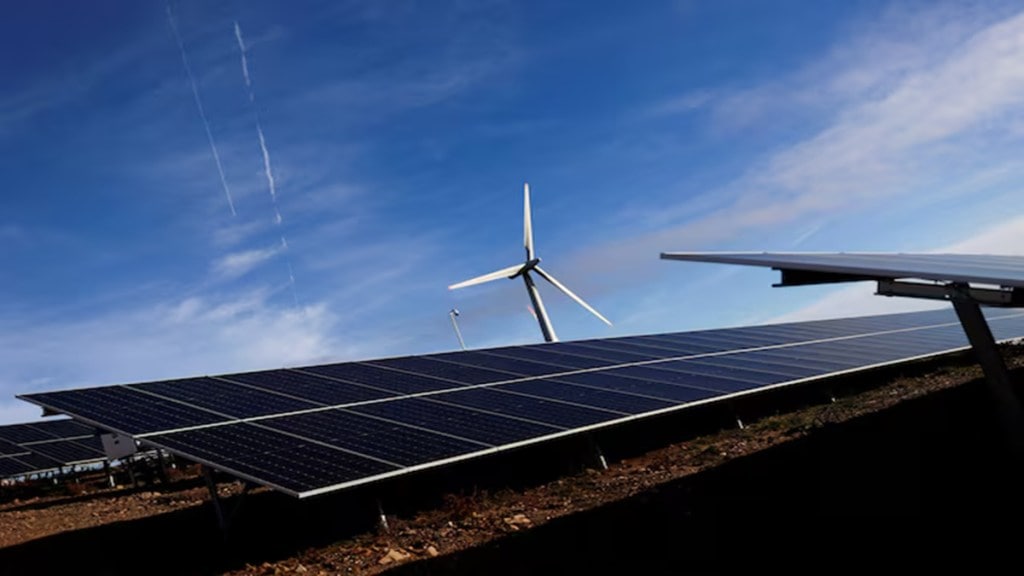
India made further headway in the renewable energy (RE) sector in the past year, with total RE capacity reaching 262.7 gigawatt (GW) as of November in the current fiscal year 2025-26. That is more than half of the total installed electricity generation capacity.
During the April-November period, the country added 34.6 GW of non-fossil fuels energy. However, key challenges including delay in signing of power purchase agreements (PPA) have resulted in up to 40 GW of stranded RE capacity.
To achieve the target of 500 GW non-fossil fuel capacity, the government has adopted a multifaceted strategy. Apart from rapid RE capacity addition, it includes streamlining the supply chain, bringing in hybrid and storage solutions, and strengthening the domestic production of raw materials.
However, even as meeting peak demand looks a lot easier now than a couple of years earlier, grid integration of RE remains a critical challenge, necessitating sophisticated grid management systems and enhanced forecasting capabilities.
Bottlenecks and Trade Hurdles
“This year has demonstrated encouraging momentum for India’s clean-energy shift, but the sector now needs a few practical policy steps to turn this momentum into bankable, on-ground projects. Long-term demand visibility, smoother financing and greater clarity on storage economics remain critical gaps for developers,” said Raaja Kanwar, Chairman & Managing Director, Apollo International Group.
Major capacity additions were bolstered by solar power projects which stood at 132.85 GW as of November, data from the ministry of new and renewable energy showed.
“2025 has been a defining year for India’s solar journey, one that reflects both remarkable progress and important inflection points. The country’s rapid strides in clean energy adoption, rooftop solar penetration, and storage-linked projects have strengthened its position as a global renewable powerhouse. At the same time, the year reminded us that ambitious capacity expansion must be balanced with calibrated demand, robust export opportunities and long-term policy continuity,” said Prashant Mathur, CEO, Saatvik Green Energy Ltd.
The government is actively exploring mechanisms to optimise transmission capacity and improve the contracting framework for renewable energy (RE) projects with stakeholders, to enable efficient addition of RE capacity to the grid. The ministry will now review the feasibility of signing power purchase agreements (PPAs) and power sale agreements (PSAs) for certain awarded capacities. However, the imposition of US tariffs has resulted in an expected overcapacity of modules in the domestic market which is likely to result in a consolidation of the smaller or pureplay module players. The US tariffs have adversely impacted the export volumes, posing new challenges for the industry as the modules have been redirected from the export market to the domestic market.
“The emergence of overcapacity in modules and cells, shifting trade barriers and pricing pressures have tested the resilience of manufacturers. But this phase is also accelerating healthy structural shifts, consolidation, stronger backward integration, higher technological efficiency, and a sharper focus on quality and reliability,” Mathur said.
KL Bansal, chairman & managing director, DEE Development Engineers noted that the year has been a strong period for India’s manufacturing ecosystem, with steady momentum across power generation, oil and gas, and industrial engineering. This growth has been supported by consistent capital spending, a clear policy push towards capacity creation, and rising global confidence in Indian engineering quality and delivery, Bansal said.
Looking ahead, Kanwar expects rational GST and tax treatment for battery storage, along with meaningful incentives for domestic manufacturing across solar, power equipment and emerging clean-tech, for significantly improving project viability.
“One area that also deserves attention is connectivity/transmission readiness, for keeping pace with capacity addition targets, availability and readiness of connectivity infrastructure has started becoming a bottleneck, this is important to maintain faster implementation and fund flow rotation. If the upcoming Budget can address these friction points while supporting a deeper local supply chain, it will provide the stability and confidence needed to accelerate truly round-the-clock, future-ready renewable power in India,” Kanwar said.
Budget 2026
To support India’s RE growth, the industry expects the upcoming Budget to support scale through customs duty exemptions on clean-tech manufacturing capital equipment, easing land-acquisition thresholds under project financing norms, waiver of refinancing prepayment penalties, and actionable mandates to stimulate demand for green fuels across refining, fertilizers, shipping, and mobility.
“Our foremost expectation is rationalisation of indirect taxes—resolving the inverted GST structure on solar manufacturing by aligning BoM and input materials with the 5% rate on modules, adopting a uniform 5% GST across EPC projects, reducing GST on BESS and pumped storage charges to NIL, and removing GST burdens on land leasing and notional corporate guarantee commissions that add avoidable costs without any economic value,” said Vineet Mittal, Chairman, Avaada Group.
On direct taxes, Mittal strongly advocates zero taxation on dividend distribution from RE special purpose vehicles to holding companies to enable efficient capital recycling and reduce the cost of equity. Additionally, targeted tax incentives, including 100% income-tax deduction and a 15% corporate tax rate for green hydrogen, ammonia, and methanol producers, are essential to accelerate domestic demand creation, Mittal said. Collectively, these measures will strengthen India’s manufacturing competitiveness, unlock affordable capital, and establish a robust domestic market for green fuels—positioning India not merely as an energy producer, but as a global clean-technology leader, the industry believes.
Icra expects the share of power generation from renewable energy (RE) capacities, including large hydro, to cross 35% by FY30 from 22.1% in FY25, with expected incremental capacity addition of 200 GW between FY25 till FY30.
This in turn also hinges on the extent of implementation of the ongoing project pipeline where the projects are bid out and the power purchase agreements are signed, the development of adequate transmission connectivity infrastructure as well as timely bidding for new RE projects, along with the PPAs signing by central nodal agencies, it had said.