



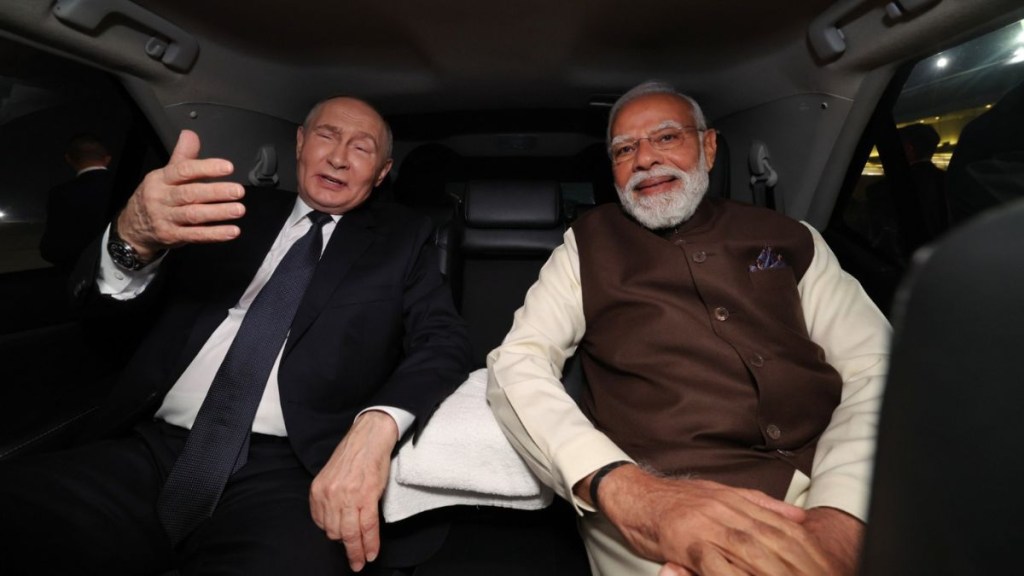
As Russian President Vladimir Putin arrived in India on Thursday on a two-day visit, India sought harmonisation of standards with Russia and reduction of regulatory barriers to enable higher exports that will balance the trade between the two countries and take it to $100 billion by 2030.
“It (bilateral trade) is very skewed and needs to be more balanced. We need to bring more diversity in our trade basket. We will work collectively to reduce and eliminate trade barriers,” Commerce and Industry Minister Piyush Goyal said at the India-Russia Business Forum meeting.
Trade summary in numbers
Of the total trade of $68.7 billion, India’s exports are just $4.8 billion and imports are $63.8 billion leading to a trade deficit of $59 billion. Of the total imports from Russia, $56.8 billion is just oil imports. A large delegation of Russian businesses is on a visit to India to look for sourcing opportunities that will help in trade diversification. Their visit coincides with the two-day state visit of Putin.
Standards and compliance requirements have been flagged by exporters from India as a significant barrier in exporting to Russia. Talks are ongoing with Russia to certify Indian suppliers of marine products who can then sell their products there.
“To make things easier for our businesses to trade on both sides, regulators need to talk to each other. Regulators need to understand and resolve issues, not create issues, not add issues. We need to see how we get into standards and certifications which match each other, which converge with each other rather than moving on the other side,” Commerce Secretary Rajesh Agrawal said at the event.
What did Goyal say?
There is a lot of positive work that is happening in this direction, he added. To address the issue of non-tariff barriers, there have been multiple meetings between the two countries in the past few months. “Many sectors with a strong potential would include the automobile sector including cars, tractors, heavy commercial vehicles, electronics, smart phones, data processing equipment, heavy machinery, industrial components, textiles, food products,” Goyal said.
Speaking at the meeting, Deputy Chief of Staff of the Presidential Executive Office of Russia Maxim Oreshkin said India’s share in Russia’s imports is less than 2% and it needs to be increased. Six major areas India can increase the supplies are agriculture, pharma, telecom equipment, industrial components, IT services, and human resources, he said. He said that Russia is ready to create conditions to welcome products from India by easing logistics, payment mechanisms and certification.
“Russian delegation and businesses are here for a specific purpose and that is to increase supplies of Indian goods and services,” Oreshkin said, adding India is one of the key drivers of the global economy and capabilities of India to supply to Russia are not fully utilised.
The government has identified engineering goods, pharma, chemicals and agri products as focus sectors of exports to Russia. India’s exports to Russia are dominated by pharmaceuticals, chemicals, iron and steel, and marine products. Imports from Russia are primarily crude oil and petroleum products, sunflower oil, fertilizers, coking coal, and precious stones and metals.