



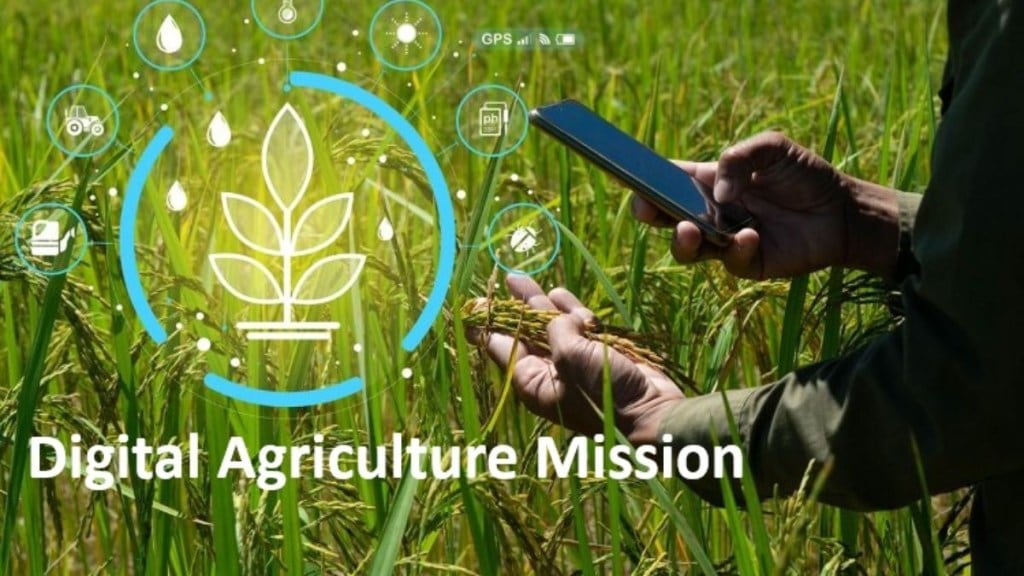
Finance Minister Nirmala Sitharaman is likely to announce a substantial hike in budgetary allocation for expanding the Digital Agriculture Mission in the forthcoming Budget for 2026–27. Sources told FE that the mission, launched last year with a budgetary allocation of Rs 2,817 crore valid till the end of FY26 — coinciding with the Fifteenth Finance Commission period — is likely to be expanded with a significantly higher allocation from FY27 onwards.
“The funding for the mission is likely to be revamped substantially with additional features for bringing transparency in crop estimation, conditions, and efficiency in the delivery of welfare schemes, including cash benefit transfers under Pradhan Mantri Kisan Samman Nidhi (PM-Kisan) and Pradhan Mantri Fasal Bima Yojana,” sources said.
Sithraman’s emphasis on building infrastructure for farmers
In her Budget speech for 2024–25, Sitharaman had announced the launch of a Digital Public Infrastructure (DPI) for agriculture to cover farmers and their land holdings over a three-year period. The mission aims to create a standardised single source of information in the form of DPI, comprising AgriStack, the Krishi Decision Support System (Krishi DSS), and soil profile maps.
Under AgriStack, a farmers’ registry linked with land records is being developed, along with the collection of plot-wise crop data for each season. So far, 16 states have issued over 77 million such IDs — also referred to as Kisan Pehchaan Patra. Officials said the target of issuing 90 million IDs would be met by the end of FY26.
What did Finance ministry officials say?
Officials added that Maharashtra, Madhya Pradesh, Rajasthan, Gujarat, Chhattisgarh, Andhra Pradesh, and Karnataka account for a large share of these farmer IDs. These IDs, similar to Aadhaar, will enable farmers to access benefits from a range of schemes, including credit, crop insurance, and direct cash benefit transfers, officials said.
In FY27, the agriculture ministry plans to issue 110 million farmer IDs, making it easier for policymakers to capture farmer demographic profiles, landholdings, and cropping patterns. Officials said that 52 million PM-Kisan records and 29 million PMFBY beneficiary records have already been validated using farmer IDs, enabling quicker enrolment and faster claim settlements.
“A pilot project has been launched in seven districts across four states to monitor urea sales to farmers and map them with farmer data available in AgriStack,” an official said. Through the digital crop survey during kharif 2025, crop-sown data for 300 million plots across 604 districts was captured to ensure more accurate production estimates.
Launched in August 2024, Krishi DSS is a geospatial platform that integrates satellite, weather, and soil data to map crops and cultivated areas, reduce the burden of digital crop surveys, provide yield estimates for insurance, assess floods and droughts, and offer inputs on crop suitability.
Under the national soil mapping programme, 39 million hectares have been surveyed, 18 million hectares digitised, and the datasets integrated into Krishi DSS for crop suitability advisories. The programme aims to cover 142 million hectares by 2030–31.
Meanwhile, the agriculture ministry will soon launch a digital platform—Virtually Integrated System to Access Agricultural Resources (VISTAAR)—under which farmers across the country will gain access to a virtual classroom to learn best agricultural practices. The platform will also facilitate access to credit, insurance, and digital marketplaces.