



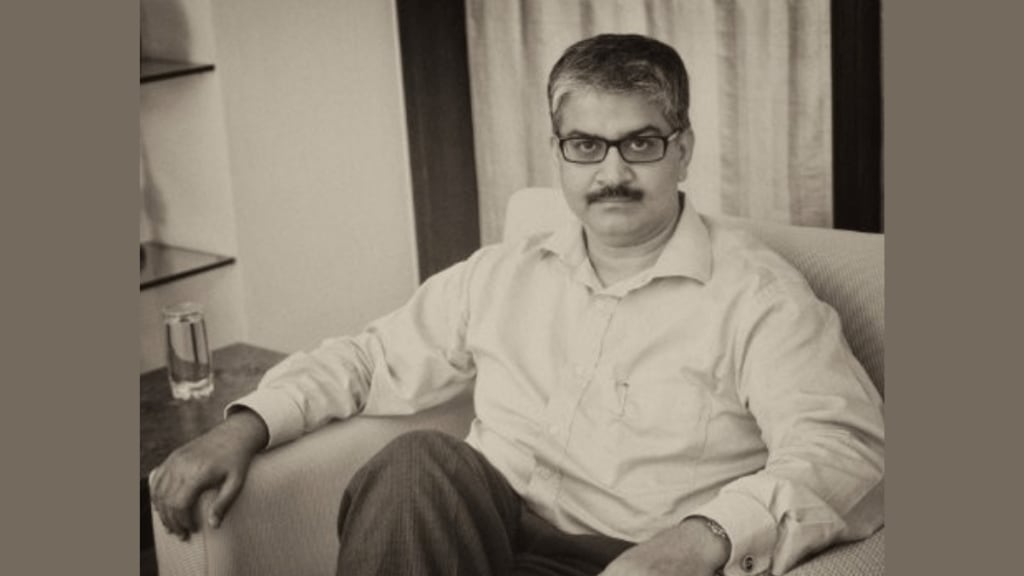
In the early 1990s, long before he became one of India’s most admired investing minds, Sanjay Bakshi was standing behind a counter at a Burger King in London, flipping burgers to pay the rent. The work was monotonous, the pay was on par with the minimum wage, and the future was certainly uncertain. Yet, it was there, far away from the corporate job he had abandoned in India, that Bakshi stumbled onto the writings of Warren Buffett. This discovery perhaps laid the foundation for his present.
Today, Bakshi, often known as ‘Fundoo Professor’, is considered to be a rare blend of practitioner and philosopher. As an investor, he has built a formidable track record. And as a teacher, his classes have been described as life-changing by generations of students. And to top it all, he is perhaps the only professor in India to drive a Porsche 911 GT3 to work.
A modest start
Bakshi grew up in Delhi, attending Delhi Public School, Mathura Road, before moving on to Kirori Mal College for a Bachelor’s in Commerce. By his own account, he was not an extraordinary student, except in mathematics. What he lacked in early academic stardom, he made up for in persistence, beginning with an articled clerkship at Price Waterhouse in 1986 and qualifying as a Chartered Accountant by 1989.
But the corporate world failed to hold his interest. In 1990, in a decision that seemed reckless to friends and colleagues, he quit and left for London with his wife to pursue an M.Sc. in Economics at the London School of Economics. Their days were divided between lectures and part-time shifts grilling Whoppers. It was, he would later say, a humbling but formative period.
London also brought the turning point. After reading about Buffett, Bakshi found what he later described as “meaning” in his life. He devoured every piece of writing he could find on the Oracle of Omaha, even writing directly to him, receiving Berkshire Hathaway’s annual reports in four days, at a time when they were not available online.
By the time he returned to India in 1994, he had a conviction: value investing was not just learnable; it was workable in Indian markets.
The early struggles
Armed with new ideas, Bakshi founded Tactica Capital Management the same year. The early years were punishing. His first fund lost nearly 40% by 1996. Instead of retreating, Bakshi doubled down on his process, refining his filters, checklists, and frameworks. The perseverance paid off: between 2001 and 2012, he compounded capital at 24% annually in USD terms, an achievement that placed him among India’s most successful long-term investors.
But the biggest pivot was yet to come.
Becoming a ‘Moat Investor’
“Sometime in late 2012, I shifted gears completely and decided to become a moat investor,” Bakshi recalled in an interview with MicroCapClub. He noted that he had an audited track record of compounding capital from 2001 to 2012 at 24% a year, in $ terms.
But the shift to buying moated businesses was instrumental in subsequent returns increasing to 45% a year, he added. Basically, he looked for stocks that were very cheap. After that, instead of focusing on price, he started looking for strong companies, the kind that are hard for competitors to defeat, have trustworthy and skilled leaders, and can grow for many years. This “moat investor” identity became the cornerstone of his later success.
Bakshi also embraced the counterintuitive practice of averaging up, buying more of a high-quality business even at or near all-time highs if its long-term value trajectory remained compelling. Underpinning this was a rigorous checklist discipline, with separate checklists tailored for moat-driven businesses, special situations and identifying valuation traps, ensuring consistency and reducing analytical blind spots.
His public disclosures over the years included holdings in Ambika Cotton Mills, Accelya Kale Solutions, TVS Srichakra, Wonderla Holidays, Pidilite Industries, Relaxo Footwears, and Polycab India, among others.
Building ValueQuest
In 2014, Bakshi partnered with Paresh Thakker to launch ValueQuest Capital LLP, which would go on to establish the ValueQuest India Moat Fund in 2014.
Sanjay Bakshi said that his investment fund performed extremely well in its first year, earning 69% returns, much higher than the market’s 17%. Since it started, the fund has grown 85%, while the market only grew 15%, and before fees, the total gain was 108%.
The fund invests in only 11 carefully chosen companies that are financially strong and profitable. Most of these companies have no debt, and even the one with debt can easily afford to pay it back. The average size of the companies is around $600 million, and the fund’s largest investment makes up 13% of the total portfolio.
According to him, the fund buys businesses for the long term and rarely selling, only if something goes wrong with the company or the price becomes unrealistically high. Bakshi said that because the stock market was booming at that time, it was harder to find great deals, but they were still able to find companies that could grow investors’ money by about 18% a year, instead of the 26% a year they were able to find earlier.
Global investors took note. In January 2018, Andrew Marks, son of Oaktree Capital’s Howard Marks, acquired a minority stake in ValueQuest Capital, a rare endorsement of an India-focused boutique firm.
The teacher
If investing made Bakshi respected, teaching made him beloved.
For two decades (2001–2021), he served as an Adjunct Professor at MDI Gurgaon, teaching courses on Behavioural Finance, Business Valuation, and Forensic Accounting. Students voted him Best Faculty 11 times, and he won InsideIIM’s “Professor of the Year” in both 2019 and 2020.
His classes were part lecture, part philosophy, part psychological exploration. He encouraged students to read widely, think probabilistically, and build what he called worldly wisdom, a mix of mental models drawn from psychology, biology, evolutionary science, spirituality, and economics.
In 2021, he moved to FLAME University in Pune as Distinguished Adjunct Professor, continuing to evolve his flagship course, “Behavioural Finance and Business Valuation,” now in its 12th iteration. The course remains freely available on his website, a rarity in the world of premium business education.
A quiet voice, at least until recently
For decades, Bakshi avoided the media. His first television interview came only in December 2024, after 15 years of requests, when he appeared on ET Now to discuss investing, markets, and mental models. He has since appeared on The Knowledge Project podcast, Talks at Google, and CFA Society India events, discussing topics ranging from evolutionary biology to value traps and India’s derivatives “casino”.
His blog, Fundoo Professor, remains a trove of case studies and reflections on market psychology, corporate governance, and human behaviour.
Still writing, still teaching, still curious
Even today, Bakshi remains prolific. As the bio on his social media platform X (Twitter) describes him, ‘opinionated professor in his virtual classroom.’ He continues to teach at FLAME, writes regularly, and participates in global investing workshops. In 2025, he joined a value investing workshop in Nepal and appeared on the India Opportunity Podcast in an extensive conversation blending stoicism, valuation, and life philosophy.
India’s markets, he told ET Now, are entering a long runway of growth. “Market cap has grown from less than a trillion 10 years ago to more than $5 trillion now,” he observed recently, pointing to expanding GDP and robust market participation.
From a young man unsure of what he wanted to a teacher who shaped thousands, Sanjay Bakshi’s life reflects the compounding power of ideas, especially when combined with discipline and patience.
And through it all, he remains what he set out to be after meeting Buffett on page three decades ago: a lifelong learner, determined to understand both markets and minds.