



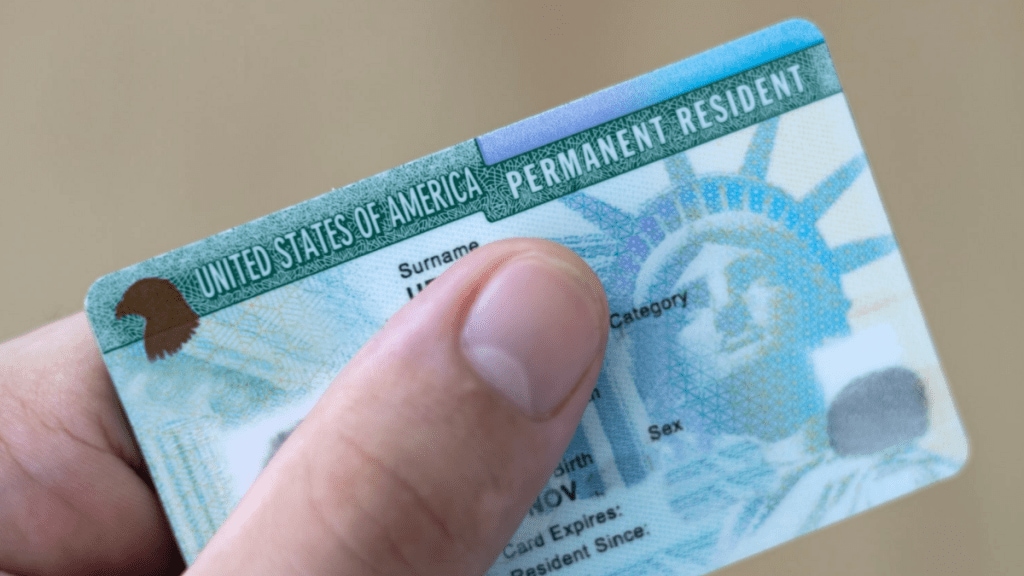
US President Donald Trump has suspended the Green Card Lottery program after a Portuguese national was identified as the suspected Brown University shooter and also potentially held responsible for the killing of an MIT professor.
Department of Homeland Security Secretary Kristi Noem has since issued a social media statement, backing Trump’s directive to get the US Citizenship and Immigration Services (USCIS) to hit the brakes on the green card lottery, which is also called the Diversity Immigrant Visa Program.
Prior to Noem’s assertion, US attorney for Massachusetts Leah B. Foley also highlighted that Portugal-born Claudio Manuel Neves Valente obtained legal permanent residence status in 2017.
Why was Green Card Lottery suspended? See Kristi Noem’s statement
In the wake of 48-year-old Portuguese national Claudio Neves Valente being identified as the suspect tied to the university tragedies, Noem took aim at the visa program for granting him legal status in the US.
“The Brown University shooter, Claudio Manuel Neves Valente entered the United States through the diversity lottery immigrant visa program (DV1) in 2017 and was granted a green card,” she wrote on X. “This heinous individual should never have been allowed in our country.”
While Trump has now rolled out the firm decision to call off this program, Noem further highlighted the Republican leader “fought to end this program” after the 2017 New York City truck attack. Sayfullo Saipov, 34, of Uzbekistan, was ultimately sentenced to eight consecutive life sentences in 2023 for carrying out a terrorist attack in the name of the Islamic State of Iraq and al-Sham (ISIS), as per the US Justice Department’s official news release at the time.
The DHS Secretary emphasised that even the culprit of the fatal NYC truck ramming incident, killing 8 people, entered America under the same DV1 program.
“At President Trump’s direction, I am immediately directing USCIS to pause the DV1 program to ensure no more Americans are harmed by this disastrous program,” Noem concluded her message.
The Brown University shooter, Claudio Manuel Neves Valente entered the United States through the diversity lottery immigrant visa program (DV1) in 2017 and was granted a green card. This heinous individual should never have been allowed in our country.
— Secretary Kristi Noem (@Sec_Noem) December 19, 2025
In 2017, President Trump…
The latest decision on this front comes after an Afghan national was identified as the gunman who opened fire near the White House, targeting two National Guard members in November. Consequently, the POTUS announced several rules against certain foreign nationals and “third world countries,” blocking their entry in the US.
And so, as has long been observed in the past few months, Trump isn’t just targeting illegal immigration, but is also going after certain mean fuelling legal migration.
What is the Green Card Lottery or Diversity Immigrant Visa?
As the name suggests, the program seeks to increase the diversity of immigrants entering the United States each year. According to the official USCIS website, the DV program makes up to 50,000 immigrant visa available on a yearly basis. Thereafter, random picks from the entries greenlight individuals belonging to countries with low rates of immigration to the United States.
As a result, individuals coming from countries that are not particularly represented in the US, mostly those in Africa, fall under this program. Once a person’s name is randomly selected in the lottery, they are invited to apply for a green card or permanent residence in the US. Ultimately, they have to go through all the same vetting processes, interviews and other legal obligations as other green card applicants.
The most basic eligibility for this visa program is that you must be a native of a country with a low immigration rate to the US and have graduated from high school or or its equivalent or having qualifying work experience.
According to the AP, nearly 20 million people applied for the 2025 visa lottery. More than 131,000 were selected in the process, including spouses with lottery winners. Portuguese nationals secured just 38 slots of the lot.
Will this impact Indians?
Indians, who may otherwise be facing the brunt of the H-1B overhaul, remain unaffected by the new directive, primarily because they were eligible for the Diversity Visa Program. As is well established already, Indian citizens are not exactly less represented in the US immigration’s scheme of things.
The South Asian nation, alongside other countries like China, Mexico, the Philippines, Canada, South Korean and Vietnam, is ineligible for the green card lottery system due to its past rate of high immigration in the US.
As per the US State Department’s previously released official instructions for the 2026 Diversity Immigrant Visa Program (DV-2026), up to 55,000 DV has been allocated for the FY 2026. However, as the new Trump order is expected to go into effect soon, a cloud of uncertainty overshadows the lottery.
“For DV-2026,natives of the following countries and areas are not eligible to apply, because more than 50,000 natives of these countries immigrated to the United States in the previous five years,” the State Department said in a PDF document available on the official government website.
It further noted, “With the exception of Cuba, which is not eligible for DV-2026, there were no changes in eligibility from the previous fiscal year.”
The ineligible countries are:
- Bangladesh
- Brazil
- Canada
- The People’s Republic of China (including mainland and Hong Kong born)
- Colombia
- Cuba
- Dominican Republic
- El Salvador
- Haiti
- Honduras
- India
- Jamaica
- Mexico
- Nigeria
- Pakistan
- Philippines
- Republic of Korea (South Korea)
- Venezuela
- Vietnam
- (Natives of Macau SAR and Taiwan are eligible)