



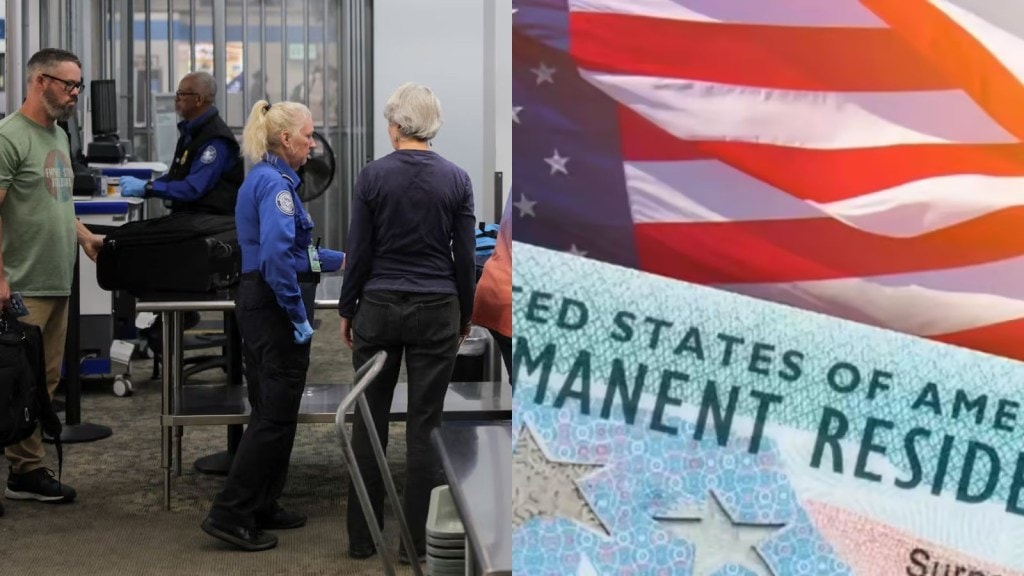
New travel and immigration rules brought in by the US Department of Homeland Security are now officially in force. The changes took effect on December 26, 2025, according to the Federal Register, and they affect non-US citizens, including people who already hold green cards.
The rules will allow stricter checks at US borders and boost the use of biometric identification such as photographs, fingerprints, and eye scans. They also bring tougher reviews for green-card holders from certain countries.
New US visa and travel rules kick in from December 26
The Donald Trump government has come down heavily against immigration after returning to the Oval office — introducing a series of restrictive measures. According to officials, the goal is to improve national security and modernise how borders are managed by using advanced technology.
According to Newsweek, under the new system, federal authorities can religiously track international travel by non-US citizens. Lawful permanent residents are included in this monitoring. Extra attention will be given to green-card applicants and holders from 19 countries that the US government has flagged for security concerns.
The biometric entry-exit system will not be rolled out everywhere overnight. The process is expected to take three to five years. It will begin at major airports before expanding to land crossings and seaports.
What has changed at US borders
One major change is the full rollout of a biometric entry-exit system. From now on, all non-US citizens will have their photograph taken every time they enter or leave the United States.
This rule applies at airports, land borders, and seaports. Children under the age of 14 and adults over 79 are no longer exempt, even though they were previously not required to go through biometric checks.
In addition, the US Customs and Border Protection officers may also collect fingerprints and iris scans. These details will be matched with existing travel documents through the ‘Traveller Verification Service.’
Stricter green-card reviews for 19 countries
US Citizenship and Immigration Services will now carry out detailed reviews of green cards issued to citizens from 19 nations. Earlier Trump administration imposed a travel ban on these countries after briefly halting the visa process.
These countries are Afghanistan, Burma (Myanmar), Chad, the Republic of the Congo, Equatorial Guinea, Eritrea, Haiti, Iran, Libya, Somalia, Sudan, Yemen, Burundi, Cuba, Laos, Sierra Leone, Togo, Turkmenistan, and Venezuela. According to the US government, these reviews are needed because of concerns about how visas and green cards were vetted and approved in the past.
What this means for green-card holders
In such a case, people who already hold green cards will be photographed and may also be fingerprinted or scanned every time they travel in or out of the US. Border questioning is expected to be more detailed. Officials may ask more questions about travel history, residence, or documentation.
Green-card holders are advised to keep all paperwork updated and easily accessible, as authorities may ask for documents at short notice. Those with pending or future visa and green-card applications should also be prepared for delays.
US Customs and Border Protection earlier explained the reason behind the changes in a filing published in the Federal Register. “Implementing an integrated biometric entry-exit system that compares biometric data of aliens collected upon arrival with biometric data collected upon departure helps address the national security concerns arising from the threat of terrorism, the fraudulent use of legitimate travel documentation, aliens who remain in the United States beyond their period of authorized stay (overstays) or are present in the United States without being admitted or paroled, as well as incorrect or incomplete biographic data for travelers,” the department said in a statement.
The Department of Homeland Security and USCIS are expected to release more guidance in the coming months. This may include details on extra paperwork or new procedures.