



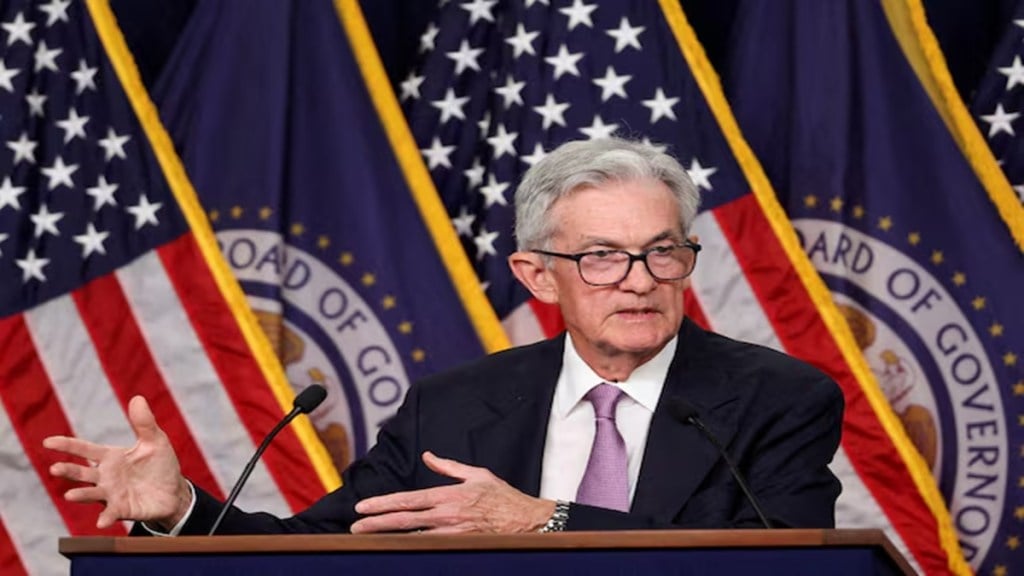
For the third time in 2025, the Federal Reserve lowered interest rates. But this time, the Federal Reserve cut the interest rates by 25bps to support the weakening labor market.
Powell’s press conference had two key takeaways for the markets: he sounded less hawkish than the markets had expected. He suggested that future rate cuts are unlikely by reaffirming confidence in the US economy’s resiliency.
“Available indicators suggest that economic activity has been expanding at a moderate pace. Job gains have slowed this year, and the unemployment rate has edged up through September. More recent indicators are consistent with these developments. Inflation has moved up since earlier in the year and remains somewhat elevated,” said Powell.
Rate Cuts in 2026
Inflation remains significantly above 2%, presenting challenges for the US Federal Reserve in 2026, influenced by Trump’s tariffs.
Fed officials project one rate cut next year, consistent with their September estimate, while indicating a cautious approach to additional cuts, emphasizing a careful assessment of the timing and extent of any future reductions.
“The ‘dot plot’ again pointed to a median expectation of one further rate cut being delivered in each of 2026 and 2027,” says Michael Brown Senior Research Strategist at Pepperstone.
How Members Voted
Jerome H. Powell, Chair; John C. Williams, Vice Chair; Michael S. Barr; Michelle W. Bowman; Susan M. Collins; Lisa D. Cook; Philip N. Jefferson; Alberto G. Musalem; and Christopher J. Waller voted in favour of 25bps rate cut.
Voting against this action were Stephen I. Miran, who preferred to lower the target range for the federal funds rate by 1/2 percentage point at this meeting.
Austan D. Goolsbee and Jeffrey R. Schmid, preferred no change to the target range for the federal funds rate in the December FOMC meeting.
The key takeaway from the December FOMC meeting and Powell’s press conference is that rates are likely to remain higher for longer, with only one rate cut each predicted in 2026 and 2027. Any improvements in the labor market and unemployment data, alongside rising US CPI data, could hinder that opportunity.
The incoming economic data on US CPI and the job market will hold the key to how the US Fed reacts in 2026.