



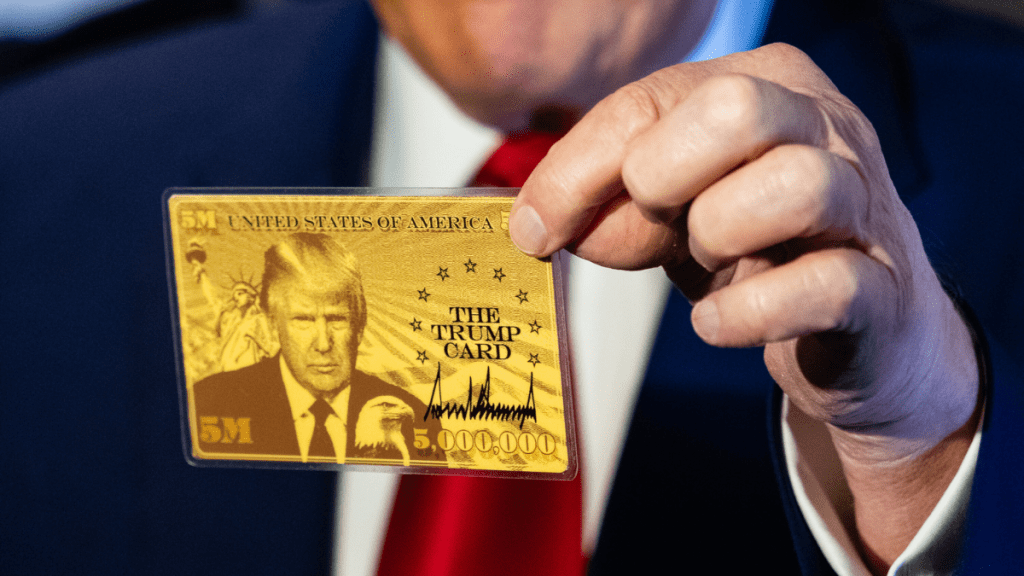
President Trump has unveiled the Trump Gold Card and launched the official website to apply for it. Priced at $1 million, the Gold Card guarantees an EB-1 or EB-2 residency status for the holder. HNWIs or UHNWIs who want fast-track residency in the US are the primary target that the US wants to invite through this scheme.
Trump Gold Card
The Gold Card is a visa based upon an individual’s ability to provide a substantial benefit to the United States. To avail the Gold Card, the US will accept a ‘gift’ of $1 million. President Trump hopes to reduce the substantial fiscal debt the US holds currently with the funds generated by these ‘gifts’.
At that price tag, it is comparable to the EB-5 Program, which costs between $800,000 and $1,050,000. But what’s the difference, and what should eligible investors opt for?
Similarities between the EB-5 and the Gold Card
Both these programs target High Net Worth Individuals (HNWIs) and Ultra High Net Worth Individuals (UHNWIs), who can afford the substantive capital required for either of these programs.
For Gold Card and EB-5 recipients, both their US income and non-US income are subject to Federal and State Tax. However, President Trump also mentioned a ‘Platinum Card’ launching soon (for $5 million). Holders of the Platinum Card would be able to spend up to 270 days in the US without being subject to taxes on non-US income.
Differences between the EB-5 and the Gold Card
The EB-5 is an investment program requiring $800,000 or $1,050,000 to invest in the US economy and generate at least ten jobs. Although not guaranteed, the EB-5 investment could generate returns at some point in the future, whereas the Gold Card fee of $1 Million is a one-time payment to the US government.
The EB-5 Program is a more business-oriented pathway, created to stimulate the US Economy through Investment and Job Creation, while the ‘gift’ required to attain the Gold/Platinum Card goes directly to the government.
The Gold Card promises an expedited processing time of weeks, not months or years as the EB-5 Program takes.
EB-5 investors are eligible for green cards and, through naturalization, may attain US citizenship. However, it is not clear for the Gold card. A successful Gold card applicant receives lawful permanent resident status as an EB-1 or EB-2 visa holder and will be subject to green card backlogs. “Basically, it’s a Green Card, but much better. Much more powerful, a much stronger path,” Trump had told reporters at the White House. But its pathway for US citizenship is not clear yet.
The EB-5 Program has legislative backing and is reauthorized to run till at least September 2027, whereas the Gold Card has been established by a Presidential Executive Order and doesn’t necessarily have the Legislative backing required.
A key thing to note is that the EB-5 Program allows all eligible family members to attain residency through your singular investment, whereas the Gold Card requires a $1 million gift per family member.
Important Things to Note about the Gold Card
Unlike the EB-5 Program, the Gold Card was not enacted by Congress as mentioned earlier; since the Gold Card program was implemented solely by Presidential authority, it may be modified, suspended, or rescinded by a future administration.
Since Trump’s Gold Card doesn’t have statutory grandfathering protections, investors who begin the process today aren’t guaranteed eligibility if the program is struck down by the court or withdrawn in the future.