



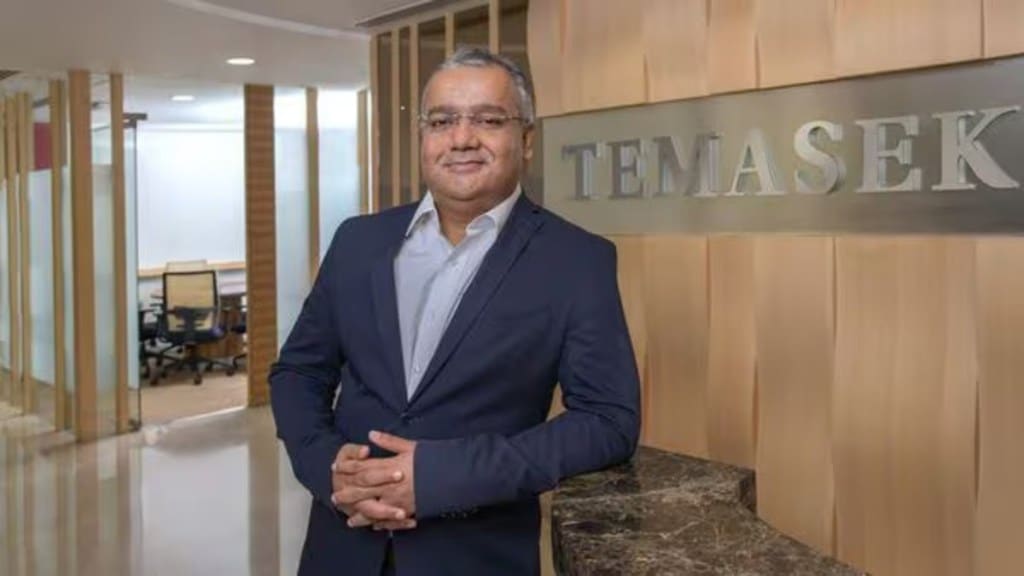
Singapore state investor Temasek has seen its India portfolio grow to a record $50 billion in FY25, with the country’s share in the firm’s total portfolio rising from 5% in March 2021 to 8% in March 2025. In an interview with Raghavendra Kamath, Vishesh Shrivastav, managing director, investment (India), said the firm sees strong visibility to sustain its current pace of capital deployment in India, driven by long-term structural trends and promising investment opportunities.
Temasek’s exposure to India is increasing, while its exposure to China is declining. What are the reasons behind this shift?
We don’t have top-down targets for how much we want in a specific country. Every investment is evaluated on its own merit against global opportunities. When we began investing outside Singapore 20 years ago, India and China were our first destinations. About a decade ago, we began investing directly in the US and Europe. As those portfolios have expanded, we have allocated more capital there, and China’s share has declined proportionally. However, in absolute terms, our China portfolio is still larger this year than last. India, on the other hand, continues to attract us due to its favourable demographics — young, aspirational, and large.
What are the bright spots you see in India?
We have constructed our India portfolio with careful consideration, focusing on four key trends: digitisation, rising consumption, longer lifespans and sustainable living. The mark-to-market value of our direct and indirect investments in India was around $37 billion in FY24, and it has grown to nearly $50 billion in FY25. This significant increase reflects both value appreciation and our continued capital commitment. Based on the opportunities we see today, we expect to keep deploying more capital into the Indian market, and we are hopeful it will continue to deliver strong returns.
In 2023, Temasek announced plans to deploy around $9 to $10 billion over the next three years. How much of that capital has already been deployed so far?
That figure was more of a guideline than a target. In the year ending March 2024, we deployed about $3 billion, and in the year ending March 2025, we surpassed that. As things stand, we see strong visibility to maintain this run rate. Ultimately, our job is to generate returns, not just to deploy capital
Sustainable living is one of your core focus areas, yet Temasek has largely stayed away from real estate, especially affordable housing. Is that a deliberate strategic choice?
I would not say there’s a conscious effort to stay away from real estate. We are looking for opportunities that make sense for us, which we believe are going to give a substantial return and can take in our kind of capital. Currently, our real estate exposure is primarily through our portfolio companies — Mapletree and CapitaLand — which we own in Singapore. Both have significant real estate operations in India.
With many corporates turning to private credit, how is Temasek capitalising on this opportunity?
Our investment approach is structured around three pillars: Temasek Portfolio Companies (TPCs), direct investments, and partnerships with funds and asset managers. We began investing in private credit a few years ago, primarily in the US, where the risk-reward dynamics became attractive as interest rates rose. If and when the Indian private credit market matures and offers opportunities with the right risk-reward balance, we’re certainly open to participating. For now, however, it remains more of a developed markets story than an India one
What opportunities do you see in the green economy, especially at a time when the global momentum seems to be swinging back toward fossil fuels?
Our commitment to sustainability remains strong, both in India and worldwide. Some of our portfolio companies, like Singapore Power and Singapore Airlines, still rely significantly on fossil fuels. Our goal is to support them in becoming more sustainable, whether by expanding their renewable energy capacity or adopting cleaner fuels. A strong example is Sembcorp, one of our portfolio companies, which has successfully pivoted its entire generation portfolio in India from fossil fuels to renewables. O2Power is another initiative in that direction, where we’ve focused on building out sustainable energy assets.