



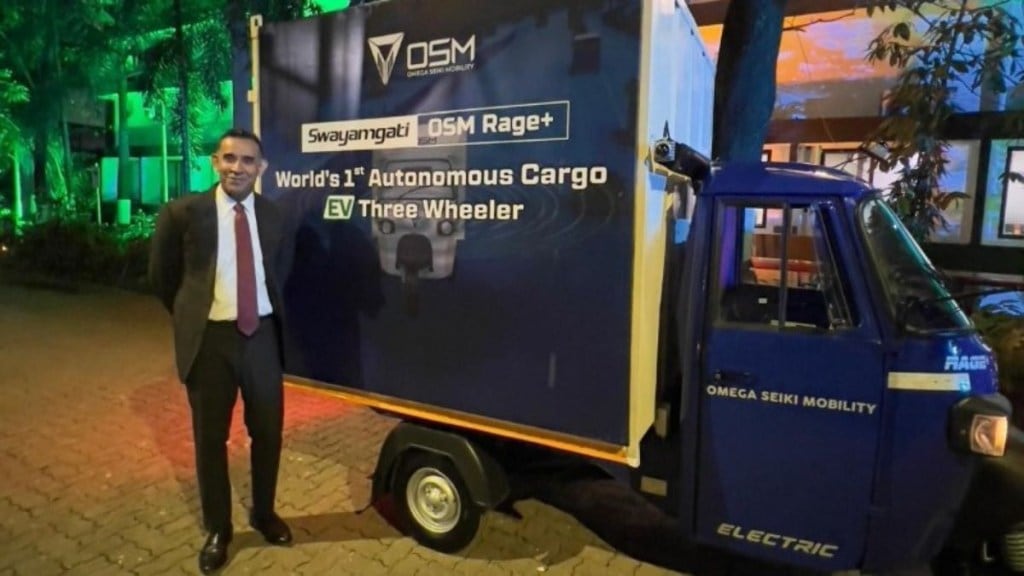
E-mobility company Omega Seiki Mobility (OSM) has launched the world’s first autonomous electric cargo three-wheeler, Swayamgati Cargo. The company has set an introductory price of Rs 4.15 lakh to make autonomous vehicles accessible, affordable, and scalable. Bookings for the Swayamgati Cargo will open on Monday, with deliveries expected to begin this quarter.
Initially, the company is targeting the Swayamgati Cargo for intra-campus logistics, featuring a driving range of up to 120 km and a top speed of 20 km/h. Uday Narang, founder and chairman of Omega Seiki Mobility, stated that this represents a first step towards building India’s autonomous mobility ecosystem.
Narang on the product’s pricing
The vehicle will operate primarily in controlled environments with limited traffic. Narang said that they have achieved a level of affordability for an autonomous vehicle that has never been seen before. Their focus on the total cost of ownership is essential for making autonomous technology viable in India.
Currently, a driver costs Rs 20,000 and works shifts of eight to ten hours, with designated holidays. Narang anticipates challenges in finding drivers in the future, while the autonomous vehicle can operate 24/7, enhancing productivity, especially for routine and repetitive tasks.
Their customers will reduce the dependence on manual labour and increase operational efficiency in controlled zones. With a price tag of Rs 4.15 lakh, the expected payback period is one and a half years. It requires one person to manage five vehicles. Operating and maintenance costs are projected to be lower than those of traditional utility vehicles.
An overview of Omega Seiki Mobility
Omega Seiki Mobility has manufacturing facilities in Faridabad and Chakan, Pune, ready to produce both autonomous passenger and cargo electric vehicles (EVs). The company had previously unveiled the Swayamgati for passenger applications.
The Swayamgati Cargo is built on the Swayamgati passenger autonomy platform, but because passengers may perceive it as risky, the focus will be on the cargo segment. Narang believes that autonomous cargo EVs are the future of structured logistics. While he acknowledges that it may take time for the market to accept autonomous vehicles, he insists that a beginning must be made.
He expects momentum to build as more players enter the segment and as additional use cases are demonstrated. The next step will involve applying this autonomous technology to trucks.
Narang said the company had received interest for procuring 1,500 units for various applications, including material movement in industrial parks, goods transportation within tech campuses, operations in manufacturing hubs and gated communities, baggage and cargo handling at airports, warehousing, factory-to-factory transfer, e-commerce fulfilment centre mobility, and military applications. With this launch, he stated, OSM is demonstrating that advanced autonomy can be designed, engineered, and produced in India at a cost effective for businesses across the country.
Swayamgati Cargo integrates OSM’s electric vehicle drivetrain with an AI-driven autonomy stack featuring Lidar, GPS, multi-sensor navigation, AI-based obstacle detection (up to 6 meters), geofenced route mapping, and remote fleet management controls. It boasts ADAS level 3 functionality and requires pre-mapped routes that are customizable for each client’s operational environment.
Currently, there are no regulations for autonomous vehicles in this category. Narang expects regulations to emerge as the market evolves.
According to global industry estimates, autonomous logistics and low-speed autonomous mobility are poised to become among the fastest-growing segments in the $620 billion autonomous vehicle market by 2030.