



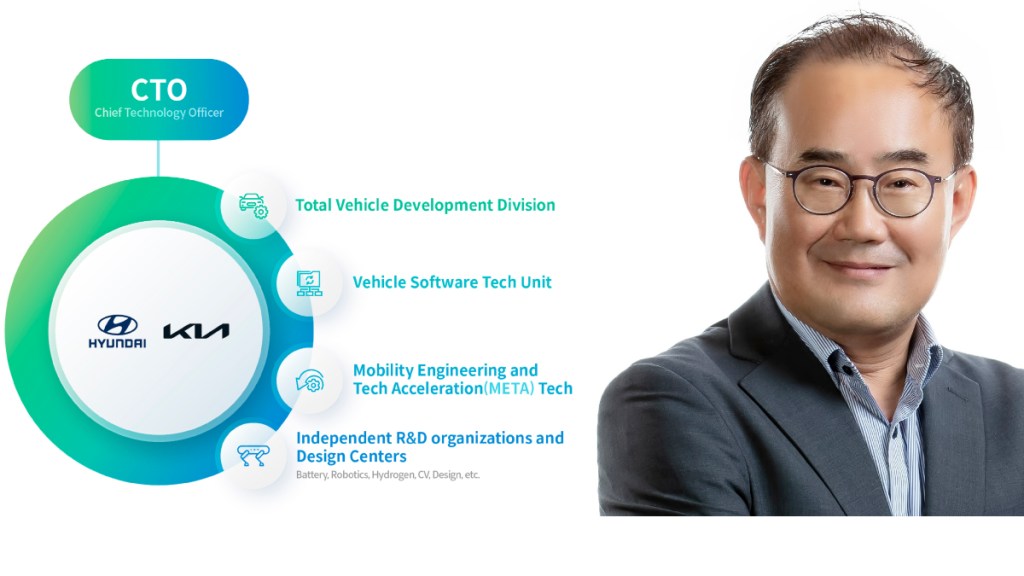
Korean auto majors Hyundai Motor Company and Kia Corporation are reorganising their joint research and development (R&D) organisation to flexibly respond to the rapidly changing global automotive industry, advance the transition to electrification and accelerate the development of Software Defined Vehicles (SDVs). The new R&D organisation will transform from a centralised structure focused on vehicle development to an independent Allianced Tech Organisation (ATO).
The companies have grouped together and elevated the areas directly related to vehicle development to enhance new vehicle development and secure quality in mass production. They have also separated next-generation innovative technology teams within the existing R&D Division as a stand-alone Tech Unit.
The revamped R&D organisation will be led by its new Chief Technology Officer (CTO), with each Total Vehicle Development (TVD) Division, Vehicle SW Tech Unit, and Mobility Engineering and Tech Acceleration (META) Tech Unit, as well as new business and Design Centres being reorganised to have their own development systems.
During the restructure, Yong Hwa Kim, Executive VP, who has been leading the R&D Division is promoted to President and named CTO. He will oversee the entire R&D organisation, while also taking place of Head of Vehicle SW Tech Unit. In addition, Executive Vice President Heui Won Yang, who previously held the position of Head of Total Vehicle Development Tech Unit, was named to the Head of TVD Division, securing continuity in R&D amid the extensive organizational restructuring.
Kim said, “The new R&D organisation will be fast and flexible, operating with the agility of a startup, and will enable us to lead in the rapidly changing mobility landscape. While the previous organisation was focused on the efficient development of vehicles, the new dynamic structure will meet ongoing changes in global consumer demands and expands the organisation to deliver aligned solutions in future mobility, electrification, software and robotics.”
Under the new system, each Division, Tech Unit, and Centre will independently focus on their technology development, whereas for cases where collaboration is required, organisations can come together and separate as needed to perform flexibly, similar to a startup.
In order to build a dynamic R&D system that can flexibly respond to rapid changes in the external business environment, Hyundai Motor and Kia have opted for a major reorganisation that completely transforms its perspective instead of making incremental changes.
New vehicle development
The new Total Vehicle Development (TVD) Division will oversee the overall process of new vehicle development, including electric vehicles (EVs). With the creation of the division, Hyundai Motor and Kia elevate their organisation responsible for product integration development to Division level with the aim of strengthening core capabilities in vehicle development.
Under this restructuring, TVD Division established the Genesis Development Tech Unit and Vehicle Development Tech Unit 1 for multipurpose vehicles and compact cars, as well as the Vehicle Development Tech Unit 2 for medium to large-sized vehicles. This new structure will facilitate efficient new vehicle development at the brand and platform levels.
Within each unit, there is a dedicated Project Manager (PM) organization overseeing product development for each model, supported by engineering design and test centers reporting directly to them.
The EV organisation, including the Electrified Propulsion Engineering Design Center and Electrified Propulsion Test Center, will now operate directly under the TVD Division, enabling agile decision-making and driving innovative technological advancements. Furthermore, dedicated research organisations focused on all-electric driving range and EV safety have also been established, expediting the efficient development of critical electrification technologies.
Software at its core
The expanded Vehicle SW Tech Unit, under the new CTO will seek the most efficient way for Hyundai Motor and Kia to transition to an SDV system. To ensure consistency in software development and build a more robust development system, Hyundai Motor and Kia added the Autonomous Driving Center, Vehicle Control Development Center and Digital Engineering Center to the Vehicle SW Tech Unit, which previously consisted of the Electronics Development Center and Infotainment Development Center. By bringing together these software-related organizations under one unit, the companies expect organic collaboration between organisations and a concentration of human and material resources.
The Vehicle SW Tech Unit will carry out R&D on the electronic architectures and integrated control strategy. It will also work closely with the SDV Division and 42dot to successfully fulfil the Hyundai Motor Group’s SDV strategy.
Based on the Domain Centralised Architecture, vehicle control systems are integrated into four domains. Through this structure, the vehicle control software system will be unified and various vehicle features can receive over-the-air (OTA) updates.
The Korean auto makers are also developing software and related devices from the perspective of a holistic user experience (Holistic UX), where mobility devices are connected to smartphones under one operating system and a vast amount of mobility data and AI technology can understand user intent so that all experiences are naturally connected.
Mobility Engineering and Tech Acceleration (META) Tech Unit
The META Tech Unit is an organisation designed to lead the development of innovative next-generation products. The division consists of the Mobility Tech Center, Vehicle Performance Tech Center, Vehicle Architecture Development Center and Materials Research & Engineering Center, which consolidate the previously decentralised organisations that promote advanced technologies and basic performance in the areas of electrification, chassis and body.
The new Mobility Tech Center will be responsible for the development of future innovative technologies and mobility concepts as well as securing next-generation architecture technologies. The also newly established Vehicle Performance Tech Center will be responsible for the mass application of outstanding technologies for high-performance vehicles as well as the proactive research and improvement of basic vehicle performance.
The Vehicle Architecture Development Center has significantly strengthened its functions for architecture-based development, with areas such as development cost and virtual development also being integrated under the Center.
Hyundai Motor and Kia are expected to increase the completeness and speed of the architecture development process while improving profitability.
The Materials Research and Engineering Center, which was previously an independent organisation of R&D, has been able to collaborate with other R&D organisations working on innovative products.
Promoting independent research and organic collaboration
Hyundai and Kia have maintained an independent R&D structure for Design Centers and business units, such as commercial vehicles, batteries, robotics and hydrogen fuel cells, except passenger vehicles. These businesses have been placed under the direct supervision of the new CTO.
These Tech Units and Centers will operate independently, conducting research and development in their respective fields while also nurturing organic collaboration with other departments as needed, with the aim of enhancing competitiveness.
In 2003, Hyundai Motor and Kia established an integrated division that brought together R&D functions that had previously been spread separately across the country to improve its R&D capability. In the mid-2000s, when sales volumes accelerated rapidly, they reshuffled the organisation into a platform-based structure by vehicle type and class to better segment the development of a diverse product lineup, including global strategic vehicles.
They also carried out continuous organisational restructuring in 2012. The Division reorganised with the goal of strengthening basic vehicle performance and customer-centric values. In 2019, they established an architecture-based system structure to secure technological competitiveness.


