



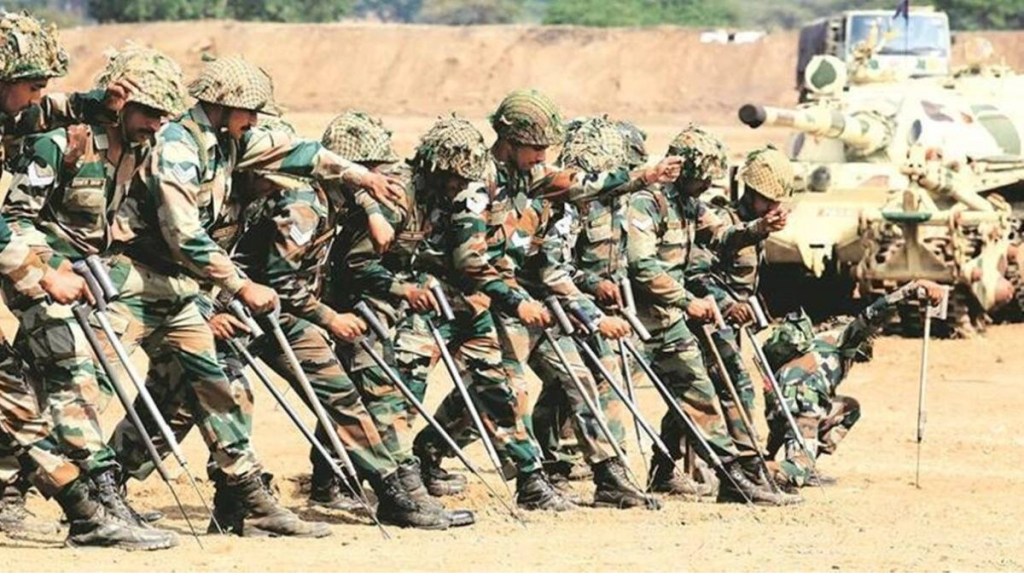
It has been almost seven and a half months since the government announced its Agnipath policy, a new recruitment initiative for Personnel Below Officer Ranks (PBOR). The policy, since its inception (June 14, 2022), has been fiercely debated with polarising views on the feasibility and impact of the defence services. Violent protests erupted out into the streets over the implementation of the scheme. Now with that in the backdrop, the policy rolls full speed ahead, with the first batch of recruits having begun training last week at multiple establishments across the country.
An estimated 26,000 recruits aged between 17 to 23 have been selected for training from a pool of 60 lakh applicants. These ‘Agniveers’, as they are called, will serve in the Indian Armed Forces for four years. Around 25 percent can continue serving for 15 to 17 years based on merit. Financial Express Online spoke to seasoned armed forces veterans to weigh the pros and cons of the Agnipath policy, factors to keep in mind and the challenges ahead. General Ashok Kumar (Retd) explains the government’s vision with the Agnipath policy. He weighs on whether it is feasible with the Financial Express Online:
“The government launched the Agnipath scheme as a new mode of recruitment in the defence forces. A lot got debated over a period of time, and the scheme has now entered the execution domain wherein Agniveers have started undergoing training in the training centres, and this strength will keep increasing in days to come. Some critical issues are re-emerging, especially in relation to training duration, as well as certain additional benefits in case the recruit gets hurt in some manner. Since the government has stated in a court of law that these Agniveers are a notch below the Sepoys, some more challenges may be faced by these personnel.”
“As far as training duration adequacy is concerned, the current duration appears reasonably adequate. The initial training is meant to impart basic training and psychological conditioning besides physical standards. Due to the large No of applicants, initial physical standards are quite good and do not pose many challenges. Educational awareness also provides the scope of reducing the training duration. Once the initial training is imparted, on-the-job training is imparted in the units/establishments. Even in the past, when No of recruits increased in one training centre, some were sent to other training centres for basic training. Not only this, part training of recruits was also conducted by units through the units to which these recruits were intended to be posted. Such experiments yielded good results, and therefore one has to wait till these Agniveers pass out and go to units. An objective assessment at that stage may form better input for modification if any.
“As far as related benefits for the Agniveers are concerned, it needs to be given a holistic view, especially in the cases of those who suffer accidents, resulting in handicap or becoming fatal. Some amount of entitlement needs to be appropriately factored in the form of pensionary benefits,” Gen Kumar, a Kargil Veteran adds.
Speaking about the challenges of Agniveers, defence and strategic affairs analyst Lt Col Manoj Kumar Channan (Retd) told the Financial Express Online: “The 26000 Agniveers 17 to 23-year-olds are undergoing training across various regimental training centres. There are discussions across multiple groups of veterans as to how this will impact the excellent organisation of the Indian Army. The experience of many veterans who have toiled on the training ground, during field exercises and on the sports field, over several years-built bonhomie and camaraderie, which underlined and emphasised the fact that victory has to be achieved at all costs.”
“Over the years, including the recent Pandemic, evacuation of citizens overseas during the Pandemic, and the ongoing Ukraine conflict, the defence services have acquitted themselves very well. While the argument holds good that coloured service was for five years, it increased to 7 years, and after 17 years, the Indian Army performed well even then. The NCOs and JCOs led by motivated young officers delivered then; why not now with four years of service?”, Lt Col Channan said.
“There is an argument purported that the Indian Army has had short service commissioned officers, the majority of officers who were killed in action were from the short service; the majority were commissioned in the Services and were on their attachment with the Infantry Battalions on commissioning,” the veteran said before going on to highlight, “The significant difference is the selection process of the Services Selection Board vis a vis the recruitment rallies.”
According to him the Indian Army has its major challenge in keeping the PLA under check; the recent incidents at Yangtse near Tawang indicate that the People’s Liberation Army (PLA) will keep the Line of Actual Control (LAC) active. Moreover, reports show the PLA is moving from a conscript army to a regular army. “In the past, since the early 1950s, the pulling out of troops from Afghanistan by the United States and the performance of the Russian conscripts in Ukraine sent out a clear message that while technology may be a force multiplier, it is the man behind the gun that counts,” the Indian Army veteran opined.
Lt Col Channan (Retd) asked readers to look back at the Kargil conflict saying: “Let us review the Operation Vijay challenge of 1999, the performance of an Agniveer, knowing fully well that a release after four years and a cheque to fund his migration to a foreign land with better prospects will weigh heavy on the combatant’s mind.”
“While the government was downsizing the Indian Army after the Galwan incident, the Ministry of Home Affairs (MHA) immediately sanctioned raising a Force Headquarters of the Indo-Tibetan Border Police (ITBP) at Chandigarh with twelve battalions,” the analyst highlighted the dichotomy of the deployment patterns of the Indian Army which is under the Ministry of Defence (MoD) and the ITBP, a Central Armed Police Force (CAPF) which comes under the MHA.
In his view the government of the day has to decide on India’s operational readiness, quality and trained human resources; with an active LoC and LAC, this is probably the wrong time to experiment with recruitment policies. In a crucial election year in 2024, the political slugfest between the rival parties on the provisioning of jobs for the youth should not compromise the security and safety of our country. “The policy will be tweaked as the years go by; threats along the LAC and the western border cannot be ignored by being short-sighted. China and Pakistan have serious economic issues, and war is not an option. Therefore, the asymmetric warfare being waged must be dealt with firmly,” he said.