



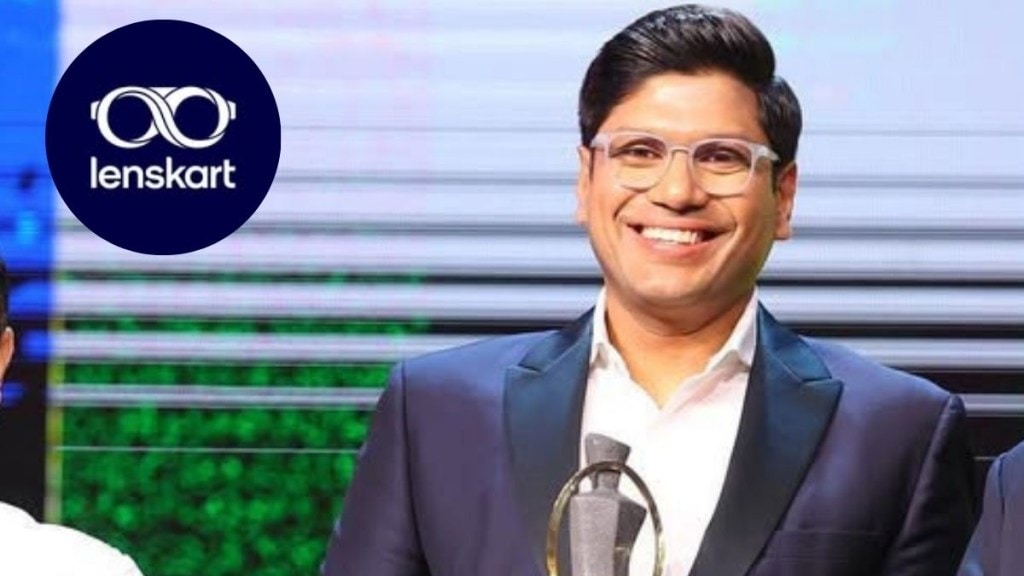
As eyewear retailer Lenskart prepares for a Rs 7,278 crore public issue, the company enters a new phase that will test whether a business built on convenience, design and data can sustain investor confidence in a public market that prizes profit over promise.
A Delhi school student who couldn’t crack the IIT entrance exam, he left for Canada to study engineering, working part-time jobs to fund his stay. That period, he has said, taught him discipline and the value of understanding consumers. After a stint at Microsoft’s Seattle office, where he learnt to approach problems from a user’s lens, Peyush Bansal returned to India in 2008.
Lenskart was founded in the same year by Bansal, Amit Chaudhary, Neha Bansal and Sumeet Kapahi, after Bansal identified a gap in India’s fragmented eyewear industry. It commenced its operations in 2010. At the time, most optical stores were small, unorganised and charged inconsistent mark-ups. Lenskart began as an online seller of contact lenses under the parent firm Valyoo Technologies, before expanding to prescription glasses and sunglasses. Today, the company’s valuation stands at Rs 69,500 crore, as per the DRHP filing.
The company’s initial pitch, affordable eyewear delivered at home, was unusual for a product that required physical fitting. By 2013, the founders realised that eyewear could not remain a purely digital business. They opened the first offline store, adopting a franchise model that would later define the company’s scale.
Today, Lenskart operates over 2,600 stores, including 2,067 in India. The offline expansion helped address a key limitation of e-commerce: customer trust. The company’s stores double as experience centres offering eye tests and product trials, while digital infrastructure continues to drive supply-chain and pricing efficiencies.
Peyush Bansal’s failed ventures before Lenskart
Before Lenskart became the company it is today, Bansal had already spent years experimenting with what worked and what didn’t in India’s fledgling internet economy. In 2007, he launched SearchMyCampus, a classifieds portal for college students. According to media reports, funded with about Rs 25 lakh of personal savings, the venture grew to a 20-member team but couldn’t scale beyond a niche audience.
Two years later came Flyrr, an online eyewear platform for the US market that would later inspire Lenskart’s model. It struggled with operational control and was shut down within a year. After Lenskart’s launch, Bansal briefly ran parallel ventures, WatchKart, BagsKart and JewelsKart, under Valyoo Technologies.
By 2014, eyewear was the only category showing sustained traction. The following year, he folded the other businesses to focus entirely on Lenskart, a consolidation that defined the company’s next phase of growth.
Today, Bansal stands to cross the $1 billion net worth mark if Lenskart’s share price rises about 25% on debut, as per news reports. Reports also suggest that Bansal is set to sell up to 2.05 crore shares, thereby foreseeing a profit of Rs 785.54 crore.
Numbers behind Lenskart’s narrative
As per the revised Red Herring Prospectus, Lenskart reported a profit of Rs 61.2 crore for Q1 FY26, as compared to a loss of Rs 10.9 crore in the same period last year. Lenskart reported revenue from operations of Rs 1,894.5 crore in the first quarter of FY26, up 24.6% year-on-year from Rs 1,520.4 crore in the same period last year, driven by an expanded store network, stronger demand across online and offline channels, and higher international sales.
Profit before tax stood at Rs 75.9 crore against a loss of Rs 12.4 crore in Q1 FY25, while total income rose to Rs 1,934.1 crore and total expenses to Rs 1,858 crore. The India business contributed Rs 1,169.2 crore in revenue, with international markets adding Rs 736.5 crore.
Backers include SoftBank, Temasek, KKR, Kedaara Capital and Premji Invest, all expected to partially offload shares during the offer. The IPO, priced between Rs 382 and Rs 402 a share, will raise Rs 2,150 crore in fresh equity, with the rest through an offer-for-sale by existing shareholders. As per reports, Peyush Bansal’s 173.2 million shares are now worth Rs 6,964 crore, representing a 10.28% stake.
Technology and integration
A major part of Lenskart’s growth has come from its use of in-house technology and vertically integrated manufacturing. The company runs automated facilities in Bhiwadi and Gurugram capable of producing around three lakh frames a month, and is setting up a larger plant in Telangana to support domestic and export demand.
Its app-based tools, such as 3D virtual try-ons and AI-based frame fitting, are meant to reduce returns and personalise recommendations. These systems have also improved turnaround times, allowing custom orders to be fulfilled within 48 hours. The company’s control over design, manufacturing and retail gives it tighter margins than traditional opticians, though the cost of expansion remains high.
Repositioning and reach
Lenskart’s marketing strategy has evolved alongside its scale. Earlier perceived as a discount player, it began positioning itself as a fashion-oriented brand from 2017, when it signed actor Katrina Kaif as its first ambassador. Since then, campaigns featuring Kiara Advani, Suryakumar Yadav and Karan Johar have tried to balance accessibility with aspirational value.
As per media reports, the company earns 40-50% of its revenue from international markets, which include Singapore, Japan, Thailand and the UAE. Furthermore, the company’s acquisitions, such as Japan’s Owndays in 2022 and Spain’s Meller in 2025, helped it enter new price segments and also create an appeal to younger customers. However, one must note that operating in multiple geographies adds currency and compliance risks to the company.
The next phase
Bansal has said the company’s focus will remain on expanding its reach in smaller Indian cities and strengthening operations in Southeast Asia and the Middle East. The larger question, though, is whether Lenskart can maintain growth without the private-market flexibility it once enjoyed.
Lenskart’s growth has not been without criticism. Its marketing of blue-cut lenses has drawn flak online, with some users and experts calling the demonstrations misleading and the benefits overstated. Customer reviews on Trustpilot, where the brand averages 1.8 stars from over 50,000 entries, point to recurring issues with frame durability, lens discolouration and after-sales service. The company has also faced scrutiny for pricing, after users noted that its Aqualens solution and a cheaper rival product are made by the same manufacturer. While some customers report quick replacements and helpful staff, others flag aggressive upselling and inconsistent service quality.
Its heavy reliance on owned manufacturing and technology infrastructure means the company must sustain volumes to protect margins. It also competes in a category where replacement cycles are long and customer acquisition costs remain high. For now, Lenskart’s listing will serve as a measure of how far India’s consumer-tech startups have matured.