



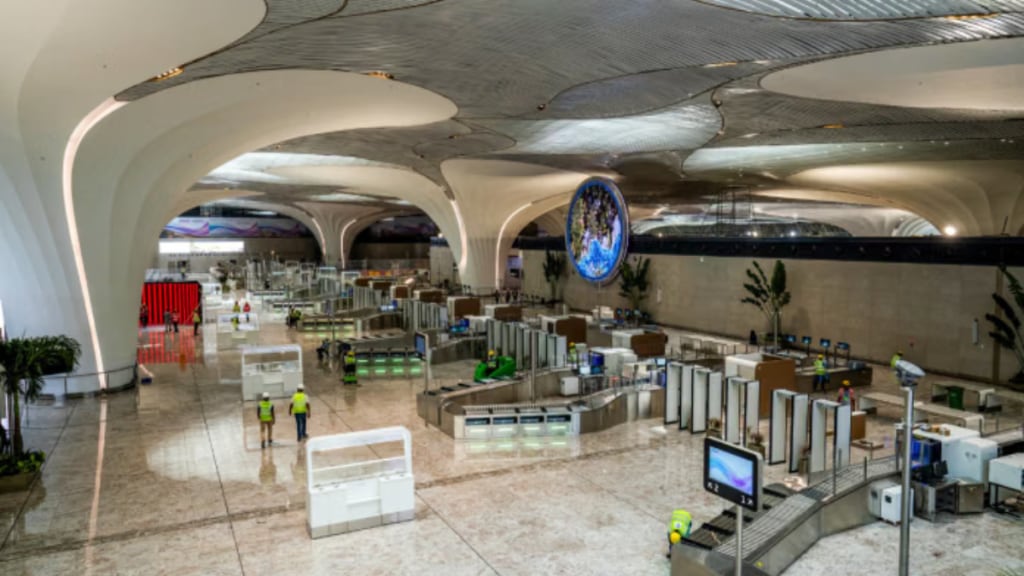
The Navi Mumbai International Airport (NMIA) will commence commercial operations on December 25, marking the launch of Mumbai’s long-awaited second airport. The first commercial flight, arriving from Bengaluru at 8 am, will formally signal the start of Phase 1 operations at the greenfield airport.
On its opening day, NMIA will handle flights to and from cities including Bengaluru, Delhi, Hyderabad, Jaipur, Lucknow, Mangaluru, Nagpur, Ahmedabad, Goa and Nanded. Regional carrier Star Air will operate the Nanded sector. Around 33 aircraft movements, including arrivals and departures, are expected on Day 1, according to Indian Express.
The launch is expected to gradually ease pressure on the congested Chhatrapati Shivaji Maharaj International Airport (CSMIA). However, several access-related and urban infrastructure elements around NMIA remain incomplete, which could pose initial challenges for passengers, the report further added.
Initial flight network and airline operations
In the first phase, the airport will connect Navi Mumbai with major domestic destinations such as Ahmedabad, Aurangabad, Bengaluru, Chennai, Kochi, Coimbatore, Delhi, Goa, Hyderabad, Jaipur, Jammu, Kolkata, Lucknow, Mangaluru, Nagpur and Vadodara. Authorities have indicated that connectivity will be expanded progressively through December and January.
IndiGo, Akasa Air and Air India Express will operate daily services from NMIA. Star Air is planning additional regional routes linking Navi Mumbai with Ahmedabad, Goa, Bengaluru and Nanded, strengthening last-mile connectivity for Tier-2 and Tier-3 cities.
Why Mumbai needed a second airport
Mumbai’s existing airport at Santacruz is operating close to its maximum capacity. With one of the highest aircraft movement rates per runway in the country, CSMIA has limited scope to add new flights or expand peak-hour operations.
Surrounded by dense urban development in the Juhu area, physical expansion of the existing airport is not feasible. NMIA has been planned as a long-term solution to accommodate rising passenger demand and future aviation growth in the Mumbai Metropolitan Region.
Phase 1 of NMIA is designed to handle around 20 million passengers annually. With additional terminals and runways planned in later phases, total capacity is expected to scale up to nearly 90 million passengers per year.
Key features and facilities at NMIA
One of NMIA’s major operational advantages is its Category II Instrument Landing System (ILS), allowing aircraft to operate in low-visibility conditions such as fog and heavy rain. The airport currently has 42 aircraft parking stands, enabling faster turnaround times, with a target curbside-to-aircraft processing time of about 45 minutes.
The airport’s digital infrastructure includes 5G-enabled systems, automated baggage handling with real-time tracking, and contactless passenger movement through Digi Yatra. An in-house mobile application, aviio, has been developed as a one-stop platform for flight updates, navigation and airport services.
Cargo operations will also begin alongside passenger flights. NMIA has an initial cargo-handling capacity of 0.5 million tonnes annually, with temperature-controlled corridors for pharmaceuticals, seafood, fruits and vegetables. Its proximity to the Jawaharlal Nehru Port Trust (JNPT) is expected to provide a logistical advantage.
Gaps in access, roads and public transport
Several key infrastructure projects around NMIA are still under construction. The Ulwe coastal road, which will link the airport’s western entry to the Atal Setu (Mumbai Trans Harbour Link), is only partially complete. As per CIDCO, the bridge is about 60 per cent finished, with completion targeted for September 2026, according to Indian Express.
Work is also underway on the elevated airport link road over Amra Marg and the western entry interchange. Construction debris remains on sections of the airport approach road due to ongoing Phase 2 and Phase 3 works. Larger projects such as the Thane–NMIA elevated corridor and the JNPT Chowk Road are projected for completion closer to 2030, the report added.
Rail connectivity and last-mile challenges
Targhar railway station, located about 3.2 km from the airport, is currently the nearest suburban rail access point. The Belapur–Nerul–Uran line operates around 50 services daily, but frequency remains limited, especially for passengers coming from CSMT, the Western suburbs or Central line stations. Gaps between Uran-bound services can range from 30 to 45 minutes.
To bridge the last-mile gap, Navi Mumbai Municipal Transport (NMMT) will operate shuttle bus services from Targhar, Seawoods, CBD Belapur and Nerul railway stations. Around 50–55 buses will be deployed initially for both airport staff and passengers, with frequency to be increased based on demand.