



Amogh Deshmukh, Member, Key Leadership Team, DDI India, in the first of a series of articles, talks about leadership challenges in the pharma sector and the way forward

The sunrise industry, the recession proof industry it is called by many names and it has been growing from strength to strength over the last few years. The Indian pharma industry has grown to become the sixth largest market in the world. All analyses suggest that the Indian pharma industry will grow to $55 billion by 2025. This is almost a threefold growth from what it is at present. With planned investments of around $200 billion by 2024 and 100 per cent FDI in medical devices, we can expect some serious action. With the pace at which India is dominating the global exports, all indicators suggest that there is a lot of action expected in this industry in the next few years.
This is a very capital intensive industry, and also a large employer of workforce. The Planning Commission expects growth in employment to cross 20 lakhs by 2020 in this industry from its current levels of eight to 10 lakhs and these estimates are associated with only direct employment. One can only say that by 2025 this number might be in the corridors of 25 lakhs. This tells us that we will have to accelerate the growth of leaders faster than ever before.
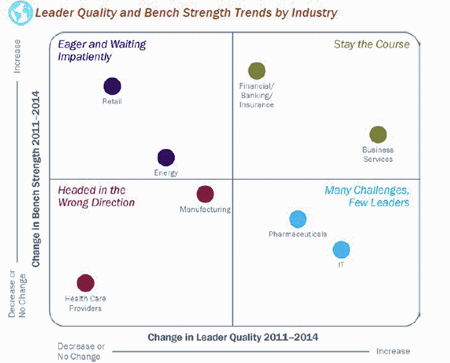
In 2014-15, we released our Global Leadership Forecast (GLF) study, a survey that looks at several talent management practices and trends in leadership succession/ bench strength globally. We found that globally, industries like pharma and IT are going to face many challenges but have fewer leaders to deal with this change. Hence, organisations might want to start developing leaders now or look at hiring talent from outside.
DDI analysed assessment data of 200+ senior/ mid-level executive across various pharma companies over the last few years. In context of the phenomenal growth that the pharma sector would experience in the next 10 years and the findings of GLF research, we wanted to review if leaders are equipped to manage this change and deal with the pace of growth.
The driving force
Leaders in the pharma sector are generally good task masters. They are very result focused, quick at decision making and excellent at marshalling large teams. Action orientation is what one might say. It’s normal to find strengths in such tactical and operational competencies. In most cases, this is a game of numbers and leaders have grown from within the organisations. churning them day in and day out. This makes them very good at managing and maneuvering their networks internally as well and managing large size teams. They are habitual to stay close to grow realities which allow them to gather necessary information quickly for taking operational decisions as and when necessary. This behaviour might come naturally to our leaders of the current world as they very ambitious and go-getters. Their burning desire to succeed allows them to drive numbers very aggressively.
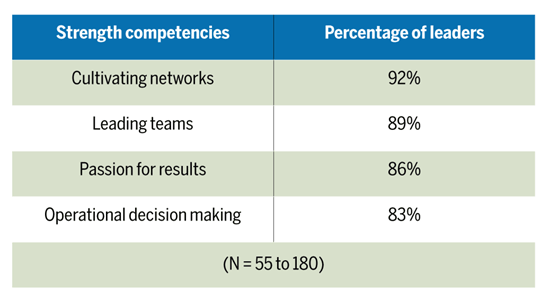
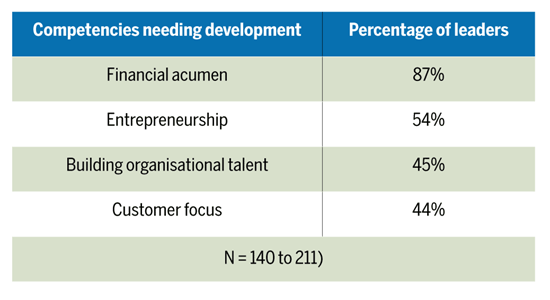
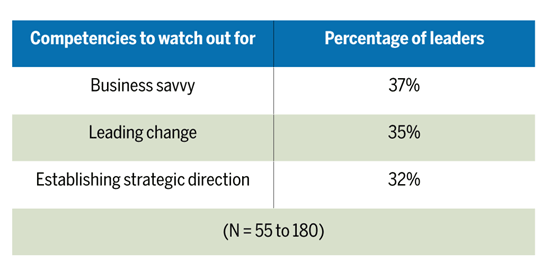
The sad news is that many of these leaders turned out to be very inward-looking and very task-focused. To an extent you might label them as tactical leaders. They lacked the ability to take organisation from strength to strength when the organisation might demand 2X or 3X growth. This builds pressure on the top management as we find this layer of leaders lacking strategic depth and inadequate to execute strategy well. Enterprise level competencies like financial acumen (87 per cent), entrepreneurship (54 per cent) and building organisational talent (45 per cent) were found weak in a large number of these leaders. When we club the above with some of the competencies needed for the future such as driving change (35 per cent), business savvy (37 per cent) and establishing strategic direction (32 per cent), it suggests that if organisations want to grow at a rapid pace then this level of leadership needs immediate exposure in these areas to develop them. Mind you, these are slightly hard competencies to develop. There is no pill or a patch that can give a quick fix. Such competencies need to be developed through experiential learning and personal mentoring by top management of the organisations. We have been hearing of mergers and acquisitions (M&A) in this space over the last few years. We hear of patents expiration in the generic drug market and many of these drugs capture market share worth millions and billions of dollars. In the next few years, imagine if these leaders have to be in the forefront in driving change. You might find them struggling to provide direction, or stretching the boundaries for their teams.
For many leaders this might come as a shock as many interpret meeting numbers as good sense of business or financial acumen. However, their past successes can be a limitation for their future growth. As Marshall Goldsmith, a renowned American leadership coach said, “What got you here won’t get you there.” Leaders might become victims of their own success. DDI’s research suggest that leaders need to have few strong qualities within themselves such as being a good listener and being receptive to feedback.
Another important area of concern we saw as with respect to understanding their customer. We found a slight confusion among the leaders with reference to the interpretation of ‘who is my customer.’ Few leaders view it from the lens of doctors as customers, a few leaders view it through the eyes of the pharmacists’ and stockists’ perspective as customers but very few see it from the patients’ lens. With improvements in technology and rapid growth of mobile apps which provide information on medicines at finger tips, end users are aware of the different types of drugs available in the market and their alternatives. Whether it is in generics, branded drugs, preferred or non-preferred drugs, unless leaders start putting the patient at the centre of their plan they might miss the point. The whole education process might see a ‘C’ change; communication might not be just to doctors but also to the patients. Leaders will have to deal with change in a lot of ways.
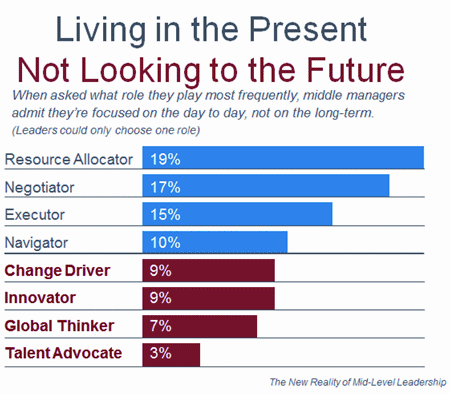
I was trying to see how we can tap these leaders’ strengths and development areas and I found this research from DDI very relevant. DDI’s research, ‘The New Reality of Mid-Level Leadership’ brings out the same challenge in a slightly different manner. When we surveyed middle level leaders, they told us that they place primary emphasis on the ‘here and now’. As you can see from the adjacent chart they are spending the majority of their energy on resources, execution, and tactics needed to get things done today, and very little time and focus on future-oriented things like the need to make change, to innovate, to think more broadly and consider talent requirements in the future to drive growth. I will not blame them. DDI’s GLF 2014-15 suggests that organisations have built their systems in such a way that leaders are forced to manage people and tasks; not to really interact with people. Thus, the ‘here and now’ focus.
The war for talent is only going to get steeper. We might have good doers and action-oriented leaders for today. They might be very tactical and operation-focused. Their approach is like being problem solvers and they might be able to optimise the resources available with them to achieve the same. But certain futuristic competencies which can make them enterprise level leaders are weaker areas at this point. They might want to balance their approach between the immediate or short-term and long-term focus. While the leaders are task-focused they might want to think of how to put long-term processes in place or introduce best practices and focus on adhering to them. Leaders will have to broaden their mindset to think beyond the functional/ operational. They might want to look at some larger levers like market drivers, customer trends, etc to make informed decisions. Leaders might be good at leading large teams, but they also need to look at development of team members by building their skills over a
period of time.
The wakeup call
All external indicators suggest that pharma industry will continue to grow. But, are we over-emphasising on capital investment and topline growth?
We believe that ‘the organisation is as strong as its weakest link’. With no development or poor development focus we will not have an adequate number of leaders to deal with this growth. As I said earlier, there is no pill or a patch that can fix this issue. Organisations need to develop able leaders over a period of time.