



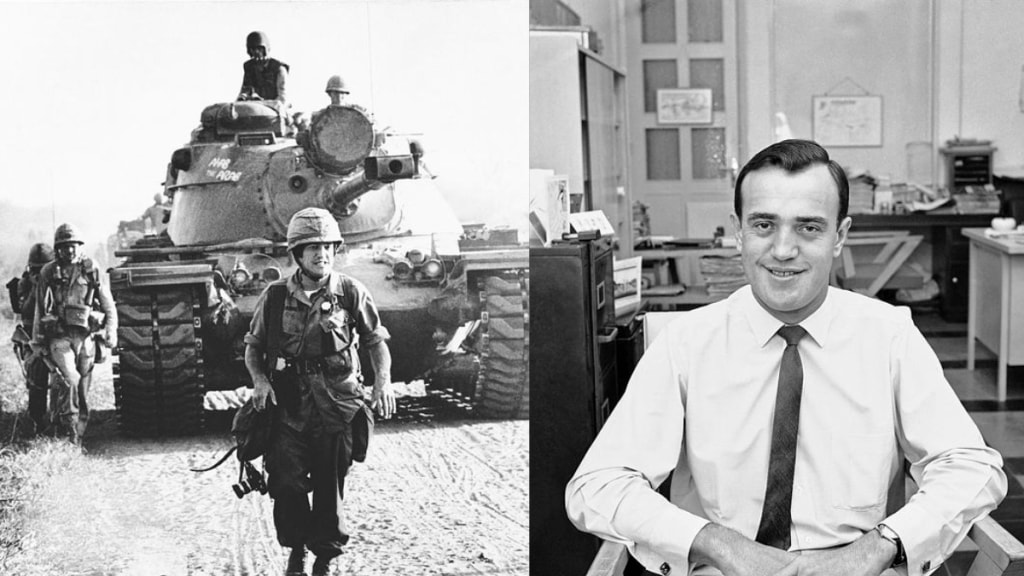
Peter Arnett, the Pulitzer Prize-winning journalist known for his frontline reporting from the Vietnam War to the Iraq War, has died at 91, the Associated Press reported. He passed away surrounded by friends and family after entering hospice care on Saturday. Arnett had been battling prostate cancer.
He is survived by his wife, Nina Nguyen, and their children, Elsa and Andrew.
Who was Peter Arnett?
As a correspondent for a wire service, Arnett was popular among journalists for his reports from the war zone during the Vietnam War from 1962 to 1975. Soon after, he started live reporting for CNN during the first Gulf War and became a household name. While most Western journalists had left Baghdad, he delivered real-time updates through a mobile phone from his hotel room, AP reported.
“There was an explosion right near me, you may have heard,” he said, per a report by AP, in one of his updates as sirens went off in the city.
Joined battalion of US soldiers, expelled from Indonesia
In January 1966, Arnett went to Vietnam a year after joining The Associated Press as its Indonesia correspondent, and joined US soldiers who were on a mission to flush out North Vietnamese snipers. He was standing close to the unit’s commander when he stopped to examine a map. As the commander leaned over the map, bullets tore through the paper straight into the officer’s chest. The colonel collapsed at Arnett’s feet.
Arnett was expelled from Indonesia after his reporting on its struggling economy didn’t sit well with the country’s government.
In 1962 joined AP’s Saigon bureau and worked with bureau chief Malcolm Browne and photo editor Horst Faas, who together would go on to earn three Pulitzer Prizes.
Browne, he said, taught him critical survival lessons for war zones, such as avoiding medics and radio operators, who are often targeted first, and never turning to look after hearing a gunshot, since the next bullet may be intended for you.
Arnett remained in Vietnam until the fall of Saigon in 1975. As the war drew to a close, AP headquarters in New York instructed him to destroy bureau documents. He, very cleverly, shipped them to his New York apartment. Those documents, AP said, are now preserved by them.
Switched companies
Arnett stayed with the AP until 1981, only to join the newly launched CNN. He was once again reporting from Baghdad and secured interviews with Iraqi President Saddam Hussein and Osama bin Laden, the mastermind behind the 9/11 attacks.
He resigned from CNN in 1999 following the network’s retraction of an investigative report alleging the use of Sarin nerve gas against US soldiers in Laos in 1970.
While covering the second Gulf War in 2003 for NBC and National Geographic, Arnett was fired for giving an interview to Iraqi state television in which he criticised the US military’s war strategy. This did not mark the end of his TV career as he went on to work with companies in Taiwan, the UAE and Belgium.
In 2007, he began teaching journalism at a University in China.
(With inputs from AP)