



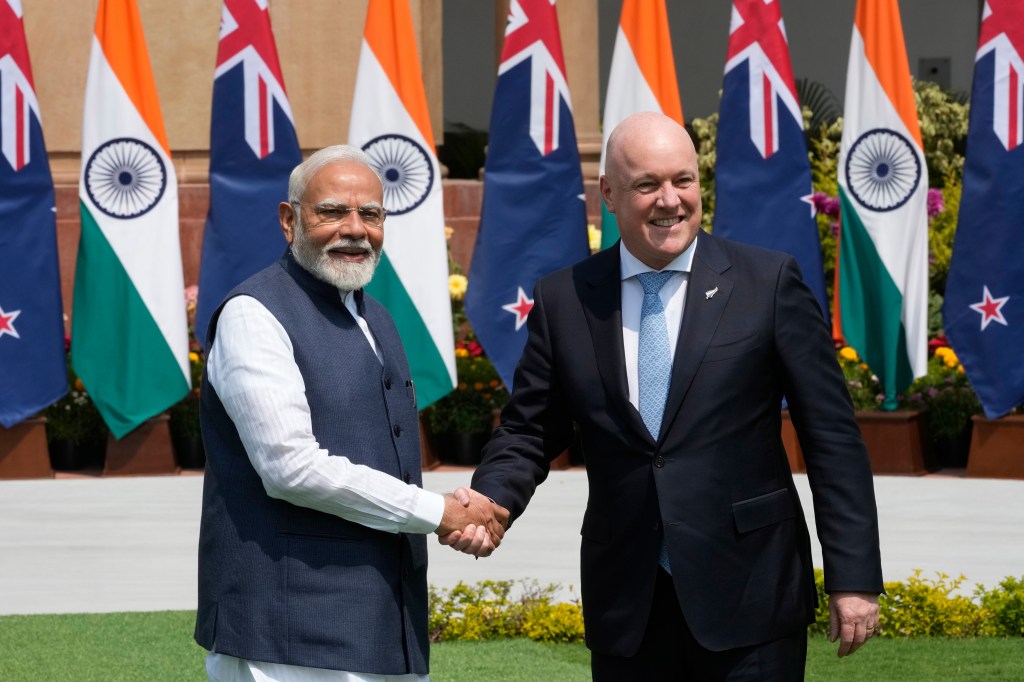
As India and New Zealand finalised a historic Free Trade Agreement (FTA), not everyone in New Zealand supported the move. Winston Peters, New Zealand’s Foreign Affairs Minister, openly opposed the deal, calling it “neither free nor fair.”
“New Zealand First is regrettably opposed to the India Free Trade Agreement announced today. We consider it to be neither free nor fair,” Peters said in a press release on Monday. “This is a bad deal for New Zealand. It gives too much away, especially on immigration, and doesn’t get enough in return for New Zealanders, including on dairy.”
New Zealand First opposes India free trade deal
In the press release, Peters explained that New Zealand First had urged its coalition partner not to rush into the agreement. He said the party wanted the full three years of the Parliamentary cycle to negotiate a better deal that would benefit both New Zealand and India. “Unfortunately, our warnings were ignored. National preferred a quick, low-quality deal rather than doing the hard work necessary for a fair agreement,” Peters said.
One of the major concerns is that New Zealand is opening its markets completely to Indian products, while India is not reducing tariffs on New Zealand’s major dairy exports, such as milk, cheese, and butter. Peters said this makes the deal hard to defend to New Zealand farmers and rural communities. “This is not a good deal for New Zealand farmers and is impossible to defend to our rural communities,” Peters said.
The India FTA would be New Zealand’s first trade deal to exclude its major dairy products. Till November 2025, dairy exports were worth about $24 billion, making up nearly 30% of New Zealand’s total goods exports.
Immigration Concessions
Peters also criticised concessions made to India that were unrelated to trade. These include encouraging more Indian workers to come to New Zealand and increasing New Zealand investment in India. “On a per capita basis, New Zealand has offered far greater access to our labor market for India than Australia or the UK did in their FTAs,” Peters said. “This is unwise, given our current unemployment and economic struggles.”
He added that the new employment visa for Indian citizens could increase migration at a time when New Zealand’s labor market is tight. Another big concern is that the rules for Indian students, both while studying and after graduation, could limit the ability of future governments to respond to changing labor market conditions.
Despite opposing the deal, Peters added that New Zealand First is committed to strengthening ties with India. “Our first overseas visit as Foreign Minister this term was to India, and we returned again this year. We have directed more resources to improving India-New Zealand relations,” he said.
Peters spoke about his long-standing respect for India’s External Affairs Minister, S. Jaishankar, and clarified that their opposition to the deal is not a critique of India, but a difference of opinion within New Zealand’s coalition government. “We have known S Jaishankar, India’s External Affairs Minister, for a long time, and have the utmost respect for him as an international statesman and champion of New Zealand-India relations. We have communicated to Minister Jaishankar New Zealand First’s position on this matter. We have made clear to him that our opposition to the deal is not a critique of the Government of India or its negotiators – but rather the reflection of a difference of opinion between the parties that comprise New Zealand’s Coalition Government.”
India and New Zealand sign free trade agreement
India and New Zealand recently finalised a landmark Free Trade Agreement (FTA) to strengthen economic ties, trade, investment, and mobility between the two countries. Negotiations for the deal began during New Zealand Prime Minister Christopher Luxon’s visit to India in March 2025.
A major highlight of the agreement is zero-duty access for Indian exports to New Zealand. The services sector will also see more opportunities. IT, finance, education, tourism, and construction businesses can now access New Zealand markets more easily. New Zealand has opened 118 services sectors and offered broad Most-Favoured-Nation (MFN) treatment.
Indian students can now work 20 hours a week while studying and may stay in New Zealand for up to four years on post-study visas. Skilled professionals have new opportunities as well, including quotas for temporary employment and working holiday visas for young Indians. As part of the deal, New Zealand has pledged to invest $20 billion in India over the next 15 years.
Agriculture cooperation is another key part of the FTA. Indian products such as fruits, vegetables, coffee, spices, and processed foods will gain improved access to New Zealand markets. At the same time, India has protected its sensitive sectors, including dairy, sugar, edible oils, precious metals, and certain industrial products, to safeguard domestic interests.