



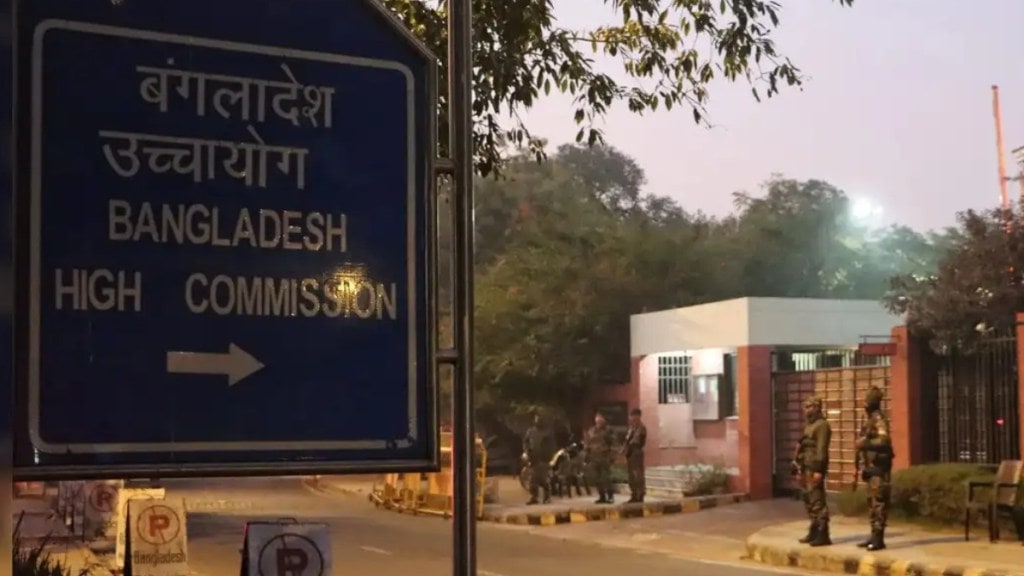
Bangladesh has raised strong objections to a protest held outside its High Commission residence in New Delhi, calling it “unacceptable” and “highly regrettable.” It said the demonstration by what it described as “miscreants” could not be accepted as “misleading propaganda.” Bangladesh’s reaction came after India issued its response earlier in the day.
In a statement, Bangladesh’s foreign ministry said, “The unjustifiable incident at the Bangladesh High Commission residence in New Delhi on 20th December 2025 is highly regrettable and cannot be accepted as ‘misleading propaganda’.”
The unjustifiable incident at the Bangladesh High Commission residence in New Delhi on 20 Dec 2025 is highly regrettable.@bdhc_delhi pic.twitter.com/XopXufH3dw
— Ministry of Foreign Affairs (@BDMOFA) December 21, 2025
The ministry said the “miscreants” were allowed to protest right outside the High Commission premises, which “created panic among the personnel inside the complex.” It also said the High Commission was not informed in advance about the organised protest. However, Bangladesh noted India’s assurance that it would ensure the safety and security of all Bangladeshi diplomatic missions in the country.
Bangladesh also rejected India’s concerns about attacks on minorities and the recent killing of Dipu Chandra Das in Mymensingh, calling it an “isolated attack.” It said, “The Government of Bangladesh has promptly apprehended the suspects in this incident. The intercommunal situation in Bangladesh is better than in many other parts in South Asia.”
In a pointed remark, Bangladesh added that it “believes that it is the duty of all governments in the region to ensure protection of minorities in their respective countries.”
India dismisses ‘misleading propaganda’
Earlier, India rejected what it described as “misleading propaganda” in sections of the Bangladeshi media over the protest outside the Bangladesh High Commission in New Delhi. It said there was no breach of security or threat to the mission.
The Ministry of External Affairs said a small group of protesters had briefly gathered outside the High Commission to express anger over the killing of Dipu Chandra Das in Bangladesh’s Mymensingh district and to demand protection for minorities there.
Responding to media queries, MEA spokesperson Randhir Jaiswal said, “We have noted misleading propaganda in sections of the Bangladesh media on the incident. The fact is that about 20–25 youth gathered in front of the Bangladesh High Commission in New Delhi on 20 December and raised slogans in protest against the horrendous killing of Dipu Chandra Das in Mymensingh, while also calling for the protection of all minorities in Bangladesh.”
He firmly denied claims that there was any attempt to storm the High Commission. “There was no attempt to breach the fence or create a security situation at any time. The police stationed at the spot dispersed the group after a few minutes. Visual evidence of these events is available publicly for all to see,” Jaiswal said, adding that India remains committed to protecting foreign missions in line with the Vienna Convention.
Bangladesh questions access to high-security zone
Bangladesh later rejected India’s explanation and questioned how protesters were able to get so close to the High Commission, which is located in a high-security diplomatic area.
“Regarding the Indian press note, we completely reject it, entirely reject it. The issue has been presented as if it were very simple, whereas in reality it is not,” Bangladesh interim government’s foreign affairs adviser M Touhid Hossain said.
According to state-run news agency Bangladesh Sangbad Sangstha (BSS), Hossain questioned how a group of 25 to 30 people, “described as belonging to a Hindu extremist organisation, could reach such a sensitive zone,” and said this should not have been possible under normal circumstances “unless they were allowed the access.”
This exchange has taken place amid rising tensions after the death of Sharif Osman Hadi, a well-known student leader and spokesperson of Inqilab Mancha. Hadi was seriously injured in an assassination attempt in Dhaka on December 12 and was later flown to Singapore for treatment, where he died.
His death led to widespread protests, violence and arson across Dhaka and nearby areas. Several targets were attacked during the unrest, including media offices and the premises of leading Bangladeshi newspapers.