



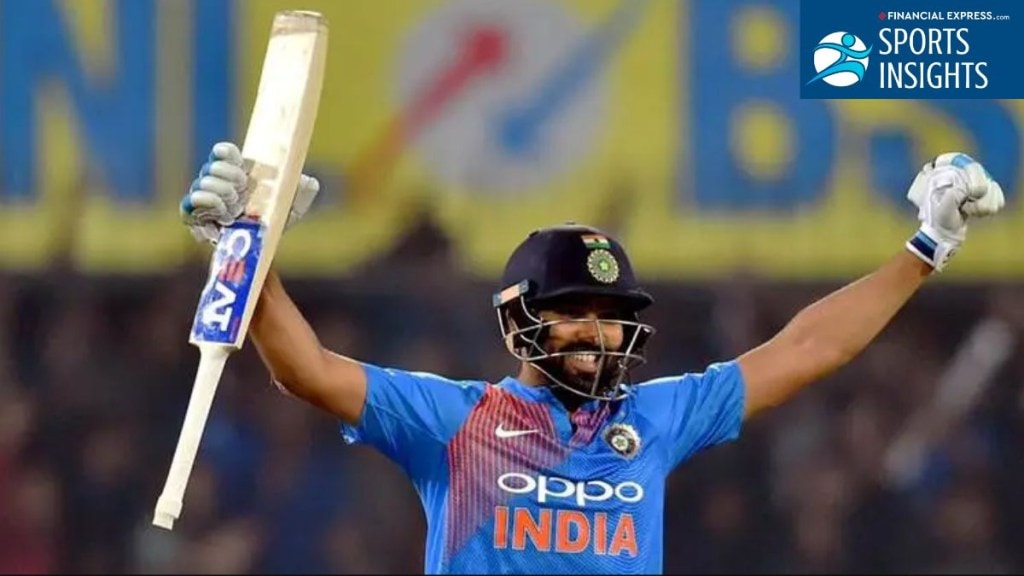
You were probably finishing dinner on December 22, 2017. Maybe switching on the TV for what you thought would be a normal Friday night T20. By the time you washed your plate, Rohit Sharma had already hit a century, and Sri Lanka’s bowlers were questioning their career choices.
Toss decision that didn’t age well
Thisara Perera had won the toss and chosen to bowl. Again. He looked at the small boundaries at Indore and saw advantage. Rohit Sharma looked at those same boundaries and saw targets. The Sri Lankan captain probably thought he was being clever. The Indian captain just smiled that sheepish smile you know so well. Two hours later, that smile made complete sense.
Angelo Mathews welcomed Rohit with short balls. Gentle ones, mind you. Sub-115 kph, the kind that shouldn’t trouble an international batsman. Rohit scored 10 runs in his first 8 balls. Your WhatsApp groups must have lit up. “Same old Rohit, slow starter,” someone typed. Little did we know he was just measuring the distance to the fence with his eyes. The next 27 balls were going to be different.
Slow start that wasn’t slow at all
Fifty runs in 23 balls. That was the warm-up. The next fifty came in 12 deliveries. Twelve. That’s fewer balls than some batsmen take to get off the mark. While you were still processing the fifty, he was already thinking about double hundred. That’s how his mind works, you see. Always ahead.
KL Rahul was playing his shots at the other end, making it look like a proper cricket match. Rohit was making it look like a video game. Short balls went over midwicket. Length balls were caressed, not smashed, over the same region. The ball wasn’t being hit. It was being placed. Into gaps. Over ropes. Into the cheap seats.
Seven bowlers, one massive problem
By the ninth over, Sri Lanka had used seven bowlers. Seven. That’s not strategy, that’s SOS signals in cricketing form. Asela Gunaratne came on. Rohit reached fifty by slapping a loopy one over midwicket. Next ball, six. Twenty-one runs in that over. Four different bowlers went for 16 or more in their first over. Akila Dananjaya, the leggie who had troubled Rohit in the IPL that year, went for 15 in five balls.
Each new bowler meant a new plan. Each new plan failed before the over ended. You could see it on Thisara’s face. He had enough bowling options to play an extra batter. The problem was he had dropped a specialist bowler, Vishwa Fernando, for that extra bat. Now he had batting depth and no one to stop the bleeding.
Ninety-one per cent innings
Let me give you a number. 91.52. That’s the percentage of runs Rohit scored in boundaries. 108 out of 118 runs. The highest ever for any T20I innings of 30 balls or more at that time. But here’s what the number doesn’t tell you – he didn’t play a single fancy shot. No reverse sweeps. No switch hits. Just midwicket clips and cover drives and the occasional slap over cover.
The six that brought up his hundred? A slap on the up over cover. The two sixes before that? Carved on either side of sweeper cover. These weren’t muscle shots. They were geometry lessons. He was solving the field, not destroying it. The ball just kept travelling because the timing was that pure.
‘I Don’t Have Power. I Have Timing‘
After the match, Rohit said something that every kid playing in narrow Mumbai lanes should write down. “I definitely don’t have so much power. I rely a lot on timing.” This from a man who hit 10 sixes that night, the most by any Indian in a T20I game. His 65 sixes across all formats in 2017 were the most by any batter in any calendar year ever at that time.
But he wasn’t swinging from his heels. He was just placing the ball where fielders weren’t. “I know my strengths and weaknesses. I try and play with the field,” he explained. “When the field is spread after six overs, I try and see where I can find my boundary options. I want to score all around the park. You become predictable if you hit in one area.”
The six off Dushmantha Chameera in the 13th over? Clipped over midwicket. Looked effortless. That’s because it was. Dushmantha finally got him later with a slower short ball. Rohit couldn’t ramp it over third man. One ball worked. One. After 35 balls of mayhem.
From 26 to 108: The Blur
India was 26 runs in 4 overs. Then this happened: 17, 16, 12, 16, 21. The 10th over gave Sri Lanka 9 runs – a moral victory. Then the 11th over happened. Twenty-six runs again. In the time it took you to argue with your friend about who should bat next, India’s score went from 26 to 108 in just 5 overs.
Sri Lanka scored at nearly 10 an over in their chase. That’s championship-level batting. They just didn’t last 20 overs. Again. Chasing 260 will do that to you. Especially when you’re playing against a number that feels more like a typo than a target.
The man behind the mayhem
Rohit Sharma will tell you he never thinks about milestones. “My job is to go out there and score as many as possible. Not just 100s or 200s. I just want to give my best and get the team a victory.” He started that innings wanting to get his team into a good position. He ended it, having done that before the innings was halfway through.
The thing about that night in Indore is that it wasn’t about power. It wasn’t about small boundaries. It was about a man who understands that cricket is still a game of gaps, not just glory. A man who hit the joint-fastest T20I century and made it look like he was having a net session.
Thirty-one sixes flew that night at Indore. Ten belonged to Rohit. The joint fastest century in T20I history came in the 12th over. Sri Lanka’s bowlers tried seven different options. None worked.
Do you remember where you were on December 22, 2017? Rohit Sharma was in the middle of a cricket ground in Indore. Smiling. Hitting boundaries. Making a mockery of small boundaries and big reputations. Timing his way into record books while admitting he doesn’t have power.
That’s the joke of it all. The most powerful innings of 2017 came from a man who says he has no power. Just timing. Just intelligence. Just that smile at the toss should have warned Sri Lanka they were in for a very long night.