



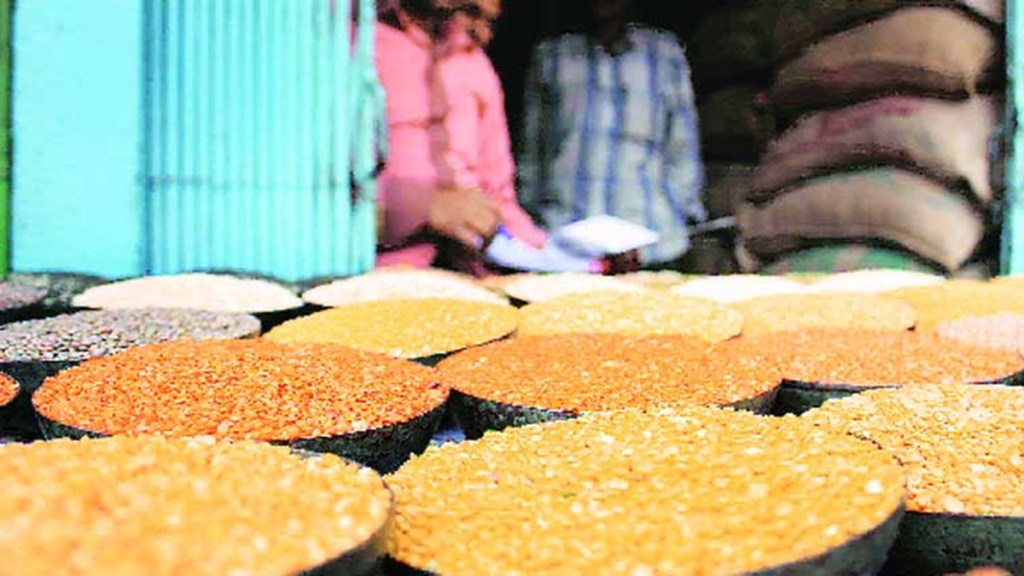
While high cereal and milk prices remain a major driver of retail inflation, rising tur and chana prices may put upward pressure on the consumer price index (CPI) in the coming months. This pair accounts for 62% of domestic pulse output and has a CPI weight of 2.38%.
Tur dal production is expected to be lower in the current crop year (July-June) due to unseasonal rains in Maharashtra and Karnataka in October. This has pushed pulse mandi prices up to ‘8400/quintal, 27% above the current season’s minimum support price (MSP) of ‘6600/quintal.
Also read: Unseasonal rains hit MSP wheat procurement
The retail inflation in tur rose from 5.57% in September, 2022 to 10.76% in February, 2023. Traders said that in anticipation of a spike in prices, stockists and farmers are holding on to stocks, largely imported from Mozambique, Malwi and Myamar.
As per the second advance estimate for food grain production for the 2022-23 crop year, tur production was estimated at 3.66 million tonne (MT), a decline of 13% from 4.22 MT estimated in 2021-22 crop year. Trade sources, however, estimate the yield of the pulse type to be just 3 MT.
Meanwhile, chana prices after ruling below the MSP for the last one year are moving towards the benchmark prices for the season Rs 5335/quintal owing to the prospects of crop losses caused by recent rains in Rajasthan and Madhya Pradesh.
Speaking to FE, Harsha Rai, head, Mayur Global Corporation, a leading pulses trading firm, said: “With Nafed stopped selling chana in the open market since the commencement of procurement at MSP and market participants anticipating lower production, prices are moving upward towards MSP.”
Currently, mandi prices for chana in major cities range from ‘4800/quintal to ‘5100/quintal. According to traders, recent unseasonal rains and hailstorms have damaged the chana crop in some parts of Madhya Pradesh and Rajasthan.
At present, against the government’s buffer of 2.3 MT, Nafed had 2.2 MT of pulses. Of this, the chana stock is 1.6 MT which was procured in the previous years.
Due to harvest delays and crop losses caused by rains, the farmer cooperative Nafed has procured only 0.4 MT of chana in the current rabi procurement season in Gujarat, Maharashtra, Karnataka, and Andhra Pradesh under the agriculture ministry’s Price Support Scheme.
The procurement began last Friday in Rajasthan, the largest producer of the pulse variety, with the goal of purchasing 0.55 MT of chana in the state under MSP operations. The pulses variety accounts for 49% of the country’s total output of 27.8 MT in the 2022-23 crop year (July-June). Gram inflation in February, 2022 declined by 1.88% on year.
Also read: Govt procurement via GeM crosses Rs 2 trillion in FY23: Piyush Goyal
Last week in a meeting with retailers, Rohit Kumar Singh, secretary, department of consumer affairs, advised them to calibrate the retail margins in such a way that the composition of the pulses consumption basket of households is not disturbed by the price rise. He directed the retailers to ensure that margins for pulses especially tur dal are not kept at a reasonable level.
To monitor the stock position of tur dal held with stockists, traders, importers and millers, the consumer affairs ministry recently constituted a committee chaired by Nidhi Khare, additional secretary with the department.