



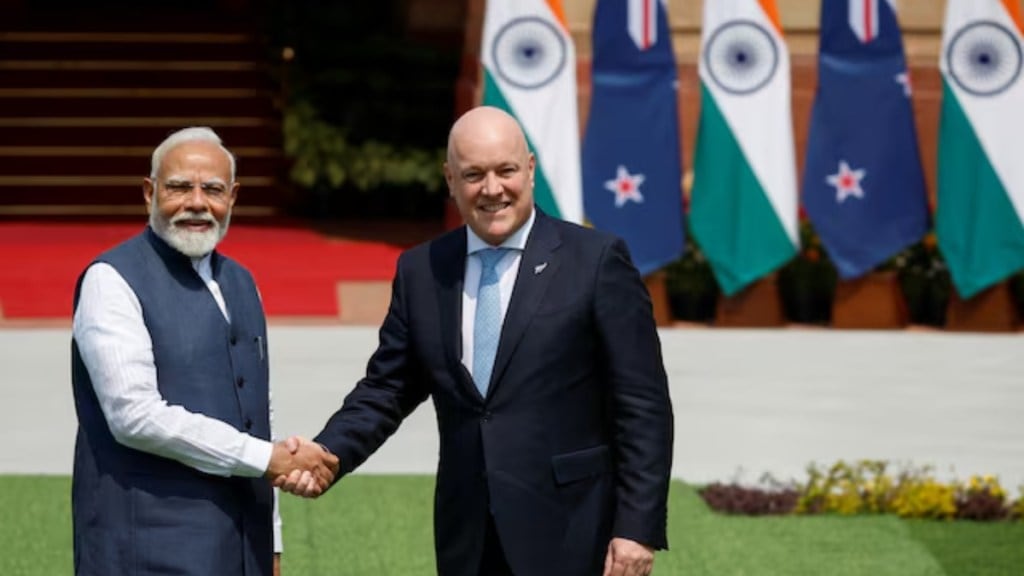
India and New Zealand on Monday announced the conclusion of negotiations on their Free Trade Agreement (FTA) that will liberalise trade and will bring in investment of $ 20 billion in the Indian economy.
The announcement was made after a call between Prime Minister Narendra Modi and New Zealand Prime Minister Christopher Luxon. The announcement came through a post on ‘X’.
The deal will come into force in the next 7-8 months. Through the agreement India will get zero duty access to 100% tariff lines of New Zealand. New Zealand currently maintains 10% tariffs on 450 tariff lines of interest to India. Gains are expected in labour intensive sectors, agriculture, engineering and automobiles. Average MFN tariff for India now stands at 16.2 %.
PM Modi announces ‘numerous opportunities for innovators, farmers, MSMEs, students and youth’
Announcing the conclusion, PM Modi wrote, “My friend PM Christopher Luxon and I had a very good conversation a short while ago following the conclusion of the landmark India-New Zealand Free Trade Agreement. Concluded in just nine months, this historic milestone reflects a strong political will and shared ambition to deepen economic ties between our two countries. This FTA ensures: Enhanced market access, Deeper investment flows. Numerous opportunities for innovators, entrepreneurs, farmers, MSMEs, students and youth.”
New Zealand’s Prime Minister Christopher Lexon also took to X and announced that the deal will cut or remove tariffs on 95% of the country’s exports to India. He said the agreement is expected to increase New Zealand’s exports to India by between $1.1 billion and $1.3 billion each year over the next 20 years.
He added that stronger trade ties will lead to more jobs, better pay and greater opportunities for working New Zealanders. The Prime Minister said the deal strengthens the close relationship between the two countries and gives New Zealand businesses access to India’s fast-growing market of 1.4 billion people. He also said the government is focused on strengthening the economy and planning for the future, and that trade agreements like this will help drive growth so that people across New Zealand can benefit.
Sectoral gains and import advantages
Import benefits to domestic industry include cheaper imports of wooden logs, coking coal, waste and scrap of ferrous and non-ferrous metals.
As per the deal New Zealand will also help India improve productivity in apples, kiwi and honey by establishing centres of excellence. In return India has allowed lower duty imports of these products but has imposed quotas. For apples, duty has been reduced to 25% from 50% for 32,500 metric tonnes in the first year. Rising to 45,000 metric tonnes in year six. There are quotas for kiwis and honey too. Kiwi currently has duties of 33%, honey 66% and milk albumin has an import duty of 22%.
Dairy, animal products, sugar, artificial honey, vegetable fat and oils, gems and jewellery, and aluminium are excluded
New Zealand will also open up 118 services to India. Special access to students and mobility have also been offered by New Zealand.
$20 billion New Zealand investment in India
New Zealand will be investing $ 20 billion in India in 15 years. It has also agreed for faster clearance for Indian pharma products and acceptance of inspection from recognised comparable regulators of US, UK, EU and Canada.
Both sides had held the first round of negotiations on the FTA in May and it took five formal rounds and many intersessional meetings to seal the deal. India and New Zealand had decided in March to re-launch negotiations on FTA during the New Zealand Prime Minister’s visit to New Delhi. The first round of negotiations were launched in May.
It is the second attempt by both countries to strike a trade deal.
The first attempt for FTA lasted from 2010 to 2015. During that period 10 rounds of negotiations were held before the pause.
Through the deal they are aiming to double their trade in the next five years. In 2024-25 the bilateral trade stood at $ 1.29 billion with India’s exports at $ 711.08 million and imports at $ 587.15 million.
‘An FTA led entirely by women,’ says Piyush Goyal
Commenting on the deal conlusion, Union Minister for Trade and Investment Piyush Goyal said that the agreement is historic and marks a major milestone. He said it was completed in a record nine months and stands out for several reasons. Goyal pointed out that the negotiations were led entirely by a women-led FTA team. He also said this is India’s third free trade agreement with a Five Eyes country, following similar deals with Australia and the UK, and now New Zealand.
Goyal added that India will soon begin trade talks with Canada by setting the terms of reference, and discussions with the United States have already reached an advanced stage.