



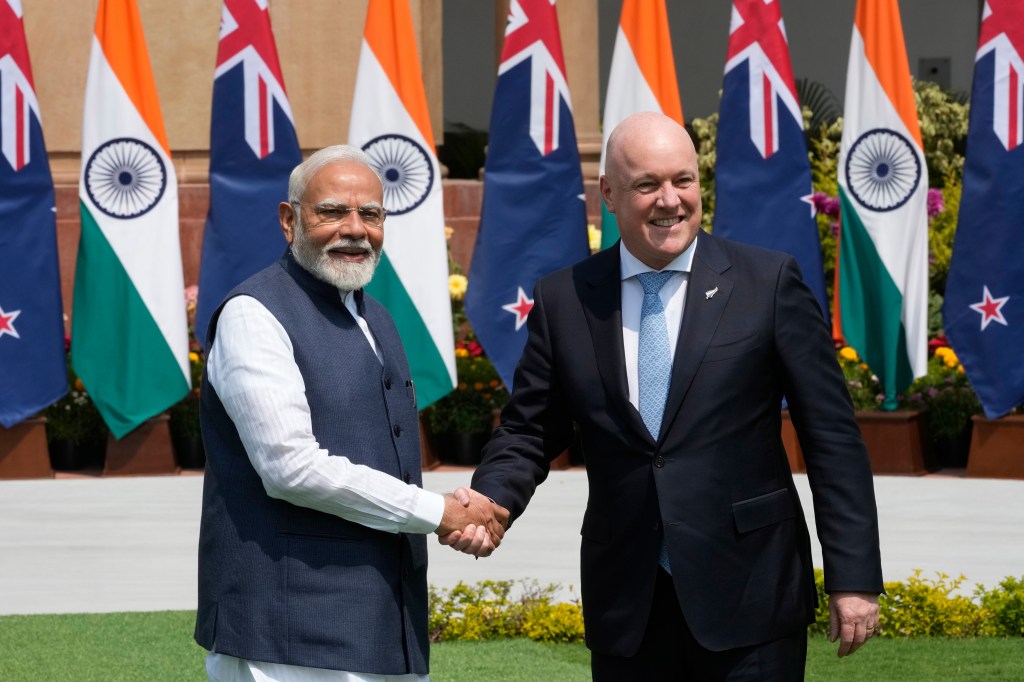
India and New Zealand on Monday concluded a free-trade agreement, the third such pact New Delhi has reached this year, even as talks with the US and European Union drag on. The landmark agreement – reached in “record nine months – ensures deeper investment flows, numerous opportunities for innovators, entrepreneurs, farmers, MSMEs, students and youth, Prime Minister Narendra Modi said on X.
The move comes as New Delhi accelerates efforts to diversify export destinations as part of a broader strategy to offset the impact of steep US import tariffs, which is India’s largest export market. A formal signing of the agreement is expected in the first quarter of next year after legal scrubbing of the negotiated text, India’s chief negotiator Petal Dhillon told reporters.
The “historic deal” ensures New Delhi zero-duty-export access for all its goods to New Zealand while Wellington would get duty concessions and market access for about 70% of New Delhi’s tariff lines, covering 95% of its exports in a phased manner, Indian officials said. While the Oceanic country will have tariff-free or subject to sharply reduced duties on products ranging from forestry and timber to sheep meat and infant formula, India has stopped short of opening its sensitive dairy sector to New Zealand, which is the world’s largest dairy exporter. Instead, New Delhi has offered to consult on extending similar treatment if it grants dairy access to comparable countries in the future, the statement said. India’s trade talks with Washington have been held up over access to dairy and other farm goods, as per Bloomberg News.
Top sectors to benefit in India
Major sectors that will gain from tax free exports include textiles, apparel, engineering goods, leather and footwear, and marine products. For New Zealand, major gains will be in horticulture, wood exports, coal, and sheep wool and meat, among others.
New Zealand has committed investments worth $20 billion in India over a period of 15 years as part of the agreement, India’s Trade Ministry said. Dairy imports such as milk, cream, whey, yoghurt, and cheese, along with animal and vegetable products, including goat meat, onions and almonds, have been excluded from the deal by India due to “domestic sensitivities.”
India-New Zealand trade deal stood at $2.4 billion in 2024
The FTA, officials said, has strong potential to double the bilateral trade between India and New Zealand, which currently remains modest compared with New Delhi’s bigger partners. At present, the two-way trade stands at $2.4 billion in 2024.
“Given the limited scale of bilateral trade, the agreement is less a trade breakthrough than a framework for deeper cooperation,” trade analyst Ajay Srivastava said, according to the Associated Press.
New Zealand Trade Minister Todd McClay said the agreement gives the country access to markets that India has not provided to any other country. “New Zealand is the first country to secure any access for apples and honey into India in an FTA. We have secured the best access for kiwi fruit into India of any country in the world,” he said.
In a post on X, Commerce Minister Piyush Goyal said the agreement creates new opportunities for India’s services sector, spanning IT & ITeS, finance, education, tourism, construction, and other areas. “New Zealand’s first-ever annexes on health, traditional medicine, student mobility, and post-study work open up unprecedented avenues for Indian professionals and students. In addition, enhanced mobility provisions, including working holiday visas, post-study work pathways, and a dedicated quota of 5,000 temporary employment visas for skilled Indian professionals, will enable Indian talent to access better global opportunities,” he wrote.
In recent months, New Delhi has accelerated a push to finalise several free trade agreements as global commerce faces strains from unpredictable tariffs and geopolitical tensions, slowing growth and raising protectionism. The urgency is also part of push by New Delhi to diversify reliance on its traditional markets like the US which imposed 50% tariffs on Indian goods — the highest in Asia — squeezing exporters in labor-intensive sectors.
The India and New Zealand free-trade agreement comes a week after New Delhi concluded a similar pact with Oman, New Delhi’s second pact after FTA deal with the UK in May.
Piyush Goyal drops big hint on India-US trade pact
Goyal, while briefing the media after the conclusion of the India-New Zealand free trade agreement, said New Delhi is in advanced discussions with Washington on a trade agreement, signalling growing momentum in bilateral economic ties as New Delhi positions itself as a key player in global supply chains.
Earlier this month, Commerce Secretary Rajesh Agrawal had said that India is “very close” to finalising an initial framework deal with the US aimed at lowering reciprocal tariffs. “We are very close to closing the initial framework deal, but I don’t want to put a timeline to it,” Agrawal had said in a December 15 presser.
India and the US have completed six rounds of talks, covering both a Bilateral Trade Agreement (BTA) and an interim arrangement to reduce reciprocal tariffs. There is a reasonable expectation that the two countries will reach an interim agreement to lower steep tariffs on most Indian exports, Agrawal said.