



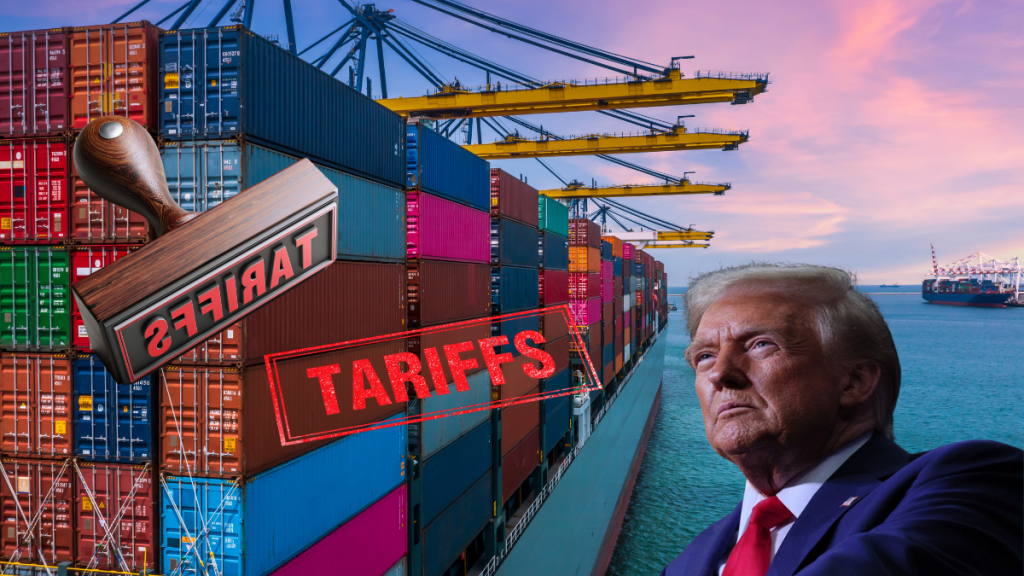
The focus of attention on the latest trade data for November has been unduly on India’s export performance to the US despite the 50% tariff disruption. As these punitive duties remain unchanged, it would be premature to draw strong inferences on the resilience of our exports during that month.
India’s shipments to the US this fiscal to November were up by 11.4% year-on-year (y-o-y) while overall merchandise exports grew by only 2.6%. Overall exports clearly are buffeted by adverse global headwinds. Trade diversification is imperative.
India’s exports to the US this fiscal experienced a two-phase trend with two consecutive months of y-o-y decline of 12.6% in September—the first month when 50% tariffs kicked in—and 8.6% in October followed by a sharp surge to 22.6% in November. Nearly 85% of India’s exports to the US in November came from sectors that first saw a decline and then staged a recovery, according to the Global Trade Research Initiative. Gems and jewellery reflected this pattern dropping to $202.8 million in September before rising to $406.2 million in November.
Exports pick up in November
Plastic exports to the US fell by 33% in October after contracting 23% in September and were up in November.
The uptick in India’s US exports in November reflected a quick clearing of backlog orders and a survival strategy to hang on to long-term customers even while facing squeezed margins and minor losses, according to a two-part series in FE. Duty-exempt shipments of smartphones and petroleum products also helped.
However, these numbers cannot be sustained unless US tariffs are brought down. The plight of textile and apparel exporters in industrial towns like Tiruppur and the seafood sector exemplify these dismal prospects.
Exporters face tariff-led stress
Exporters faced tariff-led stress with the September-October data showing a 20%-plus contraction in knitted apparel and home textiles. They do not find it easy to shift to alternative markets like Europe. “The demand bowl is the same but there are more hands,” they argue, highlighting stiff competition.
As for seafood, earlier orders are still being executed despite losses but the order pipeline post-January 15 has completely dried up. Unlike apparel exporters, however, exporters of shrimp have diversified successfully to non-US markets like China, Vietnam, Belgium, Russia, and the UK.
Looking ahead, India’s exporters must diversify to boost their dismal overall performance. The government, for its part, must implement appropriate export promotion measures like reinstating the interest equalisation scheme on pre- and post-shipment rupee credit that was scrapped last December.
Trade diversification through free trade agreements (FTAs) is certainly efficacious in this regard. Apparel exporters have indicated that without an FTA with the European Union (EU), meaningful market share gains and diversification prospects remain limited. Gems and jewellery exporters, too, have indicated that India’s comprehensive economic partnership agreement (CEPA) with the UAE and economic cooperation and trade agreement with Australia have provided crucial support by providing greater market access.
The CEPA inked with Oman and the conclusion of negotiations with New Zealand will certainly improve pathways for our exports although bilateral trade with these partners is extremely limited. India must prioritise concluding deals with bigger trading partners like the US and EU as early as possible. Although India is in an advanced stage of talks with the US, the time frames are extending for a trade deal. For such reasons, too much need not be read into the November trade numbers.