



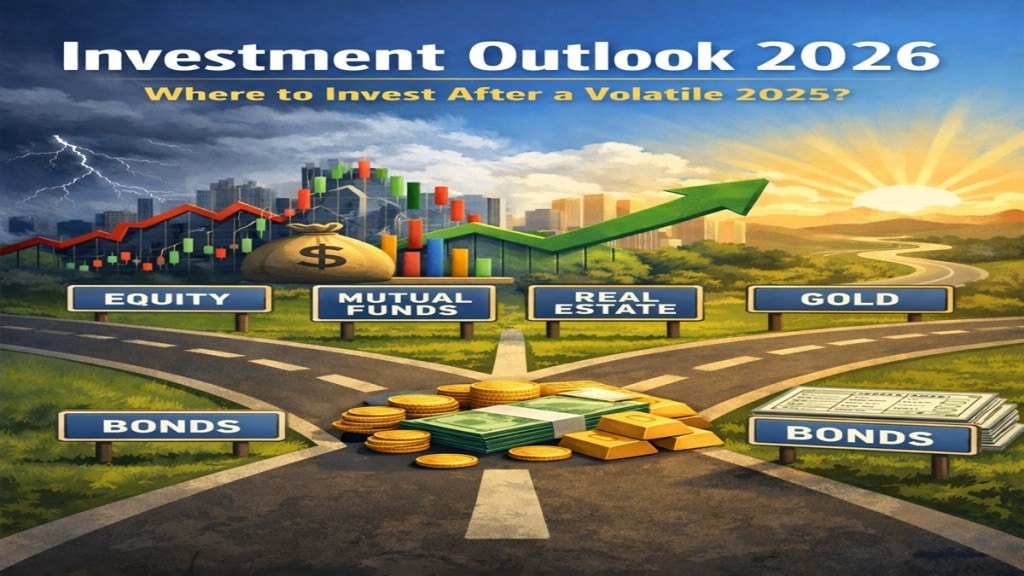
For most investors, 2025 was probably not about making money, but it was about protecting it. 2025 was not an easy year for investors at all. After several years of consistent gains, the stock market experienced intense volatility. Small-cap stocks crashed and midcaps struggled as foreign investors continued selling. Global uncertainties made investors even more cautious.
Now, as 2026 approaches, the investor perspective seems to be shifting. The question is no longer where to find the highest returns, but rather how to balance risk and strengthen portfolios.
What did 2025 teach investors?
The Indian stock market began 2025 cautiously. Continuous foreign institutional investors (FIIs) selling at the end of 2024, high stock valuations, a slowdown in corporate earnings and sluggish government and private investment put pressure on the market.
Despite all these headwinds, the Indian economy showed resilience, helped by easing inflation and central bank rate cuts. Global events, however, continued to disrupt the environment. The US-led tariff war, India’s inclusion in the list of countries with high tariffs, and geopolitical tensions continued to hurt investor sentiments.
Prateek Nigudkar, Senior Fund Manager, Shriram AMC, says, “In the year 2025, Indian equity markets staged a choppy but ultimately resilient run. Early part of the year saw a decent sized correction largely on account of valuation concerns, slowing earnings growth and unexpected tariff related announcements.”
Nevertheless, large-cap stocks held their ground.
In 2025, the Sensex and Nifty delivered returns of up to 8-9% on a year-on-year basis. However, mid and small-cap stocks performed poorly. The BSE Smallcap index fell by approximately 9%, while the Midcap index remained almost flat.
Will 2026 be better than 2025?
Many market experts believe that 2026 could be better and more stable than 2025. This is because the impact of the global risks that shook the market last year has largely played out. A potential trade deal between India and the US could be a key factor in 2026.
Even if the benefits accrue in phases, it could support the rupee and strengthen investor confidence, experts are of the view.
However, risks are not completely away. Uncertainties around interest rates in the US, the Russia-Ukraine war, currency market risks, and high equity valuations are still key concerns. The only thing that is positive now is that the volatility associated with these factors has decreased compared to before.
On 2026 outlook, Nigudkar says, “We enter 2026 on a cautiously constructive global macro backdrop that includes expectations of a gradual Fed easing, benign energy prices, resolution to the Russia – Ukraine war as well end of tariff related uncertainty.”
Mutual Funds: Volatility tests investor discipline
The impact of equity market volatility was clearly visible in equity mutual fund performance in 2025.
Large-cap funds, mirroring benchmark indices, delivered returns of around 7.9% YTD. In contrast, small-cap funds fell 6.4%, while mid-cap funds managed modest gains of about 2.1%.
Flexi-cap funds returned 3.1%, multicap funds 1.4%, and large-and-midcap funds around 1.7% YTD, according to data from AMFI and Value Research.
Despite muted returns in several categories, investor participation remained strong. Net equity mutual fund assets under management rose to Rs 35.65 lakh crore by November 2025, up from Rs 30.35 lakh crore a year earlier—a jump of over 17%. The overall mutual fund industry AUM grew 19% year-on-year to Rs 80.8 lakh crore.
The strongest signal of investor confidence, however, came from SIP inflows. Monthly SIP contributions rose to Rs 29,445 crore in November 2025, up 16.3% from November 2024. SIP AUM crossed Rs 16.5 lakh crore, accounting for more than 20% of the industry’s total assets.
As investors head into 2026, mutual funds are increasingly being viewed not as return-chasing tools, but as vehicles for long-term asset allocation and discipline.
Deepak Jain, President & Head-Sales, Edelweiss MF, says “For retail investors, adopting a multi-asset and multi-strategy approach is the most sensible way forward. It is extremely difficult to time markets, whether in equities or other assets such as gold or silver. A balanced allocation across equity, debt and other asset classes can help investors navigate different market cycles more effectively.”
Gold and silver: Standout performers of 2025
Amid geopolitical uncertainty, policy shifts and global trade tensions, gold and silver emerged as the best-performing asset classes of 2025.
Gold prices surged more than 73% in domestic markets during the year, while silver delivered an extraordinary rally of over 127%. This sharp rise was reflected in investor flows as well—gold ETFs rose 71% YTD, while silver ETFs jumped 128%.
Silver’s rally was driven not just by safe-haven demand but also by strong industrial usage.
Persistent supply deficits along with rising demand from solar panels, electric vehicles and semiconductors supported silver prices.
However, the outlook for 2026 is more nuanced. Stretched valuations, potential profit-booking, ETF outflows, a stronger dollar and rotation into other commodities could introduce volatility.
For many investors, precious metals are increasingly being seen as portfolio stabilisers rather than short-term return drivers.
Bonds: From duration play to income focus
India’s bond market has gone through distinct phases over the past two years—from a duration-led rally in 2024 to liquidity-driven movements in 2025, experts said. As 2026 unfolds, the focus is expected to shift towards accrual-based strategies.
Stable interest rates, tightening liquidity and strong structural demand for long-duration bonds are likely to support the market. For investors, bonds are regaining relevance as a source of predictable income and risk balance, according to experts.
At the same time, India’s corporate bond market is entering a critical growth phase.
According to a recent report by NITI Aayog, corporate bond issuances surged to ₹53.6 trillion in FY2025, marking a three-fold expansion over the past decade.
The report estimates that India’s corporate bond market could exceed Rs 100–120 trillion by 2030, positioning it as a key pillar of the country’s financial system. While challenges such as limited liquidity and concentrated investor participation remain, growing retail interest is expected to play a transformative role.
Real Estate: Structural strength going into 2026
India’s real estate sector is entering 2026 with renewed momentum. According to a sentiment survey by CREDAI and CRE Matrix, nearly 70% of developers expect housing prices to rise by more than 5% in the coming year, supported by sustained demand.
Commercial real estate continues to perform strongly. Office leasing crossed 50 million sq ft in the first nine months of 2025, led by Global Capability Centres. Analysts at Colliers India note that sustainability and technology are becoming decisive factors, with 80–90% of new office supply expected to be green-certified by 2026.
Hybrid work models are also reshaping demand, with flexible office spaces now accounting for nearly 20% of Grade A leasing.
Government schemes: Stability for conservative investors
For risk-averse investors, government-backed savings schemes continue to provide comfort. Interest rates on small savings schemes such as PPF (Public Provident Fund), SCSS (Senior Citizens Savings Scheme), and (SSY) Sukanya Samriddhi Yojana were kept unchanged for the October–December 2025 quarter, offering predictability.
At the same time, the National Pension System (NPS) remains attractive for long-term retirement planning. Being market-linked, NPS offers potentially higher returns, along with tax benefits and greater withdrawal flexibility following recent PFRDA updates.
As 2026 approaches, these instruments are likely to remain portfolio anchors rather than return maximisers.
How is investor thinking changing for 2026?
The biggest investment story of 2026 isn’t about returns, but about a shift in mindset. Investors are now focusing on more balanced portfolios, regular investing, and risk management.
Conclusion: A year of building wisely, not gambling
After a turbulent 2025, investors are stepping into 2026 with greater realism. Volatility may not disappear, but the lessons are clear. Diversification, patience and balance are becoming central to investment decisions.
Disclaimer: The views, facts and suggestions mentioned above are those of respective experts/commentators. They do not reflect the views of financialexpress.com.