



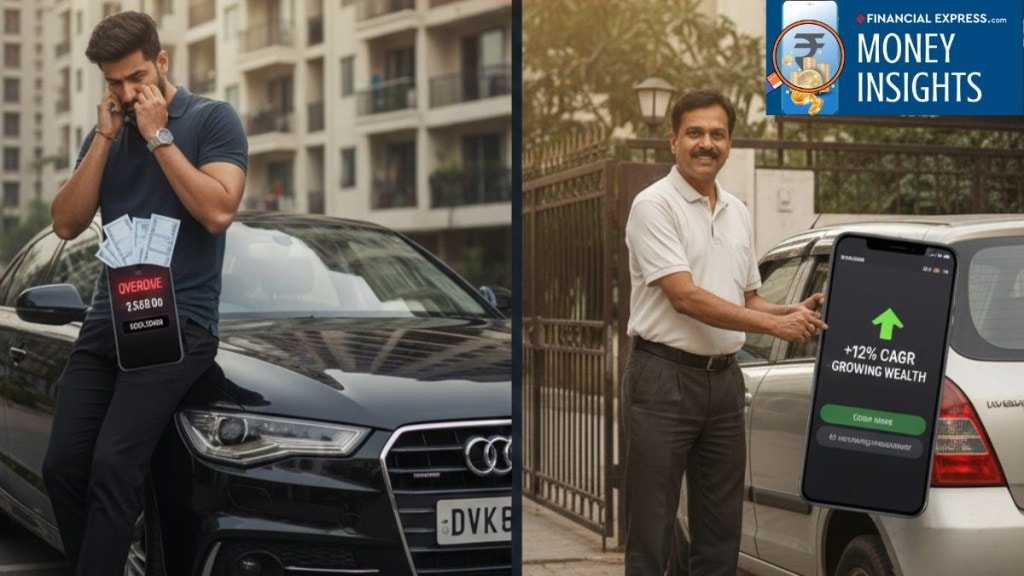
It was a fine chilly Friday morning in the cool Mumbai December. I stood on the road divider with a coffee in my hand waiting to get to the other side. And I saw something that triggered a round table discussion between my heart and my brain.
On my left I saw a sleek, black luxury sedan. Brand new.. My first instinct was, “Damn I want that car!” I peeped inside and saw the driver was a young rich 30 something wearing a branded watch that catches the sunlight and attention. He looked at me staring at the car and turned his gaze away like he had seen a samosa seller.
Now before you judge me, I was walking to the other side of the road, where my dignified 10-year-old mid-size car waited for me. I am not actually a samosa seller (not that it is wrong to be one in any sense). As I opened the door to my car, I saw a common man around my age, parked right next to me was his hatchback, wearing a simple cotton polo t-shirt with no watch on his wrist.
That’s when my brain went straight to what the human brain does best. Form judgements. Because our brains are wired to make instant judgments. We instinctively label the guy in the luxury sedan as “Rich” and the guy in the hatchback as “common.”
But what if I told you the guy in the sedan could be drowning in EMI debt, has no money in his emergency fund, and is terrified of losing his job? And what if the guy in the hatchback owns the building that the sedan driver rents an apartment in?
That right there is the Rich vs. Wealthy Paradox. And in modern India, mixing up these two concepts is the single biggest financial mistake many smart people make.
The Instagram Trap: Receipts vs. Net Worth
We live in a unique time in Indian economic history. We are seeing a massive wave of “premiumization.” Look at the data: sales of luxury cars in India hit record highs in recent years, and growth in demand for premium housing has outstripped affordable housing.
Social media has poured fuel on this fire. On Instagram, success is visual. You can’t post a picture of your mutual fund portfolio or your debt-free status. It’s boring. But you can post a picture of a Maldives vacation, a new SUV, or a designer bag.
We have built an economy based on “receipts.” If you have money, you must show the receipt to society to get credit for it.
But here is the problem…
Spending money to show people how much money you have is the fastest way to have less money. This money you spend to show the world how rich you are, is called the ‘Validation Tax.’ Something you pay to get the validation of the society, certifying that you are now worthy of living.
Rich vs. Wealthy: Why Income is Not Wealth
Morgan Housel, the author of The Psychology of Money, makes a brilliant distinction that every Indian investor needs to understand.
He says, Rich is a current income. It is visible. It is the salary credit SMS. It is the car you drive. It is the gadget you hold. “Rich” is what you spend.
But Wealth… It is hidden. It is income that is not spent. It is the car you didn’t buy. It is the first-class ticket you declined so you could invest the difference. Wealth is an option. It is the ability to wake up tomorrow and say, “I can do whatever I want today.”
The tragedy is that most of us chase “Rich” thinking it will make us “Wealthy.” But they are often opposites.
Showing the society how rich you are, costs you wealth. You burn money you don’t have, to impress people you don’t know.
The ‘Validation Tax’: Buying Respect That Never Comes
In biology, animals use signals to show fitness. Like a peacock showing its feathers.
And in economics, humans use luxury goods to signal status. That Luxury bag, those handcrafted leather shoes, that limited edition watch… The list goes on.
When you buy a luxury car for Rs 75 lakhs, you are not just buying transportation. A Rs 15 lakh car can get you from Point A to Point B just as safely and comfortably in Indian traffic.
The extra Rs 60 lakhs is what we call the “Validation Tax“. It is a tax you pay to society to say, “Look at me, I am successful.”
But here is the hard truth that might come as a shock to most… NOBODY CARES.
There is a psychological phenomenon called the “Man in the Car Paradox.” When you see someone driving a nice car, you rarely think, “Wow, that guy is cool.” Instead, you think, “Wow, if I had that car, people would think I am cool.” Exactly the thought I had when I was standing on the divider.
You don’t admire the driver; you use the driver’s car as a mirror for your own fantasies. The driver thinks he is buying respect, but he is only buying a shiny object that makes you think about how far behind you are in this race for vain validation.
The Mathematics of Looking Rich
Let’s look at the data. Let’s say you are 30 years old, and you get your long-awaited big promotion. In a fit of happiness, you throw a party for friends and colleagues, where you decide to buy a luxury car worth ₹50 lakhs on a 5-year loan.
You might think the cost of the car is ₹50 lakhs (plus interest). You are wrong. The real cost is the Opportunity Cost.
If you had instead bought a practical car for Rs 15 lakhs and invested the remaining Rs 35 lakhs in a simple Nifty 50 Index Fund (historically returning ~12%), do you know what that money would be worth when you retire at 60?
That Rs 35 lakhs would grow to approximately Rs 1 cr in just 10 years. In 30 years? It could be worth over Rs 10 cr.
That fancy car didn’t cost you 50 lacs; it cost you ₹10 Crores of your freedom in your golden years.
Is the validation from strangers at a traffic light worth Rs 10 cr? For most rational people, the answer is no. But we don’t do the math. We play the status game.
The Ultimate Asset: Freedom
The most valuable financial asset you can own isn’t a stock, a bond, or a piece of real estate. It is autonomy.
Wealth gives you the power to quit a toxic job without having another one lined up. It could very well allow you to take a year off to write a book, travel or start a passion project.
Imagine not having to run pillar to post trying to arrange funds when a medical emergency arrives and the bills come knocking. That is freedom!
When you trade wealth for status items, you are trading your freedom for inventory. You are filling your garage, your lavish house, but possibly emptying your future.
You Can Opt Not to Play
In a society that judges you by your spending, saving is an act of rebellion.
Being wealthy requires a different kind of mindset. It requires you to be comfortable with being “unimpressed” by yourself. It requires you to drive a car that is slightly below what you can afford. It requires you to live in a house that is slightly smaller than your bank balance allows.
Real wealth is what you don’t see. It is the unspent money sitting in your demat account, compounding silently, working 24/7 so that one day, you won’t have to.
The bottom line is that there are many people in India who look rich but are broke. And there are many people who look average but are wealthy. Be careful which role model you choose.
The goal of money isn’t to look like you have money. The goal is to have money.
Don’t go broke trying to look rich to impress people who don’t care about you. That is a game you can never win. The only way to win the status game is not to play it at all.
I cannot count the number of people whom I felt bad for in my life, only to later know they could stop working today and it wouldn’t matter to them. And then there is another category that keeps paying the Validation Tax and keep getting poorer – Like me.
But I changed today… What About You?
Disclaimer:
The purpose of this article is only to share interesting charts, data points, and thought-provoking opinions. It is NOT a recommendation. If you wish to consider an investment, you are strongly advised to consult your advisor. This article is strictly for educative purposes only.
Suhel Khan has been a passionate follower of the markets for over a decade. During this period, he was an integral part of a leading Equity Research organisation based in Mumbai as the Head of Sales & Marketing. Presently, he is spending most of his time dissecting the investments and strategies of the Super Investors of India.
Disclosure: The writer and his dependents do not hold the stocks/securities/funds discussed in this article.
The website managers, its employee(s), and contributors/writers/authors of articles have or may have an outstanding buy or sell position or holding in the securities, options on securities or other related investments of issuers and/or companies discussed therein. The content of the articles and the interpretation of data are solely the personal views of the contributors/ writers/authors. Investors must make their own investment decisions based on their specific objectives, resources and only after consulting such independent advisors as may be necessary.