



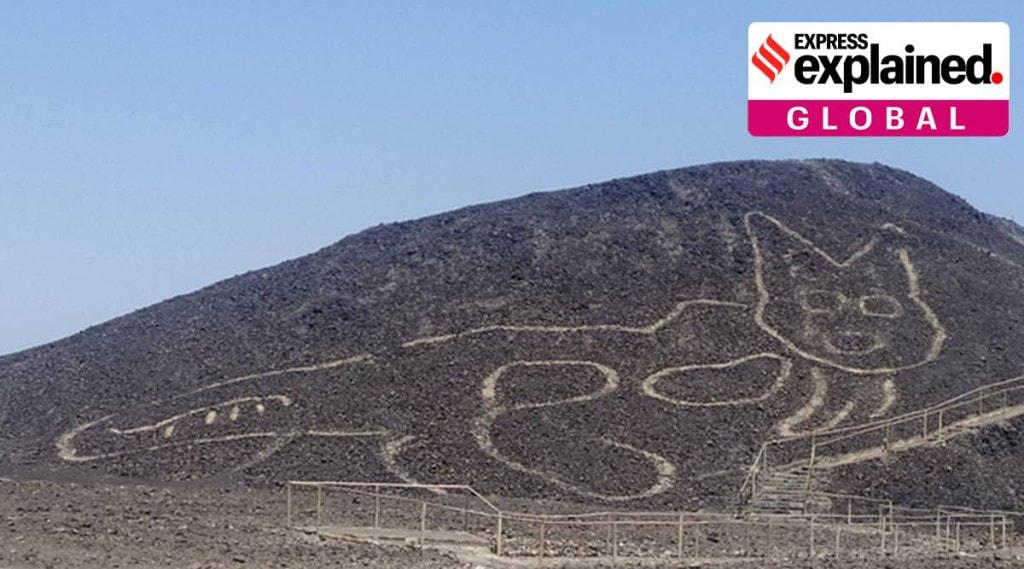
Nazca Lines: A famous UNESCO Heritage Site in Peru, the Nazca Lines, has recently garnered much attention on social media. The Nazca Lines is famous for its larger-than-life depictions of imaginary beings, plants and animals. The recent attention is due to the discovery of the carving of a massive resting cat on a steep hill’s slope. The country had announced the discovery last week, and the etchings are believed to be over 2,000 years old, according to a report in IE.
The Ministry of Culture in Peru had taken to Twitter to state that a new geoglyph corresponding to a feline was identified at the Nazca Lines amid the remodelling work.
Nazca Lines explained
The Nazca Lines are among the top places in Peru for visit. It is a group of geoglyphs, which are massive designs on the ground made using landscape elements like dirt, limber, stones or gravel, the report added. Due to their nature, continuity, size and quality, the Nazca Lines are believed to be the greatest known archaeological phenomena, because sometimes, the images are so big that flying over them is the best way to get a complete view.
The geoglyphs are made on various subjects, but mostly revolve around animals and plants. They were drawn over 2 millennia ago on the arid Pampa Colorada’s surface. Some are also geometric shapes like spirals, triangles and trapezoids, while some have been linked with astronomical functions, the report stated.
The discovery of the Lines goes back to 1927, while they were declared to be a UNESCO World Heritage Site in 1994.
The new geoglyph: The resting cat
The report stated that the new geoglyph is believed to be older than the earlier ones at Nazca. The discovery came when archaeologists were carrying out maintenance at the site amid the coronavirus pandemic.
The country’s ministry of culture stated that the geoglyph was hardly visible. Due to its location on a steep slope, the geoglyph was more prone to natural erosion and therefore, was about to disappear.
Further giving details about the geoglyph, the ministry stated that seen horizontally, the figure is as long as 37 metres. It goes back to the late Paracas era between 500 BC and 200 AD. The report added that the recent restoration work has led to the showing of a feline figure having its head in front. Moreover, the width is varied between 30 and 40 cm, as marked by lines. In the Paracas society’s ceramics and textiles, representations of such felines were also frequent.