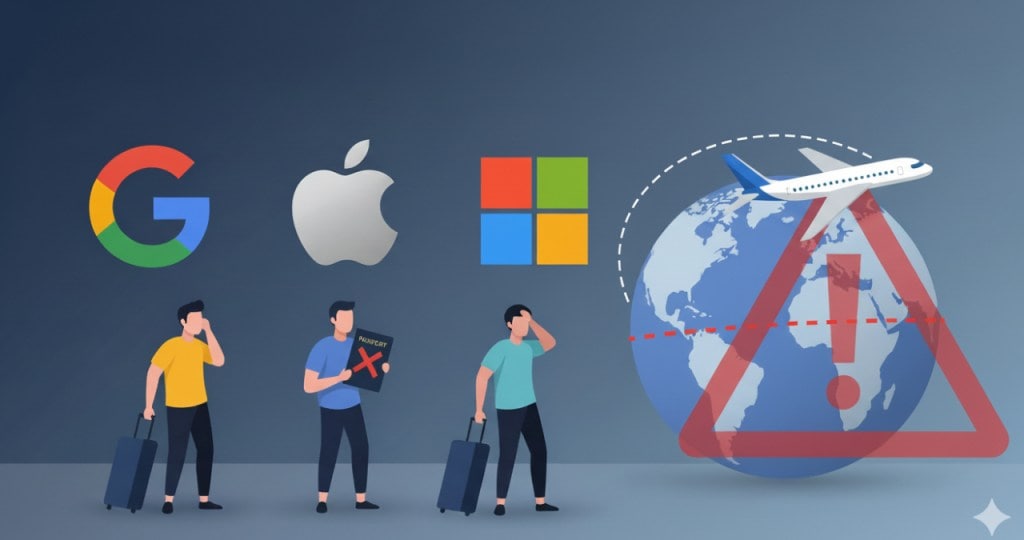
Google, Apple, and Microsoft have issued urgent warnings to their visa-holding employees, asking them to avoid international travel at all costs. The advisories, which were sent via internal memos from the companies’ legal and immigration partners, come as US embassies worldwide, particularly in India, report historic appointment delays of up to 12 months. The disruption in visa issue process has reportedly turned routine end-of-year trips into a ‘high-risk’ gamble for thousands of high-skilled professionals on H-1B, H-4, F-1, and J-1 visas.
The ’12-month wait’ warning
Memos from BAL Immigration Law (representing Google) and Fragomen (representing Apple) were circulated to staff this week, highlighting a growing crisis in visa stamping.
Google’s Memo:
“Please be aware that some US Embassies and Consulates are experiencing significant visa stamping appointment delays, currently reported as up to 12 months,” the advisory from BAL stated. It warned that employees who travel now “risk an extended stay outside the US” if their appointments are postponed.
Apple’s Memo:
Fragomen urged Apple employees without a valid visa stamp to stay put, citing the “possibility of unpredictable, extended delays when returning to the US.” The firm “strongly recommends” that employees postpone any travel that requires a new visa stamp for re-entry.
Why is this happening?
The “Operational Constraints” mentioned in the memos are tied to a significant shift in U.S. immigration policy that took effect on December 15, 2025.
– New “online presence reviews” require consular officers to manually screen the last five years of an applicant’s social media history across platforms like Facebook, Instagram, and X.
– A State Department spokesperson confirmed that consulates are now “prioritising thoroughly vetting each visa case above all else,” moving away from previous efforts to reduce wait times.
– Hundreds of Indian professionals who travelled home for the holidays have already reported last-minute cancellations. Appointments originally scheduled for late 2025 are being pushed as far back as June or even October 2026.
The ‘Dropbox’ bottleneck
The crisis is exacerbated by the near-total end of the “interview waiver” (Dropbox) system for many applicants. In 2026, most visa renewals will require a physical, in-person interview. With limited slots and the time-intensive nature of social media screening, the system has essentially ground to a halt in high-volume hubs like Chennai and Hyderabad.
The timing is particularly painful for the tech sector. Google and Apple together applied for nearly 10,000 H-1B visas in the 2024-25 cycle alone. For these companies, the risk of a “brain drain”—where critical software engineers or project leads are stranded abroad for a year—is a major threat to their 2026 product roadmaps.