By Radhika Roy
What is the internet? A foundational network of interconnected computers that allows free-flowing communication across geopolitical borders? Amongst other things, it allows you to remain abreast of developments in countries across the world (there are mosquitoes in Iceland now) or remain in touch with a friend who resides in Colombia whom you met while backpacking through Eastern Europe.
The internet, by virtue of these characteristics, is visualised as open, free and borderless. However, this open internet seems to be in danger. Countries such as China and Russia have, on their own terms, walled the internet within their borders, impeding access to information within and outside their countries. Techno-democracies such as the US and India have exhibited tendencies to barricade their digital resources and capabilities in the face of rising threats to national security due to emerging technologies.
While the US seeks to maintain status quo as the reigning champion in digital innovations, other states such as the EU and India are grappling with attempts to create their own self-sufficient development capacities. On top of that, growing AI technologies, specifically generative AI, are accelerating the transformation of the internet and digital platforms, raising both large opportunities and large risks.
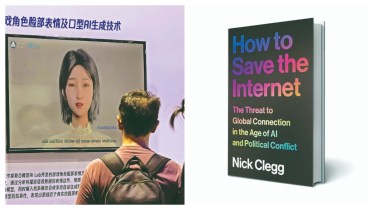
It is in the context of this political conflict and AI boom that Nick Clegg, author of How to Save the Internet, makes the plea for an international collaborative approach that protects the essence of the open internet. Former deputy PM to the UK Prime Minister as well as former president of global affairs at Meta, Clegg brings to the fore an insight from the corridors of power —both in government and in Big Tech. His perspective on how the government and tech companies must interact with each other reflects his unique position.
Clegg’s claim is essentially that the internet as we know it is under threat, not primarily from the technology (or even the technology companies) per se, but from political fragmentation, deglobalisation, authoritarian regimes, and misguided regulation that fails to preserve openness. He identifies two principal threats, with the first being the increasing assimilation of generative AI in our daily lives and its ability to reform the global economy, and the second being the protectionist stances of countries such as the US.
The book is thus divided into four parts. Part I delves into platform accountability where Clegg proceeds to inform his readers that tech companies are not as bad as we make them out to be—that ‘techlash’ afflicts every new technology. As per Clegg, our serious misgivings with the impact that social media platforms have on our mental health and democracy, and the power wielded by the companies which operate these platforms is misplaced.
Over the past decade and more, there has been a distinct rise in hate speech, disinformation, political and religious divides, and mental health issues. Coincidentally, the past decade has also witnessed the proliferation of social media platforms and generative AI technologies, with Instagram and ChatGPT consuming the majority of our screentime. Many associate the rise in unfavourable elements with the infiltration of digital technologies. However, Clegg states that “correlation is not causation”. While that may be true, completely disregarding the multitude of data and findings on how tech companies are garnering a bigger say in the running of nations comes off a tad naive.
Part II of the book explores the massive power shift because of AI. The infrastructure, the data, and the energy required for computing behind AI are increasingly concentrated in the hands of a few large tech firms and/or powerful states. This creates both enormous opportunity (innovation, productivity, access), and risk (surveillance, manipulation, digital sovereignty). The power paradox, as per Clegg, is that the tools that could democratise knowledge and empower many may also centralise power more than ever, thereby reinforcing digital divides and geopolitical splits.
Flowing from the first two parts of the book, Clegg then arrives at Part III of the book where he uncovers the politics behind the concentration of digital power. In doing so, he selects three democracies (the US, the EU, and India) to demonstrate the disproportionate influence that they have on the regulatory power involving the internet. Clegg stipulates that while regulation in the US is lagging in terms of technological development and is increasingly observing protectionism (Trump’s recent tariffs are a glaring example), the EU is stifling its economy and technological innovation with a hyperactive regulatory regime. India, on the other hand, is a case-in-point of how a powerful country is caught between preserving the tenets of digital democracy and instating authoritarian control over information.
These observations bring Clegg to the last leg of the book where he puts forth his recommendations which emphasise global cooperation, evidence-based regulation, and maintaining cross-border flows of data and innovation. He pushes for what he calls ‘radical transparency’ from tech firms and a new institution of international collaboration which he dubs as ‘Digital Democracies Alliance’ to pool infrastructure, data, and regulatory frameworks amongst all states. He further beckons the US to take a lead on initiating this Alliance, and praises Meta’s commitment to openness and transparency.
As I sat down to write this review, I came across a recent development—a preliminary investigation by the European Commission revealed that companies like Meta and TikTok were failing to comply with transparency obligations, amongst other things, outlined in the EU’s Digital Services Act. Simultaneously, Trump’s absurdly high tariffs on China, Canada, India, and other countries are still fully functional. Any disputes being raised with the WTO are proving to be futile due to the US’ blocking of appointments to the WTO’s Appellate Body. In view of this, the author’s recommendations might be deemed visionary, but they are hardly operational in this geopolitical environment.
Clegg’s work is a significant contribution to the field of internet governance and digital geopolitics. It stands out for its global perspective, the author’s high-level experience, and its accessibility to a non-specialist audience. However, while it convincingly argues that the open internet is facing real structural threats, it falls short in some respects. The moderate reformist stance, for instance, exemplifies Clegg’s political stance of keeping a varied voter base satisfied.
More importantly, How to Save the Internet reads as a defence of the industry it critiques. Clegg’s proximity to Meta makes his appeals for moderation and global governance sound cautious, sometimes even corporate. Apart from the credibility dilemmas, the policy prescriptions, while sound, are not always deeply developed. For anyone wanting to dig deeper into platform power, algorithmic harm, and governance reform, I would recommend more critical works, ideally outside the tech-industry orbit.
Radhika Roy is a lawyer based in Delhi, working on technology policy and digital rights
How to Save the Internet: The Threat to Global Connection in the Age of AI and Political Conflict
Nick Clegg
Penguin Random House
Pp 320, Rs 999