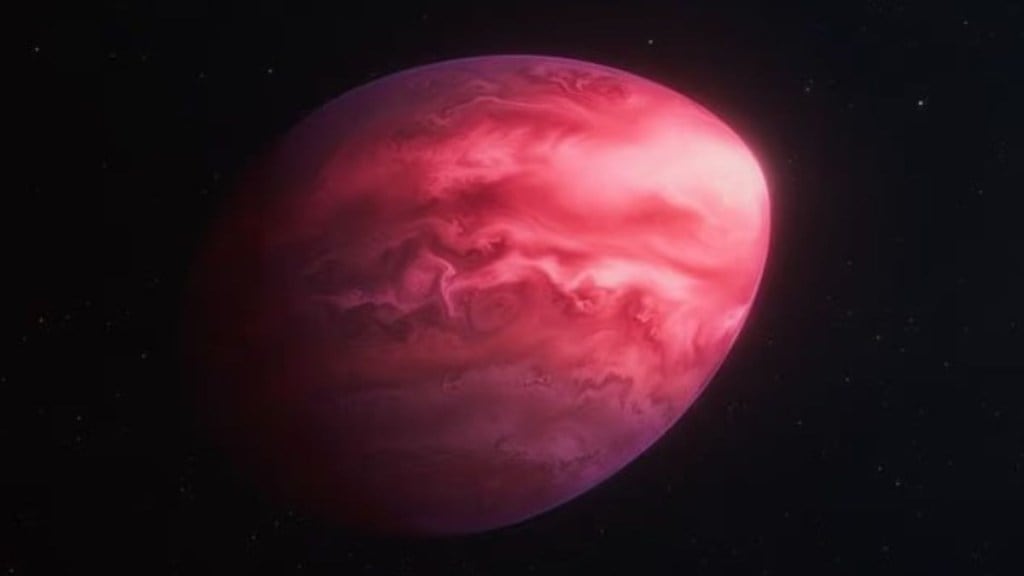
The James Webb Telescope has recently studied an object, PSR J2322-2650b, with the same mass as Jupiter. With a strange atmosphere and an oblong shape, the planet’s equatorial diameter is about 38 per cent wider than its polar diameter. This phenomenon can be explained by the Earth’s rotational tendency, making it bulge by 0.3 per cent, from equator to pole.
According to a NYT report quoting Michael Zhang, “It’s the stretchiest planet that we’ve confirmed the stretchiness of.” Describing PSR J2322-2650b as a lemon-shaped planet in The Astrophysical Journal Letters, it was first discovered in 2011 by the Parkes Radio telescope in Australia.
What is PSR J2322-2650b?
Located 2000 light-years away from Earth, this Jupiter-sized gas giant orbits a pulsar. A pulsar is a dense star that spins rapidly, a leftover after a supernova. They shoot out jets of radiation from their pole, and with the planet located a million miles from the Pulsar, the world completes an orbit in about eight hours. Interestingly, it is the only known gas giant orbiting a pulsar.
The lemon-like shape can be attributed to its proximity to the radiating star. The gravity pulling on it is the primary reason behind its bulging shape, explained experts from the Carnegie Institute for Science. Peter Gao shared, “You have a literal tip, like a point, where material actually comes out of the planet and spirals in.”
How the lemon shape affects the world
The shape is not merely an external feature, but it has a large impact on the world’s atmosphere. Given its unique ability to orbit a pulsar, the observation found a bizarre fact about the planet’s atmosphere. The composition entirely lacks hydrogen, oxygen, and nitrogen, the majority of which make up the Earth’s. The gas giant is primarily made of helium and molecular carbon, according to the NYT.
The Carbon-Helium dominance is also one of its kind. The carbon atmosphere gives it its ‘clouds made of graphite’ and even diamond at its core. Bands of storms surround the planet, tracing its lemon exterior in the shape of a W, while the red colour comes from its dust and soot-like particles formed by the carbon.
PSR J2322-2650b – not a planet
Technically, as per Gao, PSR J2322-2650b is not really a planet. Given its strange properties, the world is estimated to be a remnant of a star which once orbited the pulsar, slowly being eaten away. It is likely that PSR J2322-2650b might be consumed entirely over time, since it may have lost more than 99 per cent of its mass already.