



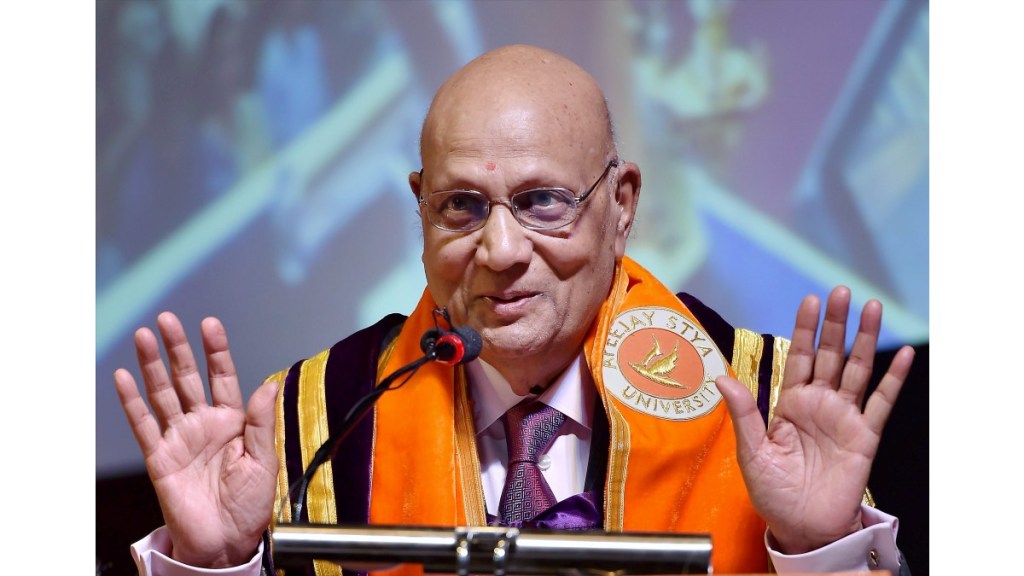
Despite the many tragedies in his life – his daughter Ambika passed away at age 4 because of leukemia, and son Angad, 45, fell to death from his penthouse in 2015 – Swraj Paul knew how to hide his sorrow behind an always smiling face.
He didn’t lose his sense of humour, too, till almost the last. At a function in Leicester a couple of years ago where he was a receiving a lifetime achievement award, a friend wanted to know: “Why are you still working?” Paul’s reply was typical: “At my age, what else can I do?”
As he passed away at age 94 on Thursday evening in London, which remained his home after he left India in the 1960s, the India-born Chairman of the Caparo Group would be remembered as much for his zeal for life as also for the indelible mark he made in the business and industrial spheres in India, the UK and other countries.
Legacy of industry and resilience
The journey from the bylanes of Jalandhar to becoming a regular name in the annual ‘Sunday Times Rich List’ (this year he was ranked 81st with an estimated wealth of £2 billion) was stupendous indeed, making Paul one of the most well known NRI entrepreneurs and philanthropists. Headquartered in London, Caparo operates internationally from over 40 sites, with operations based in the UK, India, North America, and the Middle East.
Caparo, founded by Paul in 1968, is a diversified business group with interests in design, manufacture, marketing and distribution of value-added steel and niche engineering products for the automobile and engineering industries. It is one of the largest 100 per cent single family-owned businesses. With its India headquarters in Gurugram, Caparo has over 25 manufacturing units in India, many of which are greenfield developments. Its India operations began in 1994 with Caparo Maruti Ltd (CML), a joint venture with Maruti Suzuki India to provide sheet metal stamping, weld assemblies, and complete sub-modules. It is also one of the biggest suppliers to the Indian Railways.
Not bad going for a man whose father Payare Lal ran a small foundry that produced steel buckets and farm machinery as part of the Apeejay Group, managed by Paul’s older brothers Satya and Jit. Payare Lal had named his youngest son Swraj – meaning independence – because Mahatma Gandhi had visited their home around the time of his birth.
Hostile takeover that changed India Inc.
More than anything else, Paul would be remembered for unwittingly giving birth to the so-called Bombay Club, a grouping of Indian industrialists who joined hands to protect themselves from hostile takeovers.
He could be called the original hostile takeover artist. That’s because he spotted a few bloated, family-controlled Indian companies trading at massive discounts, with promoters holding puny stakes and enjoying massive government patronage. The Nandas controlled Escorts with 5% and the Shri Rams ran DCM with 10%. It was corporate control by dynasty, not by ownership. Paul targeted them by quietly buying 13% of DCM and 7.5% of Escorts, making him the largest shareholder in both. These were among India’s first hostile takeover attempts, exposing governance gaps and prompting key regulatory reforms in NRI investment and corporate control.
But the establishment struck back. Though Paul was a friend of the then Prime Minister Indira Gandhi and finance minister Pranab Mukherjee, the companies refused to register Paul’s shares. After the Reserve Bank of India raised imaginary objections, an embattled government facing huge pressure from the Opposition, imposed a 5% ceiling on foreign holdings after liberalising NRI investment just months earlier.
Though Paul won in the Supreme Court later, the hostility of the establishment tired him out, forcing him to accept a compromise by selling stakes back to the families with whom he had waged a legitimate battle. Years later, he told journalists that if NRI investment had been allowed at that time, India “would today be ahead of China”.
Prime Minister Narendra Modi said in his post on X.“Deeply saddened by the passing of Shri Swraj Paul Ji. His contributions to industry, philanthropy and public service in the UK, and his unwavering support for closer ties with India will always be remembered. I fondly recall our many interactions,”
Though he was friends with politicians of all hues in the UK, Paul faced a host of controversies. In 2009, he was in the spotlight for UK parliamentary expenses scandal. Though he maintained his innocence, he requested an investigation and voluntarily repaid money. Family disputes over Caparo Financial Solutions management saw his children battling in the National Company Law Tribunal over alleged mismanagement, further damaging the Caparo brand.
London may have been his home since 1966, but Paul never forgot his roots and let everybody know that he left India just to save the life of his ailing daughter. Till recently, he would pay an annual visit to India and make it a point to meet the politicians, industrialists and media friends just to remain in touch. RIP, Lord Paul!