



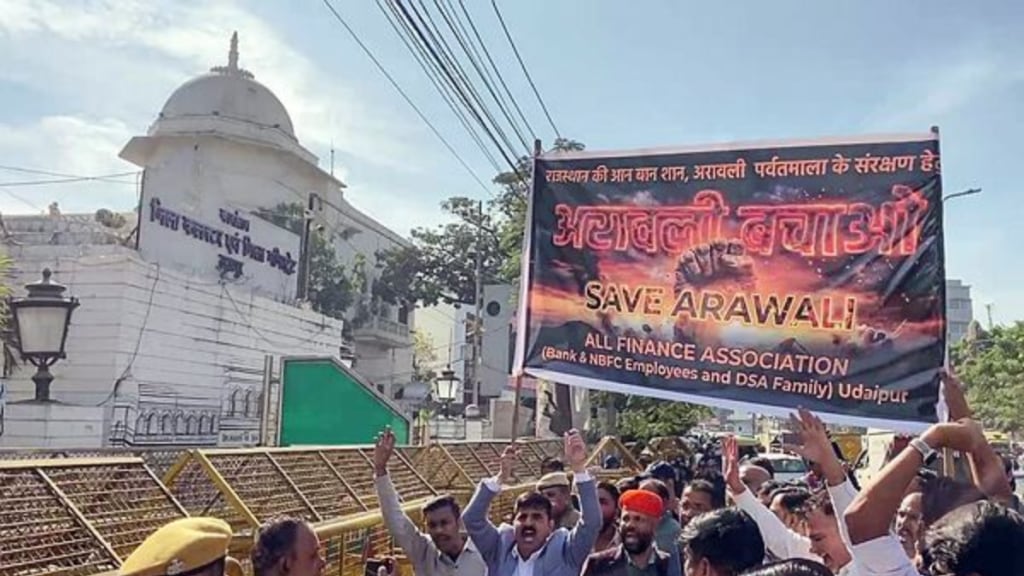
Union Environment Minister Bhupender Yadav on Monday said mining activity in the Aravalli hills is limited to just 0.19 per cent of the total area and that no new mining leases will be granted until an assessment is completed.
“Mining activity in the Aravalli range will only be possible in 0.19 per cent of the area, which is less than one per cent, and even there, no new mines have been opened… This process has been made stricter. The main problem in the Aravalli range is illegal mining,” he told news agency ANI.
His remarks came amid backlash over the Supreme Court-approved definition of hills, under which landforms with a height of 100 metres or more are classified as mountains. The definition has sparked concern among environmentalists, who fear it could open large parts of the Aravalli range to mining.
Mining in only 0.19% of Aravalli
Addressing the concerns around Aravalli during a press conference, Yadav said the revised criteria would make only 277.89 sq km of the Aravallis eligible for mining out of a total area of 1,43,577 sq km spread across 37 districts. Of this, 247.21 sq km lies in Rajasthan, 27.35 sq km in Gujarat and 3.33 sq km in Haryana, according to data from the Ministry of Environment. This, he said, means that mining is limited to only 0.19 per cent of the total area.
Yadav also sought to provide a clarification on the newly agreed-upon definition, stating, “…The height of 100 metres will be measured from the base of the mountain structure, and mining will not be allowed around or beneath the hill’s structure.”
He also added that the definition will bring more than 90 per cent of the Aravalli region under “protected area”. Yadav said that “lies” have been spread on the issue and asserted that “no relaxation has been granted” concerning the protection of the Aravalli region.
अरावली के 90% से भी ज़्यादा भाग में किसी भी तरह की माइनिंग हो ही नहीं सकती है।#AravalliIsSafe pic.twitter.com/OX7Wx1koQQ
— Bhupender Yadav (@byadavbjp) December 22, 2025
He said the Indian Council of Forestry Research and Education (ICFRE) will prepare a Management Plan for Sustainable Mining (MPSM) in line with Supreme Court directions. “The court asked to form a technical committee only for the mining sector, and this (new definition) is also restricted to the purpose of mining. Even after this definition, the order has stated that no new mining leases would be given,” Yadav said.
The minister added that exceptions would be made only for critical, strategic and atomic minerals. He also said ICFRE would draw up district-wise plans identifying permissible mining zones, ecologically sensitive areas, conservation-critical regions and restoration-priority zones within the Aravalli landscape.
‘Stop spreading misinformation!’: Yadav
In a post on X (formerly Twitter), Yadav urged people to “stop spreading misinformation”. He also reshared a post by Union Minister Gajendra Singh Shekhawat, in which a person tries to explain “facts” to people.
“If you want to know the truth about the Aravallis, you must understand the facts. The Aravalli range spreads across around 2,43,000 square kilometres, of which nearly 1,23,000 square kilometres are already permanently restricted. Why is that? Because these areas include cities, forts and temples,” the man explained in the video.
He added, “Places like Ajmer, Bundi and Kota fall within the Aravalli region, and mining cannot be carried out there. The areas where mining does take place account for only about 2–2.5 per cent of the entire Aravalli range. Even so, it is being claimed that the Aravallis are being destroyed,” before stressing, “This is not based on facts; it is noise and misinformation.”
अगर अरावली को लेकर सच जानना है, तो उसके तथ्यों को समझिए।
— Gajendra Singh Shekhawat (@gssjodhpur) December 22, 2025
झूठे और भ्रामक दावों से दूर रहिए, सच जानिए और समझिए। pic.twitter.com/tWPxN0hwNP
Aravalli hills row
The Supreme Court has earlier warned that unchecked mining poses a serious threat to the Aravallis, which act as a green barrier against desertification in the Indo-Gangetic plains. It had directed that a sustainable mining plan be prepared after considering biodiversity, aquifers, wetlands and protected areas.
Following the court’s order, the Environment Ministry constituted a committee to arrive at a uniform definition of hills across the Aravalli range to regulate mining activity. The final definition excludes from mining all landforms enclosed within the lowest contour surrounding hills of 100 metres or more, irrespective of their height or slope.
After the Supreme Court accepted the definition, it triggered a wave of criticism as environmentalists argued that a significant portion of the Aravalli range falls outside its ambit and could be vulnerable to mining.
Responding to these concerns, the government, in a press statement, said it was incorrect to conclude that mining would be permitted across all landforms below 100 metres. It clarified that all landforms within 500 metres of two adjoining hills of 100 metres or more are excluded from the grant of mining leases.
Yadav further said the Supreme Court has also appreciated the ministry’s Green Aravalli Wall initiative and stressed the need for a scientific approach to conservation. “There can be no alternative; therefore, the Aravalli range needs protection. Just planting trees all around is not enough; this ecology includes grass, shrubs, and medicinal plants, which are part of an ecological system,” he said.