



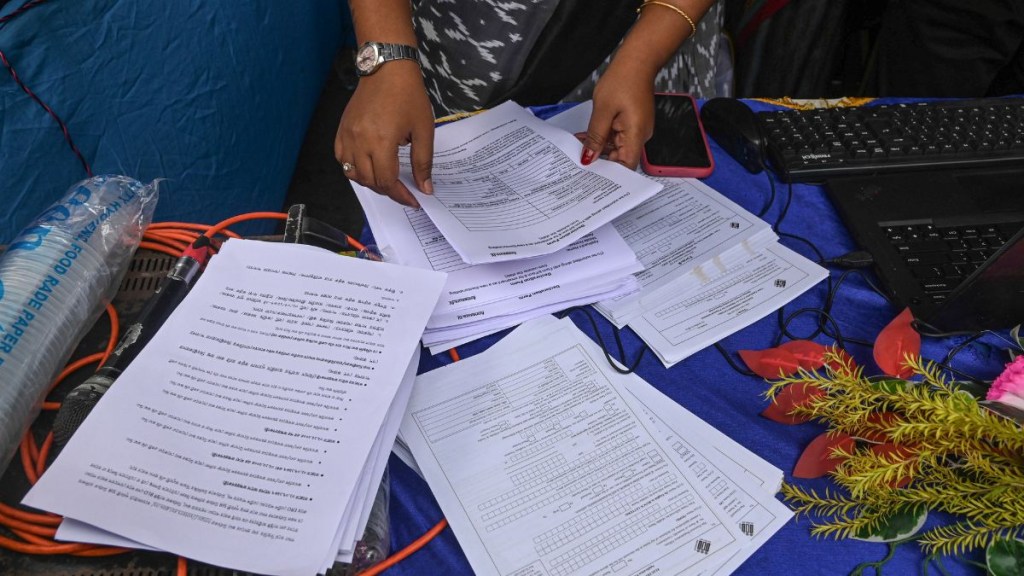
The Special Intensive Revision (SIR) of electoral rolls cannot copy paste the earlier voters lists, and hence a process involving checks to ascertain, not determine, citizenship could be placed, the Supreme Court said on Thursday while hearing a batch of pleas against the exercise in various states and Union Territories. The SC said voter enumeration in subsequent SIR can include an inquisitorial process to ascertain the citizenship.
Appearing for the petitioners, senior advocate Raju Ramachandran, argued that voter enumeration exercise cannot begin with distrust on part of EC to test citizenship of every voter, especially when the statutory task to determine citizenship, upon receipt of a complaint about a foreigner, is vested with other authorities.
To this, a bench of CJI Surya Kant and Justice Joymalya Bagchi said, “EC is constitutionally vested with the power of superintendence of elections, which would include ensuring that only Indian citizens are registered as voters. Would it mean that EC must await a complaint, or undertake an inquisitorial exercise to determine who are doubtful voters? It is better to conduct a summary inquiry rather than await a complaint.”
Bihar SIR vs pan-India SIR
Ramachandran stated that the Election Commission of India (ECI) conducted SIR in Bihar for two main reasons — mass migration and rapid urbanisation.
However, he added, “Reason for Bihar SIR cannot be reason for conducting pan-India SIR as different states have different demography and ground situation relating to electoral rolls.” The counsel said the top poll panel failed to provide detailed reasons for conducting such an exercise.
Earlier in June as well, the top court had backed the exercise and the intent to update the voter rolls.
‘EC cannot assume role of suspicious neighbour’
Meanwhile, the apex court was also told that the election commission cannot assume the role of a “suspicious neighbour” or a “policeman” treating voters with doubt. Ramachandran delved into the conceptual foundation of the SIR and urged that the poll panel’s constitutional mandate is to act as a facilitator and enabler of voting rights.
“The negative way of viewing one’s own role is that of a disabler or that of a suspicious policeman,” Ramachandran said. The counsel for petitioners further said hat when there is an adequate statutory scheme regarding citizenship, the poll panel cannot become a “nosy parker” instructing booth level officers (BLOs) to cast doubt on voters.
The CJI-led bench said that the SIR cannot be seen too much on procedural aspects. “Let us keep in mind that they are doing something after 20 years and the SIR cannot become an annual feature. That is why we cannot intervene too much on the technical procedural aspects,” it added, quoted PTI.
The arguments would continue on Tuesday.