



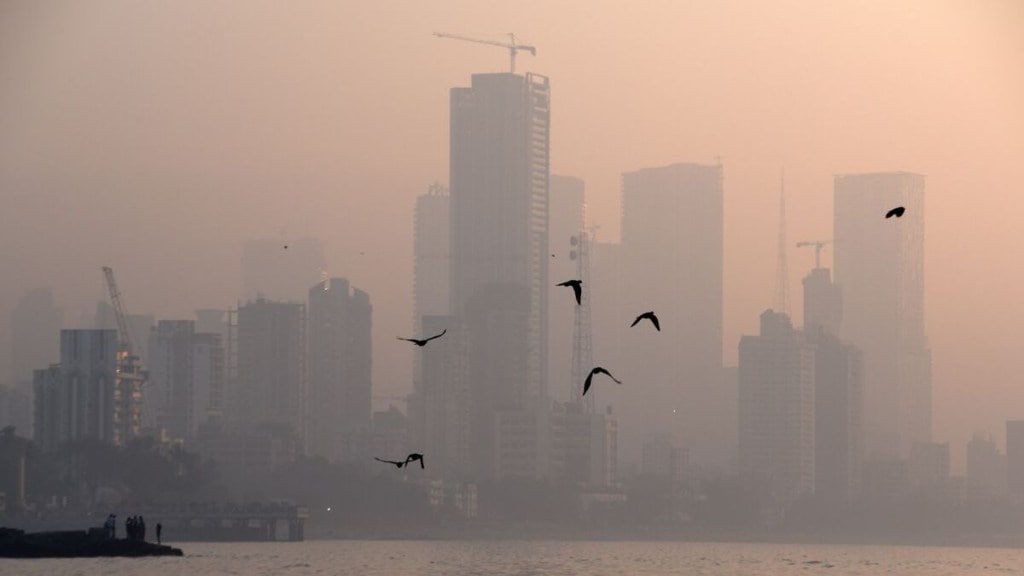
India’s “Maximum City” has for long been comforted by the belief that sea winds would keep its skies cleaner than Delhi’s. But Mumbai’s air is telling an uncomfortable story these days with the air quality index hovering in the “poor” category, according to the Central Pollution Control Board.
For decades, the city’s coastal geography acted as a natural cleanser, with strong sea winds dispersing pollutants. But Mumbai’s reliance on nature’s ventilation system is beginning to look like wishful thinking. The sources of pollution are multiplying faster than the wind can carry them away.
Start with vehicles. According to Vahan data, as many as 2,92,459 vehicles were registered across Mumbai’s four regional transport offices between January and December 18 this year. That works out to roughly 830 new vehicles every single day. Each one adds a little more exhaust to already crowded roads.
Then there is the relentless churn of construction. Mumbai is in the middle of an infrastructure and real-estate boom unlike anything it has seen before. As per Knight Frank, 21 major infrastructure projects are underway in the city and its surrounding areas—from the Mumbai–Ahmedabad bullet train to multiple metro corridors such as Line 2B, Line 4 and Line 4A. These are transformative projects, but they also mean years of dust, debris and diesel fumes.
The state government is unapologetic about the pace. Maharashtra Chief Minister Devendra Fadnavis recently said that all major infrastructure projects in Mumbai would be completed by 2032 to decongest the city. The promise of a smoother, faster Mumbai lies at the end of the tunnel—but the tunnel itself is clouding the air.
How does real estate development contribute to this?
Real estate development adds another layer. Mumbai accounts for the lion’s share of residential construction in the Mumbai Metropolitan Region. Of the nearly 5,16,000 housing units under development across MMR, about 73%—or 3,78,000 units—are in Mumbai alone, according to Anarock Research and Advisory.
“The construction industry is definitely a big part of this,” says Prashant Thakur, executive Director & head – research & advisory of Anarock. Construction activity in the metropolitan area rose over 95% between 2021 and 2023. Dust from construction sites accounts for an estimated 10–15% of PM10 emissions, with areas such as Byculla and Navi Mumbai frequently recording AQI levels above 200.
Overlay this with Mumbai’s massive society redevelopment wave. Knight Frank estimates that around 210 societies, covering roughly 100 acres, are currently under redevelopment in the city. With floor space index norms ranging from 3 to 6, the final built-up area—and the accompanying environmental impact—could be far higher. These projects alone are expected to generate over 50,000 new homes, but redevelopment cycles typically last eight to ten years, prolonging the pollution burden.
Is transport reform unavoidable?
Gulam Zia, senior executive director at Knight Frank India argues that transport reform is unavoidable. “Old vehicles are far more polluting. We need a clear policy to junk private vehicles over 10 years,” he says, pointing out that while government vehicles face stricter rules, private cars largely escape. He also notes that while most city buses are now electric, EV penetration among private vehicles remains low. Stricter enforcement—such as penalties for driving without valid licences—could also reduce unnecessary traffic.
Zia even suggests radical zoning ideas: declaring Bandra Kurla Complex, Mumbai’s prime business district, a low-density zone with heavy penalties on vehicle movement.
Developers acknowledge their role. Niranjan Hiranandani, managing director at Hiranandani Group says pollution is the cumulative outcome of government policy, private development and individual behaviour. “Half of Mumbai’s population lives in slums. Redevelopment is inevitable—and it will cause pollution. The answer lies in mitigation,” he says, citing measures such as covering sites and using spray guns to control dust. He adds that better metro coverage will eventually reduce vehicle emissions—and when the winds pick up, pollution levels do ease.
But architects warn that mitigation must go beyond construction sites. Renowned architect Hafeez Contractor believes Mumbai has missed opportunities to build green buffers. “I suggested a 500-metre green stretch along the western freeway; it was opposed. The same happened with the coastal road. We want development, but we resist greenery,” he says.
Mumbai’s pollution problem is no longer just Delhi’s distant cousin—it is becoming a homegrown crisis. The city is building its future at breakneck speed. The question now is whether it can do so without slowly suffocating itself along the way.
(with inputs from Akbar Merchant)