



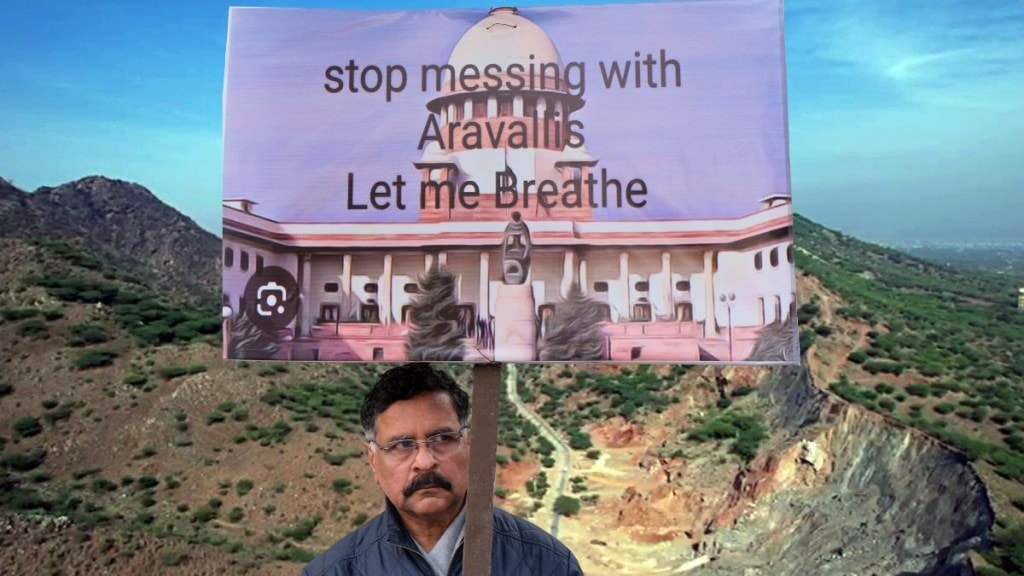
Spread approximately 600-800 km across three states (Haryana, Rajasthan and Gujarat) and one union territory (Delhi), the Aravalli hills have become one of the most serious news headlines these days. The hill, housing rich flora and fauna, has united people over the past few days who want to save it.
Why Aravalli Hills is in news
A change of definition, and a Supreme Court ruling have raised concerns over mining in the Aravalli mountain range. The opposition called it a collusion with the mining mafia, as protesters sought revising the definition to what it was.
Here’s a breakdown of what the new definition is, and why it has caused a huge ruckus. We also break down on what the Supreme Court said and the government’s clarified on the sensitive matter.
Aravalli Hills Row: All explained in 10 points
- A Committee was formed by the Ministry of Environment, Forest and Climate Change after a Supreme Court order to define hills across the Aravalli range. Since only Rajasthan had an established definition, the panel consulted the states concerned to make a uniform policy of Aravali Hills and Ranges specifically in the context of regulating mining.
- The SC raised concern over uncontrolled mining, which it said poses a “great threat to the ecology of the nation” and directed uniform criteria to safeguard them.
- The final agreement among the states was that all the landforms enclosed within the lowest binding contour encircling Hills of height 100 metre or more irrespective of their height and slopes are excluded for the purposes of grant of mining lease.
- The SC accepted the definition, beginning widespread criticism as concerns were raised around the existence of Aravalli. Environmentalists fear this could increase mining in the area, putting the core existence of Aravalli Hills at stake.
- The Aravalli mountain range spans 692 km across Gujarat, Rajasthan, Haryana, and Delhi, standing as a vital green barrier against the encroaching Thar Desert. It is 2 billion years old, and today it is fighting for its very existence, Environmental activist Neelam Ahluwalia told NDTV.
- Reports claim over 90 per cent Aravalli range falls out of the new definition. The low range-mountain of Aravalli acts as a major source for some rivers, prevents the extension of Thar desert and is rich in minerals like limestone, marble, granite, and also minerals such as lead, zinc, copper and gold.
- Refuting the concerns, Union Environment Minister Bhupendra Yadav said that with the new definition, mining will be possible only in 0.19 per cent of the area. “Mining activity in the Aravalli range will only be possible in 0.19 per cent of the area, which is less than one per cent, and even there, no new mines have been opened… This process has been made stricter. The main problem in the Aravalli range is illegal mining,” he told ANI.
- Addressing the issue, the government, through a release, said that Aravali range has been explained as all the landforms which exist within 500 metres of two adjoining Hills of height 100 metre or more. All landforms existing within this 500 metre zone irrespective of their height and slopes are excluded for the purposes of grant of mining lease, it said. The government said it is not apt to conclude that mining is permitted in all landforms below 100 metre height.
- Stating that the SC appreciated the Ministry of Environment’s Green Aravalli Wall movement, Yadav said the geologists worldwide accept a standard definition by Richard Murphy: that a hill that is 100 meters’ high is considered a mountain. Its height alone doesn’t define it as a mountain. From the height to the ground level, the entire 100 meters is protected, 90 per cent of the area is protected, he added.
- The minister further said that for new mining, the Supreme Court’s plan is that there will be a scientific plan first and ICFRE will be involved. “There can be no alternative; therefore, the Aravalli range needs protection. Just planting trees all around is not enough; this ecology includes grass, shrubs, and medicinal plants, which are part of an ecological system,” the minister clarified.