



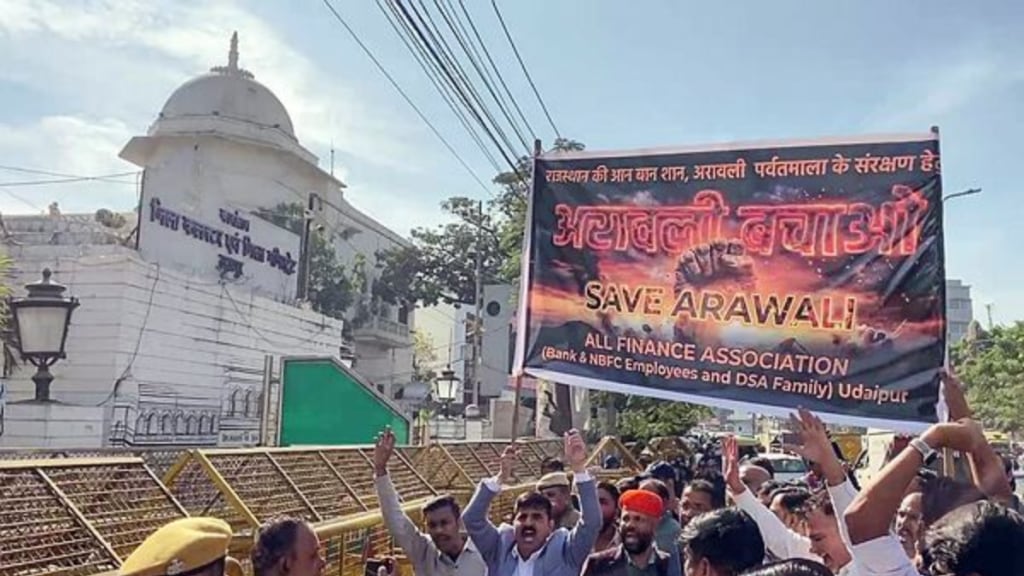
Amid a row that erupted over the revised definition of the Aravalli hills, the government on Monday assured that mining is not allowed in the NCR region. Union Minister for Environment, Forest and Climate Change Bhupender Yadav went on to highlight that the Green Aravalli have seen significant growth over the past few years under the leadership of Prime Minister Narendra Modi. But while the government insisted that the “Aravallis remain under robust protection”, it did not address the Environment ministry’s contested submissions to the Supreme Court or the threats facing the Aravallis other than mining, all of which have severe environmental ramifications, according to The Indian Express.
The Aravalli Hills and Ranges are among India’s oldest geological formations, stretching from Delhi through Haryana, Rajasthan, and into Gujarat. Historically, they have been recognised across 37 districts by state governments, with their ecological role noted as a natural barrier against northern desertification and a protector of biodiversity and water recharge.
Under the new definition, any landform that is at an elevation of 100 metres or more above the local relief will be considered as part of Aravalli Hills. The proposed 100-metre benchmark and the use of ‘local profile’, environmental groups argue, could leave many hillocks and ridges vulnerable. They point out that any activity in the Aravalli range – which is among the oldest mountain systems in the world – could weaken its role as a natural barrier against desertification and worsen environmental risks for the Delhi-NCR region, including dust pollution, groundwater depletion and rising temperatures.
Responding to these concerns, the Ministry of Environment has said it would be wrong to conclude that landforms below 100 metres are automatically available for mining. According to the Centre, the definition protects the entire hill landform, including its base, slopes and associated features, based on contour mapping rather than absolute height alone.
Citing statistics, Bhupender Yadav, who heads the ministry, said that Ramsar sites in the country have climbed from only 24 in 2014 to 96 under the BJP-led NDA government.
“Under the leadership of the Prime Minister, the Green Aravalli Movement and issues related to Green Aravalli have been advanced in recent years. This is why, in 2014, there were only 24 Ramsar sites in this country; the number has now increased to 96, and among these, the Ramsar sites of Sultanpur, Bhindawas, Asola, Siliserh, and Sambhar in the Aravalli region were declared during our government’s tenure…” he said.
He also noted that the judgment regarding Aravalli Hills states protection, especially in Delhi, Haryana, Gujarat, and Rajasthan.
Under the new definition, any landform that is at an elevation of 100 metres or more above the local relief will be considered as part of Aravalli Hills. The
proposed by a committee under the Environment Secretary and approved by the Supreme Court on November 20,
But the 100-metre benchmark and the use of ‘local profile’, the immediate surroundings of a hill, as the measuring base rather than a standardised baseline such as the state’s lowest elevation would result in a very significant part of the Aravalli range not being counted as Aravalli any more.
What remains protected
Parts of Aravallis are designated as tiger reserves, and eco-sensitive zones and hence remain out of bounds for mining or development, unless permitted specifically under the relevant wildlife and forest Acts, irrespective of their status as Aravalli Hills, The Indian Express reported.
But despite such protection, Sariska tiger reserve was at risk of Rajasthan‘s attempt to “rationalise” its boundaries – a move that would have allowed mining now barred in the vicinity of the reserve limits, The Indian Express reported.
It may be noted that the new Aravalli benchmark does not exclude all landforms under a 100-metre elevation from the range. It identifies all landforms rising at least 100 metres from the local profile as Aravalli Hills. Only when two such hills are less than 500 metres apart that the intervening stretch — irrespective of its elevation — that they will be counted as part of the range, the Indian Express reported.
What is excluded
The revised definition, however, excludes large tracts identified as part of the Aravalli range under the Forest Survey of India’s (FSI) 3-degree slope formula which counts all areas above the minimum elevation of an Aravalli state — 115m in case of Rajasthan — with a slope of at least 3 degrees as Aravalli, according to the Indian Express report.
Besides, a number of districts across Gujarat, Rajasthan, Haryana and Delhi have been dropped from the list of 34 Aravalli districts, the report said.
These include Rajasthan’s Sawai Madhopur district. Located at the convergence of the Aravalli and the Vindhya hill ranges, Sawai Madhopur district is famous for the Ranthambhore tiger reserve. Chhitorgarh district, famous for the fort built on a high Aravalli outcrop and a UNESCO World Heritage Site, is also not part of the list. Rajasthan’s Nagaur district, where the Forest Survey of India identified 1,110 sq km as Aravalli, is also excluded, according to The Indian Express.
The Supreme Court has accepted the Centre’s definition of the Aravalli hills, which states that “any hills in the range with an elevation of less than 100 metres are not subject to the strictures against mining.” The apex court also accepted the recommendations for sustainable mining in the Aravalli Hills and the steps to be taken for preventing illegal mining.
The Union Environment Ministry has also issued a detailed clarification, stating that no new mining leases will be allowed until a comprehensive study is undertaken, in line with the Supreme Court’s November 20 order.
With the definition now operational, the court has ordered that no new mining leases be issued until the MPSM is finalised, a move officials say serves as a preventive measure against immediate ecological damage.
The Aravalli range is a 670-kilometre-long mountain range in northwestern India. The highest elevation in the range is 1,722 metres.
The highest peak of the range is known as Guru Shikhar, in Mount Abu, Rajasthan.
The Aravalli range is the oldest fold-mountain belt in India, dating back around 2 billion years.