



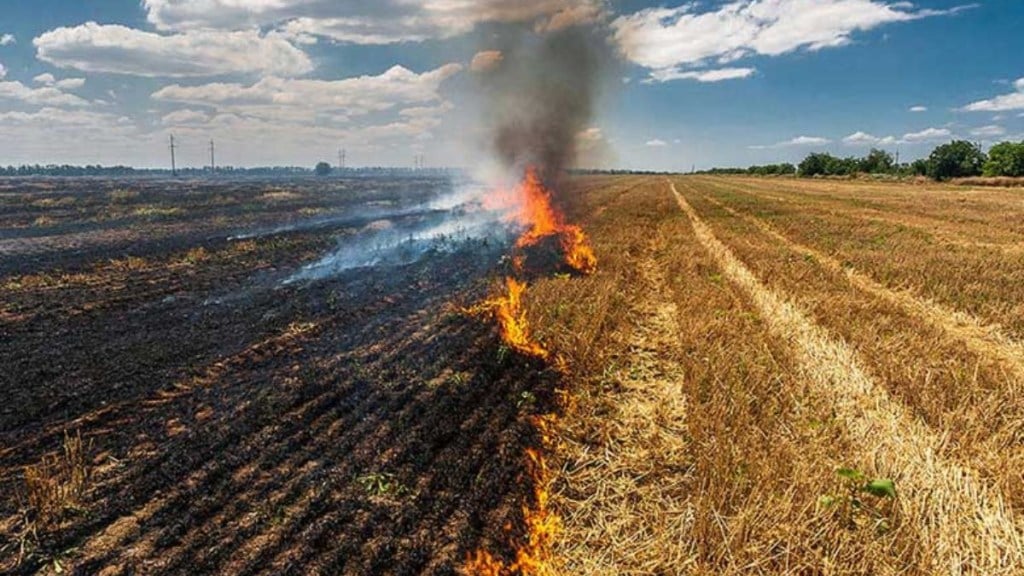
More than 90% of large farm fires in Punjab and Haryana in 2024 and 2025 are undetected by the official monitoring systems as farmers are shifting stubble-burning activities to late afternoons, according to a report published on Monday.
The stubble-burning status report 2025 by the International Forum for Environment, Sustainability and Technology (iFOREST) stated this led to a major underestimation of the contribution of stubble burning to Delhi’s air pollution this year.
The report has stated that the government’s current monitoring protocol, run by the Consortium for Research on Agroecosystem Monitoring and Modeling from Space (CREAMS) of the Indian Agricultural Research Institute, is unable to detect most farm fires as it relies mainly on polar-orbiting satellites that observe India only between 10:30 am and 1:30 pm.
Why was Stubble burnings to Delhi pollution underestimated
“The contribution of stubble burning to Delhi’s air pollution was highly underestimated this year because Moderate Resolution Imaging Spectroradiometer (MODIS)/ Visible Infrared Imaging Radiometer Suite (VIIRS) are NASA satellites which captured only a small fraction of active fire counts,” according to the report.
The report stated that the current system’s dependence on polar-orbiting satellites, which observe the landscape only at fixed times of the day, has become a structural limitation as farmers shift their burning practices. According iFOREST, Spinning Enhanced Visible and InfraRed Imager’s (SEVIRI) 15-minute observations clearly show that the majority of large farm fires now occur after 3:00 pm, beyond the overpass times of polar satellites.
What did Chandra Bhushan say?
“Our analysis provides incontrovertible evidence that India’s current stubble-burning monitoring system is structurally misaligned with ground realities,” Chandra Bhushan, CEO, iFOREST, said. “Farmers have shifted burning in late afternoon, while our monitoring relies on satellites that capture active fires only during a narrow time window (10:30 am to 1:30 pm),” he said.
The report finds real progress on the ground, with burnt areas in Punjab and Haryana falling by 25-35% over recent years.
The report said burnt-area mapping provides a more accurate picture than active fire counts, which currently suggest a much larger decline. It has stated that the government push to reduce stubble burning in Punjab and Haryana through ‘in-situ’ (management in the field) and ‘ex-situ’ (treating stubble outside the field) practices is delivering positive results.
“However, large-scale burning—around 20,000 sq km in Punjab and 8,000 sq km in Haryana—continues to significantly affect air quality in both states and in Delhi-NCR,” according to the report.
According to the CREAMS data, stubble burning this season between September 15 – November 30 saw the most significant decline at 33,028 events across northern states – Punjab, Haryana, Madhya Pradesh, Rajasthan and Uttar Pradesh compared to 78,850 events since 2021.