



Breathable air can’t be a luxury for a country aspiring to be an economic superpower. But for the millions of inhabitants of the national capital region (NCR), and several other cities in the country, the toxicity of the air they inhale is something that they feel, experience and is very palpable. They no longer need the daily nuggets of information about the rising Air Quality Index (AQI), the high PM2.5 level to appreciate the severity of the situation.
For the record, the NCR and adjoining areas invariably shifts to a spell of “very poor” or “servere” air quality with intermittent falls to the “hazardous” category, ahead of the winter onset. But the fact is during most parts of the year, except for certain short periods of heavy monsoon rains, Delhi’s air remains abysmally poor.
The authorities are reportedly going to get another study conducted to determine the relative contribution of various air pollutants, but experts contend instead of a more accurate “source apportionment,” quick, concrete action to curb the quantum of pollutants is what the city needs at this hour.
Who is the highest contributor to Delhi’s pollution nightmare?
Transport sector’s share in emissions is the highest, and serves as a sort of “critical mass” when it comes to accumulation of air pollutants. A situation similar to what NCR is now witnessing was experienced in Chinese cities like Beijing a couple of decades ago.
However, despite China being the world’s largest automobile producer and consumer, it has managed to reverse the air quality deterioration of its cities. Its multi-pronged strategy includes converting coal to gas, achieving high fuel quality, installation of sophisticated terminal treatment facilities, and strict enforcement of emission standards.
In contrast, the NCR’s planned transition into cleaner public transport and electric vehicles (EVs) to fight persistent air pollution is making only slow headway.
Delays in awarding tenders by the Delhi state government and Convergence Energy Services (CESL), owned by a few power-sector PSUs, have slowed a proposed rollout of the large batch of EVs, sources said.
Delay on E-busses and public transport
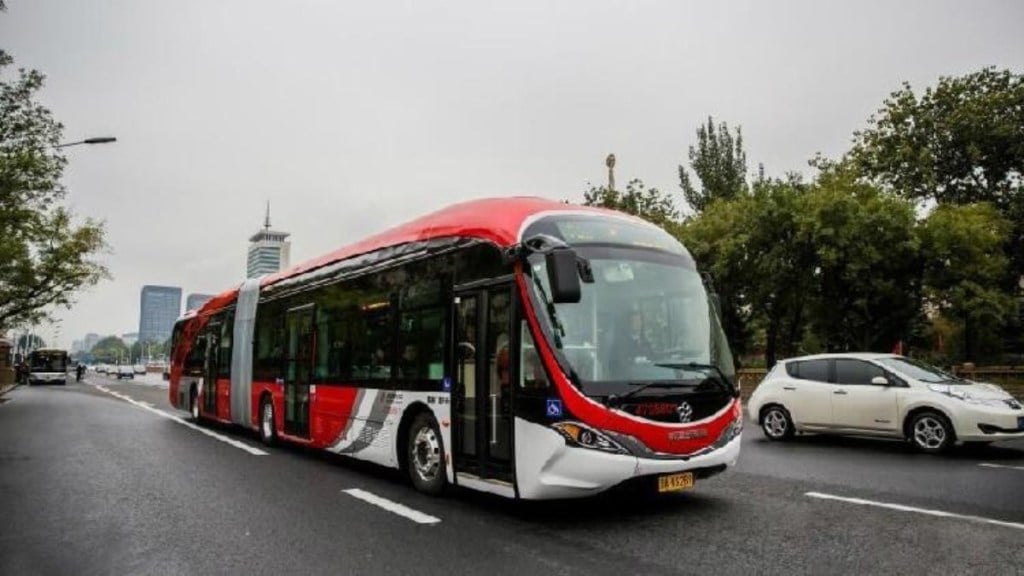
Though the Delhi government’s transport department has finalised plans to procure 5,000 new e-buses, none has hit the roads yet. “Deliveries are now expected to start only by March 2026, and full deployment may take several years”, an official source told FE, on condition of anonymity. The slowdown is despite the fact that the capital urgently needs more buses to ease road congestion and reduce reliance on private cars.
According to a Centre for Science and Environment (CSC) study last year, an estimated 1.1 million vehicles enter and exit Delhi daily, worsening the air quality. A high-level task force on air quality has stated that Delhi holds more than half of all vehicles in the NCR and 37% of vehicles in Delhi-NCR still belong to the outdated BS-I to BS-III emission norms.
Experts say that replacing the city’s entire existing bus fleet with new electric buses could cut total pollutant emissions by nearly 75%, offering one of Delhi’s most effective tools for reducing ambient pollution levels.
As of September 2025, Delhi operates 5,267 public buses, including 2,917 e-buses—with 2,517 under the Delhi Transport Corporation and 839 under the Delhi Integrated Multi-Modal Transit System cluster scheme. Transport planners have repeatedly warned that the city needs at least 11,000–12,000 buses to provide reliable and high-frequency public transport coverage. “Unlike episodic events such as farm fires or festivals, transport emissions persist throughout the year and are steadily increasing. This is why cities are increasingly feeling the burden of transport-related pollution. The solution lies in promoting walking, cycling, and zero-emission vehicles such as electric mobility,” Amit Bhatt, Managing Director-India, International Council on Clean Transportation (ICCT), told FE. Around 3,400 EV buses are currently on city roads, and the environment ministry aims to increase the fleet to over 5,000 by March, 2026.
But Delhi’s larger electric mobility story is also faltering. Despite aggressive policy attention, the adoption of electric cars remains sluggish: e-cars account for under 7.5% of new registrations in 2025, far from the levels needed to meaningfully curb the city’s vehicular emissions.
The draft Delhi EV Policy 2.0 has laid out even more ambitious goals—95% EV penetration in new registrations by 2027 and 98% by 2030. However, a reality check suggests that Delhi is already struggling. The previous policy, which targeted 25% EV penetration by 2024, achieved only 13–14%, revealing a significant implementation gap.
“More worrying is the daily synchronised rise of PM2.5 (particular matter) and other toxic gases of nitrogen dioxide (NO2) and carbon monoxide (CO) largely from vehicles and combustion sources, creating a toxic cocktail that has gone unnoticed,” Anumita Roychowdhury, executive director, CSE said. “Yet, every winter pollution control efforts is dominated by the dust control measures with feeble action on vehicles, industry, waste and solid fuel burning,” Roychowdhury said while adding that Delhi and NCR cannot hide behind the smokescreen of farm fires any more as even with much lesser contribution to local air quality this time.
The environment ministry has acknowledged that stubble burning remains an episodic yet significant contributor to winter pollution in Delhi-NCR, alongside vehicular emissions, industrial pollution, waste burning, construction dust, landfill fires, and weather patterns during early winter months.