



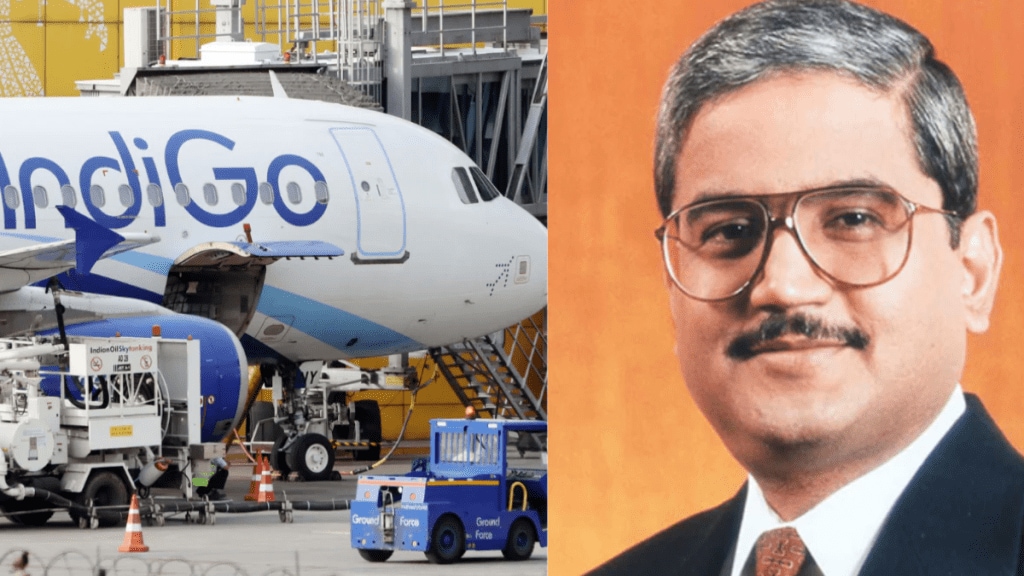
IndiGo, the airline long celebrated for industrial-grade punctuality, is now confronting the very lapses it was engineered to avoid. Through December, its on-time performance sank to 19.7%, more than 4,000 flights were cancelled, and airport terminals were filled with stranded passengers. For an airline that once ran on stopwatch discipline, the breakdown has raised an unsettling question: has IndiGo drifted too far from the system it was built upon?
That question inevitably leads back to the man who designed the system, Rakesh Gangwal, the co-founder who exited the company three years ago and now watches the turbulence from thousands of miles away in the United States.
Following a public spat between Gangwal and the company’s co-founder, Rahul Bhatia, Gangwal simply resigned and announced that he would become a passive investor. This would be followed by quiet block deals. By late 2025, his family trust is said to hold barely 5% of the company he had once architected from the ground up. His initial holding was well over 30%.
From boardrooms in America to a blank sheet in India
Born in 1952 in Kolkata, he studied mechanical engineering at IIT Kanpur before earning an MBA from the Wharton School. His professional life unfolded almost entirely in the United States, where he rose to senior planning roles at United Airlines, became President and CEO of US Airways, and later led the travel technology firm Worldspan as Chairman and CEO. By the time he turned his attention to India, he had already run one of the world’s largest carriers.
In 2005, he partnered with Rahul Bhatia, the head of InterGlobe Enterprises. The contrast between the two men was stark. Bhatia was the local executor, politically connected, fluent in regulation and negotiation. Gangwal was the strategist, data-driven, and operationally rigid.
His condition for joining was non-negotiable: the airline would follow a strictly low-cost, operationally ruthless model. It would not attempt to emulate full-service carriers that had already begun to collapse under debt. The airline’s only true product, he believed, was time.
Not just an airline
What emerged was not merely a budget airline but a financial and operational engine.
Gangwal’s most consequential innovation was the sale-and-leaseback model. IndiGo placed massive bulk orders for aircraft, including a landmark order of 100 Airbus A320s in 2005, securing deep manufacturer discounts. On delivery, the aircraft were immediately sold to global lessors at higher market prices and leased back. The transaction often generated cash profits on the first day. IndiGo, unlike its competitors, remained asset-light and debt-free from inception.
He imposed a six-year fleet cycle, returning aircraft before expensive heavy maintenance checks were due. The result was one of the youngest fleets in global aviation, fuel-efficient, reliable, and largely insulated from grounding risks.
Standardisation became the organising principle of everything else. For over a decade, IndiGo flew only one aircraft family. Any pilot could fly any plane. Any engineer could fix any aircraft. Under Gangwal’s direction, luxury service was rejected, hot meals, and even fancy upholstery were viewed as distractions from the airline’s only essential promise to have predictable operations at the lowest possible cost.
By 2019, IndiGo controlled more than half of the domestic aviation market. Its competitors, burdened by debt, mixed fleets, and expensive service ambitions, steadily fell away.
The rupture
The breakdown did not begin quietly.
In July 2019, when Indigo was flying sky high, Gangwal wrote to the Securities and Exchange Board of India alleging serious failures of corporate governance. The dispute centred on related-party transactions involving contracts awarded to companies linked to Bhatia without competitive bidding. In his most quoted line, he wrote that “Even a paan ki dukaan (paan shop) follows some governance.”
According to Bloomberg, Rakesh Gangwal accused Rahul Bhatia of exercising what he termed “unusual controlling rights” that allowed him to dominate board decisions and push through related-party transactions without adequate checks.
Bhatia, in turn, argued that Gangwal was attempting to dilute the shareholder agreement that secured InterGlobe Enterprises’ control over the airline. Bloomberg reported that Bhatia accused his co-founder of seeking to undermine this structure, even as Gangwal insisted he had no intention of taking control.
The public clash rattled investors, wiping out nearly $1 billion in market value in a single session, and raised fears that a prolonged boardroom battle could distract IndiGo at a time when India’s aviation sector is under pressure from rising fuel costs and intense competition.
How the company responded to Gangwal’s allegations
When the allegations unfolded, IndiGo’s management pushed back firmly against Gangwal’s allegations, telling shareholders that related-party transactions were both immaterial and compliant, according to an ET report.
As per the report, CEO Ronojoy Dutta said such transactions totalled Rs 156 crore in the previous fiscal, less than 1% of IndiGo’s Rs 30,000 crore revenue, and were all conducted at arm’s length with audit committee oversight. He also denied the existence of any whistleblower complaint, countering Gangwal’s claim of governance lapses tied to dealings with InterGlobe Enterprises.
Though Gangwal did not attend the AGM, he voted in favour of all resolutions, including amendments to the Articles of Association after initially objecting that the new structure strengthened Rahul Bhatia’s control. Shareholders questioned the fallout from the dispute, with some calling the controversy “unfortunate,” while Bhatia closed the meeting, saying the matter was settled and adding, pointedly, that he hoped Gangwal would “walk the talk.”
As things stand today, Bhatia and his sons now oversee IndiGo’s operations through InterGlobe, with the promoter group firmly in charge of the airline’s direction.
The silent exit
What followed was one of the most methodical ownership exits in Indian corporate history.
From 2022 to 2025, Gangwal sold down most of this 37% stake through institutional block deals, avoiding any abrupt market shock. There were no public interviews or any commentary on the strategy.
By late 2025, he had realised more than $5 billion from his exit and effectively transitioned from promoter to minority investor.
In 2024, he joined the board of Southwest Airlines in the United States. By late 2024, amid pressure from activist investors, he was elevated to Chairman of the Board. In 2025, he stepped down from the chairmanship but remained on the board, leading the fleet oversight committee, returning to operational work.
Gangwal held 3.61 million Southwest shares, equal to a 0.7% stake, which made him the airline’s largest individual insider shareholder, controlling 64% of all insider-held shares, as per the Telegraph. He was estimated to have made $4–$6 billion from selling down his IndiGo stake and was still believed to hold around 5% of the airline, the report said.
After the architect
IndiGo continued to grow rapidly after his departure. By mid-2025, its fleet had expanded to more than 430 aircraft. Growth, once engineered cautiously under Gangwal, became faster and more aggressive. According to industry observers cited in a TOI report, the airline added aircraft without a proportionate expansion of trained pilots, spare crews, or operational buffers that Gangwal had always insisted were essential.
As per the data given by DGCA, the pilot and co-pilot count in FY21 was 3,734, while in FY20, it was 4,017. The pilot count post-Gangwal was 4,407 for FY23 and 5,038 for FY24. According to data by Statista, Indigo bought a total of 540 commercial jets from Boeing and Airbus in 2023 and 2024.
When regulatory changes to pilot duty norms and weather disruptions struck in December 2025, the system fractured. Over 4,000 flights were cancelled, on-time performance hit a low, passengers were stranded, and ground staff had their hands full.
A departure without closure
Gangwal built India’s most profitable airline without being a resident of the country. He imposed a philosophy that rejected glamour in favour of mathematics. He turned aircraft into liquid financial instruments. And then, when the governance structure no longer matched his principles, he chose not to fight publicly for control but to exit privately. As of today, Gangwal’s net worth stands at $5.6 billion as per Forbes.
The airline still carries millions of passengers. The logo still fills Indian skies. But the architect who once enforced every invisible margin has already moved on with no intention of returning.