



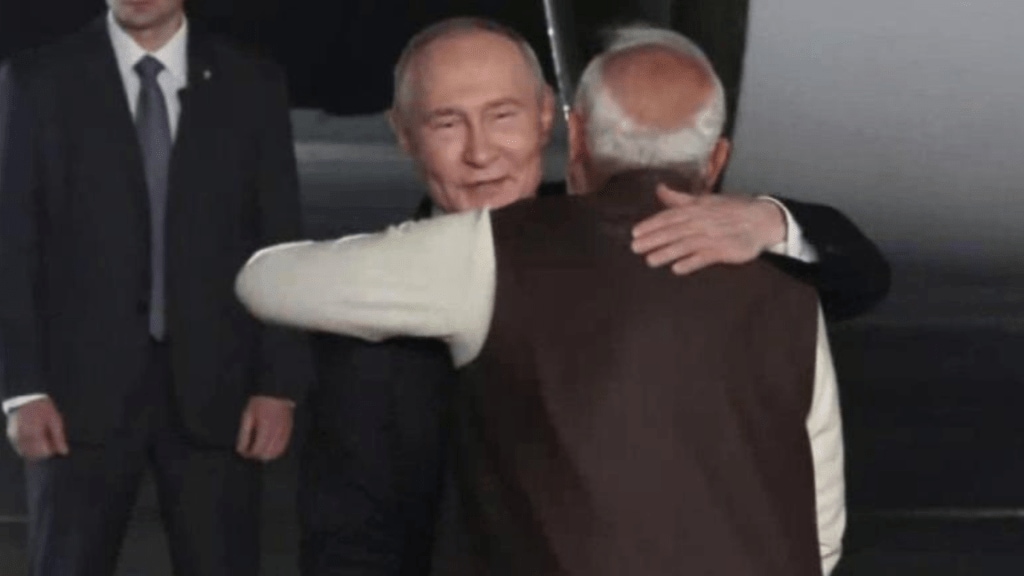
Russian President Vladimir Putin began his 27-hour visit to India Thursday evening, amid expectations the two countries will seal a clutch of agreements during his short stay here, re-defining bilateral trade and investment ties.
Even as the US sanctions have cast a cloud over Russia’s sales of crude to India, the two sides are likely to agree to a plan to rejig energy trade. Moscow will also explore ways to buy more Indian goods to cut the huge trade deficit – about $60 billion annually –suffered by New Delhi.
Deals on missile systems, fighter jets and small modular reactors for nuclear energy are also expected to be signed on Friday at the 23rd India-Russia annual summit. A bilateral contract may be finalised under which India would undertake to buy more S-400 air defence missile systems from Russia, adding to the competent fleet of five purchased by it under a $5 billion deal signed in 2018. The plan to sign a new S-400 contract is despite the chances that it also might attract US sanctions.
Russian Sberbank and JSC First Asset Management launch First-India MF
On Thursday, Russia’s largest bank Sberbank and JSC First Asset Management launched a new mutual fund — First-India — offering investments linked to the performance of the Nifty50 index, in what could give Russian retail investors direct exposure to India’s buoyant stock market. The bank, which has just two branches in India at present, is also gearing up to expand its presence in India by opening eight more branches soon, and establish a wholly owned subsidiary (WOS) in two to three years.
Putin’s India visit, the first since the war began in Ukraine, will also see a pledge by Russia to increase harmonisation of standards and reduction of regulatory barriers to enable higher India exports. The two countries are eyeing bilateral trade worth $100 billion by 2030, up from about $69 billion in 2024-25. “It (bilateral trade) is very skewed and needs to be more balanced. We need to bring more diversity in our trade basket. We will work collectively to reduce and eliminate the trade barriers,” Commerce and Industry minister Piush Goyal said at the India-Russia Business Forum meeting here on Thursday, shortly ahead of the Russian President’s arrival.
Deputy Kremlin Chief of Staff Maxim Oreshkin on India-Russia summit
A Russian delegation consisting of business representatives arrived here with “a specific goal” to lay the road map for buying more Indian goods and services. “We want to significantly increase their purchases (from India),” Deputy Kremlin Chief of Staff Maxim Oreshkin said.
Prime Minister Narendra Modi hosted a dinner in honour of the visiting leader just a couple of hours after the latter touched down on the Palam military airbase. The Indian and Russian sides are also likely to discuss New Delhi’s proposed free trade agreement with the Eurasian Economic Union, sources said.
On Tuesday, Kremlin spokesman Dmitry Pescov said at a press conference that while Delhi’s purchase of crude oil from Russia might decline for “a brief period” in view of the stricter US sanctions on Lukoil and Rosneft , Moscow is taking steps to enhance the supplies. Washington maintains a whopping 50% additional tariff on Indian goods, half of it linked to New Delhi’s procurement of Russian oil.
In July last year, Modi travelled to Moscow for the annual summit.
Of India-Russia trade of $ 68.7 billion in 2024-25, India’s exports were just $ 4.8 billion and imports a sizeable $ 63.8 billion. Of the inward shipments, oil imports, which skyrocketed in recent years, accounted for $56.8 billion in the last fiscal year. After the US imposed sanctions on biggest Russian exporters – Rosneft and Lukoil — India is scaling back purchases from Russia.