



On a small smartphone screen in a tier 3 town in Uttar Pradesh, a woman scrolls through a catalogue of sarees priced lower than a movie ticket. She selects a couple of them, shares it on WhatsApp and waits. A few hours later, an order pings. For her, this is not just a sale, it is a source of income and, with that, the entry into India’s vast digital economy.
This is the world Meesho built.
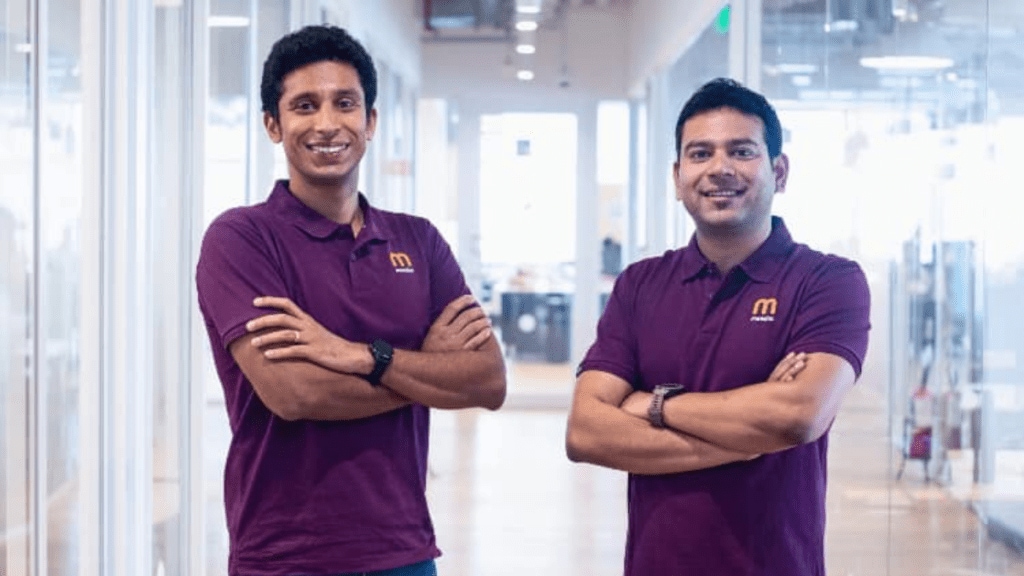
Founded in 2015 by Vidit Aatrey and Sanjeev Barnwal, two IIT Delhi graduates, Meesho did not begin as the e-commerce giant it is today. Its first version was a hyperlocal fashion app called Fashnear, designed to connect users with nearby fashion retailers.
In an interview, Vidit Aarey said, “Tried this for about three, four months, very quickly realised that people do not buy fashion the same way they buy food. People are looking for a lot of selection, which is not available with a few shops around you. When people in India buy online, especially fashion, they’re looking for discounts that are not available until the end of the season.” The founders knew they had to start again.
During groundwork, the founders noticed women selling clothes through WhatsApp and Facebook within their social circles. That insight led to a full pivot, and Fashnear became Meeshomeesho, short for ‘Meri Shop’. The company repositioned itself as a platform where anyone could start an online business with zero investment. There is no need for an inventory or a storefront, just a phone and a network.
The Silicon Valley validation
Its breakthrough came in 2016 when it was selected for Y Combinator, the Silicon Valley startup accelerator. Meesho entered their summer batch and raised $120,000 in seed funding. By 2019, Facebook made an investment of $25 million in Meesho, valuing the company at $700 million, as per Tracxn. By 2024, it had reached a valuation of $3.9 billion after raising $275 million in Series F funding. The latest funding was done in 2025 for an undisclosed amount, as per Tracxn data.
While Amazon and Flipkart chased urban customers with speed and scale, Meesho looked elsewhere. It focused on Tier 2 and Tier 3 markets. It was built for users who were new to online shopping and more comfortable speaking regional languages. Today, around three-fourths of Meesho’s orders come from these smaller cities, with average order values standing at Rs 269.36 in the three-month period that ended in June, as per a Business Standard report.
Zero commission wild card
Meesho did what its competitors wouldn’t. It scrapped commissions.
While Amazon and Flipkart charged sellers anywhere between 2% and 20%, Meesho allowed them to retain the entire product value, excluding shipping costs. This helped it attract over 1.3 million sellers as of 2023, with plans to scale that to 10 million by 2027.
This model turned pricing into its core advantage. As per the company, around 65% of Meesho’s products were priced 20–30% lower than rival platforms. It also meant that over 80% of its sellers were first-time e-commerce participants, coming from smaller towns and rural regions.
By 2021, the platform had enabled nine million women to start businesses, many balancing household responsibilities with digital storefronts. To make the platform accessible, it added eight regional languages and translated over 33,000 terms to make the interface more intuitive for new internet users.
The cash game
For years, Meesho operated in a market known for cash burn and endless funding rounds. Yet, in recent times, it achieved what few consumer internet companies in India have managed. Revenue grew from Rs 5,735 crore in FY23 to Rs 9,389 crore in FY25, as per Inc42. Losses narrowed sharply. The company reduced its monthly cash burn by 90% in two years and achieved profitability.
Adjusted losses narrowed from Rs 1,671 crore in FY23 to Rs 108 crore in FY25, as per Inc42. Furthermore, as per Meesho’s website, its annual transacting users touched 187 million in nine months ending in December 2024. Meesho also became the most downloaded shopping app for four consecutive years.
Valmo’s entry
Logistics, often the weakest link in Indian e-commerce, became another area of control. Through Valmo, its logistics marketplace, Meesho built a system that reduced per-order delivery costs and handled close to a million shipments a day.
It covers more than 15,000 pin codes and is supported by 6,000 logistics partners. Logistics costs per order have fallen from Rs 50.45 in FY23 to Rs 37.70 by Q1 FY26, making Valmo roughly 5% cheaper than traditional logistics providers. This focus on cost efficiency allowed Meesho to profitably ship even low-value products like Rs 99 home decor items across thousands of pin codes.
Meesho also introduced Varsha, a generative AI-powered voice bot, capable of handling customer calls in noisy environments and resolving 95% of queries without human support. This cut call costs by 75% and improved customer satisfaction by 10%, as per Business Standard.
The public market
Meesho is now preparing for an IPO. The e-commerce firm is raising Rs 5,421 crore in IPO through a combination of 38.29 crore fresh shares worth Rs 4,250.00 crores and an offer for sale of 10.55 crore shares of Rs 1,171.20 crores. The price band is of Rs 105-111 per share, valuing Meesho at Rs 50,096 crore, which is around $5.6 billion, at the upper end.
targeting a valuation of around Rs 52,500 crore. The public issue will include a fresh issue of Rs 4,250 crore and an offer for sale by existing shareholders. The company has also moved towards corporate restructuring to enable domestic listing.
The strategy behind Meesho’s rise
Meesho’s core strategy rests on four pillars: affordability, seller empowerment, logistics innovation and deep localisation. Unlike competitors that focused on urban convenience, Meesho built a platform for India’s mass market, first-time buyers, budget-conscious households and micro-entrepreneurs.
Yet challenges remain. Around 75% of orders are still cash-on-delivery, increasing the risk of failed deliveries and cash recovery delays. Dependence on small sellers also exposes Meesho to risks around compliance, quality control and fulfilment standards.
Still, the company’s footprint is difficult to ignore. By 2024, nearly 13% of India’s population, about 187 million people, had made at least one purchase on Meesho. It now processes close to 1.3 billion orders annually, positioning itself not merely as a low-cost marketplace, but as an infrastructure layer for mass digital commerce