



IMF is of the view that India’s national account statistics are based on the outdated base year of 2011-12, which makes the GDP estimates unrepresentative of today’s economy. However, the IMF has retained the grade for India’s national account statistics, or GDP data, in the overall Data Adequacy Assessment.
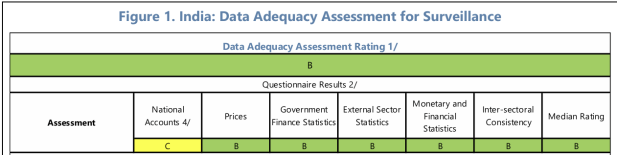
In its annual staff report for India for 2025, in accordance with Article IV, the IMF on the 26th announced it retains a ‘C’ grade for India’s national account statistics, or GDP data. The Median Rating of the overall Data Adequacy Assessment was a ‘B’ grade.
This raises concern, following the announcement of the increase in the Q2 of FY 2025-26 GDP growth rate, the highest since Q3 of FY 2023-24, as to how accurately this data is being collected.
What is the significance of a ‘C’ grade?
Within the IMF’s Article IV Consultations, the Staff assigns grades ranging from A-D across multiple categories – National Accounts (GDP Data) , Prices (CPI, WPI, PPI etc.), Government Finance Statistics (Revenue, Expenditure, Public Debt etc.), External Sector Statistics (Balance of Payments, FDI Inflow/Outflow etc.), Monetary and Financial Statistics (Money Supply, Interest Rates etc.), Inter-sectoral Consistency (Consistency across categories).

India received a Median Rating of ‘B’ however received a ‘C’ in National Accounts indicating shortcomings in data collection pertaining but not limited to Production, Output, Expenditure and Income across economic agents such as Households, Corporations etc., the major reasons which lead to the lack of adequate data are:
- One of the primary concerns of the IMF is the outdated base year of 2011-12, which makes the GDP estimates unrepresentative of today’s economy.
- Lack of Producer Price Indices (PPIs) and overreliance on single deflation leading to cyclical bias.
- Weak Coverage of the Gray Economy.
- Insufficient detail for key components such as Gross Fixed Capital Formation (GFCF).
India’s Rating in other Categories amidst pending MoSPI revision
The IMF evaluated India’s Data as ‘B’ in every category barring National Accounts meaning the data provided is “broadly adequate for surveillance.”
However, the IMF does note issues which are to be improved to elevate India to an ‘A’ Rating in the future.
- Due to the outdated base year in the CPI (2011-12), the basket doesn’t reflect modern-day spending habits.
- Consolidated Central + State Government fiscal data hasn’t been published since 2019 (for FY2015-16).
- Mismatch between BoP, trade data and related datasets
- Discrepancies between production and expenditure GDP
The MoSPI revision will prepare India for an elevated rating when the IMF publishes its staff report in late-2026 as the updated base year for CPI and GDP along with improved price collection technology will improve the granularity of the data available.
What does the IMF consider as ‘National Accounts’?
The IMF uses national accounts to measure economic activity based on the System of National Accounts 1993 (SNA 1993) was created collaboratively by the United Nations, the IMF, the World Bank, the OECD and Eurostat. The purpose and motive behind the SNA 1993 were to create an international standard for compiling national economic and accounting statistics. The SNA effectively integrates classical and neo-classical economic thinkers’ concepts of economic strengths such as Smith’s ideas of National Wealth and Keynes’ newer approaches of Economic Flows.
Grades Received by Competing and Developing Economies similar to India
- United States of America – A (2024)
- United Kingdom – A (2025)
- China – C (2024)
- Japan – A (2025)
- Brazil – A (2025)
- Indonesia – B (2024)
Apart from China, nearly every single Member-State which is a competitive or comparable economy to India has obtained a better grade. India having the same grade as an officially authoritarian regime outlines the negative international effects that India faces due to the nation’s inability to provide accurate data.