



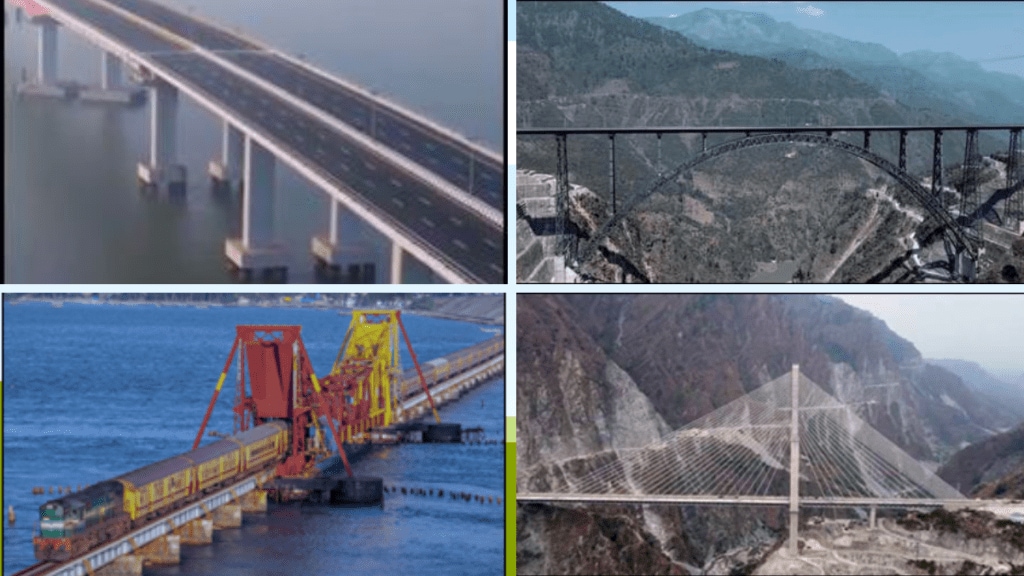
From storm-lashed coastlines to deep Himalayan gorges, India’s bridges stand as enduring symbols of engineering ambition and national integration. Built across some of the country’s most unforgiving terrain, these structures do far more than span rivers or valleys, they connect regions once separated by geography, climate and isolation. Each bridge carries a story shaped by difficult landscapes, technological innovation and the persistence of thousands of engineers and workers.
Together, these projects underline how infrastructure has become central to India’s growth narrative, transforming mobility, trade and everyday life in ways often taken for granted.
Bridges That Redefined Urban and Coastal Connectivity
Atal Bihari Vajpayee Sewri–Nhava Sheva Atal Setu
Rising across the Arabian Sea, the Atal Bihari Vajpayee Sewri–Nhava Sheva Atal Setu, popularly known as the Mumbai Trans Harbour Link (MTHL), represents a landmark shift in Mumbai’s transport landscape. Designed to decongest the island city, the sea bridge provides a direct and faster connection between Mumbai and Navi Mumbai, dramatically cutting travel time across the harbour.
Spanning 16.5 kilometres over water and another 5.5 kilometres on land, the project is India’s longest sea bridge. Built with advanced safety systems and modern construction techniques, it offers improved driving conditions and reduced accident risks. Beyond easing daily commutes, the bridge has strengthened logistics movement, supported industrial growth and boosted tourism in surrounding regions. Approved at a cost of Rs 17,843 crore, the project remained on schedule even through the disruptions of the Covid-19 pandemic.
Chenab Bridge
India’s engineering capabilities reached a historic milestone with the completion of the Chenab Bridge, now the world’s highest railway arch bridge. Towering 359 metres above the Chenab River, the structure rises even higher than the Eiffel Tower and has emerged as both a critical transport link and a global engineering landmark.
Part of the Udhampur–Srinagar–Baramulla Railway Link (USBRL), the 1,315-metre-long steel arch bridge has been designed to withstand wind speeds of up to 260 kmph and is expected to last 120 years. Built at a cost of Rs 1,486 crore, it was constructed amid extreme weather, unstable terrain and frequent rockfalls. Once Vande Bharat trains operate on the route, travel time between Katra and Srinagar is expected to reduce to around three hours, significantly improving access to the Kashmir Valley.
Anji Khad Bridge
Another critical link in the USBRL project is the Anji Khad Bridge, India’s first cable-stayed railway bridge. Located in the Himalayan region between Katra and Banihal, the bridge stretches 725 metres across a deep gorge, rising 331 metres above the Anji River valley.
Its most striking feature is a 193-metre-high inverted Y-shaped pylon supported by 96 high-tensile cables and reinforced with over 8,200 metric tonnes of structural steel. Built in challenging geological conditions marked by unstable rock formations, the project required extensive slope stabilisation to protect the fragile mountain ecosystem. Completed in just 11 months, the bridge is designed to withstand seismic activity and plays a key role in strengthening rail connectivity between Jammu and Kashmir and the rest of the country.
New Pamban Bridge
Connecting Rameswaram to the mainland, the new Pamban Bridge has set a global benchmark as India’s first vertical lift railway sea bridge. Stretching 2.07 kilometres, the structure includes a 72.5-metre lift span that can rise 17 metres to allow ships to pass without disrupting train services.
Built at a cost exceeding Rs 700 crore, the project faced significant challenges, including strong currents, cyclones, seismic risks and tight tidal windows for construction. Advanced materials such as stainless steel reinforcement, fully welded joints and specialised protective coatings have been used to ensure durability in harsh marine conditions. The bridge has also been designed with provisions for a second railway line, supporting future traffic growth.
Dhola–Sadiya Bridge
In India’s northeast, the Dhola–Sadiya Bridge, officially named the Bhupen Hazarika Setu, plays a vital strategic and economic role. Stretching 9.15 kilometres over the Lohit River, a major tributary of the Brahmaputra, it provides the first permanent road connection between Assam and Arunachal Pradesh.
Designed to carry 60-tonne military tanks, including the Arjun and T-72, the bridge enhances both civilian mobility and defence logistics. By linking Dhola in Assam’s Tinsukia district to Sadiya in Arunachal Pradesh, it has significantly reduced travel time and strengthened regional integration.
More Than Steel and Concrete
Across the country, bridges such as the Bogibeel Bridge and New Saraighat Bridge in Assam and the Digha–Sonpur Bridge over the Ganga in Bihar continue to reshape mobility through rail-cum-road connectivity. Together, these structures reflect more than engineering progress; they signal India’s determination to overcome natural barriers and expand opportunity.
As India pushes ahead with infrastructure development, its bridges remain powerful expressions of a nation in motion, spanning landscapes, linking communities and steadily building pathways toward the future.