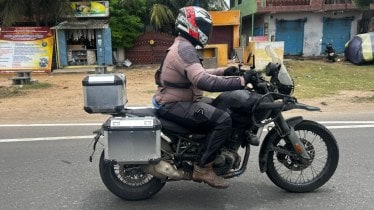
Most leisure riders—from motorcycle riding clubs of Delhi NCR that I regularly interact with—claim the Royal Enfield Himalayan to be the most comfortable motorcycle in its segment. But while it is easy on day-long rides, how does it fare on cross-country rides? We recently rode it to Spiti and Ladakh from Delhi, as part of the Himalayan Odyssey 2022.
The ride
Its 411cc engine (24.3bhp, 32Nm) ensures the acceleration (0-60 km/h) is effortless, but gradual. However, it’s the 40-100 km/h acceleration, even in fourth gear, where the Himalayan appears to come in its element, be it a plain highway or a winding uphill road.


Riding position
It’s a tall motorcycle, so straddling it may not be easy for everybody. But once on it and riding, it’s like a toy. At over 190 kg, the Himalayan is heavy, and if you get stuck in sand or urban traffic where you have to put your feet down, it can tire you.
Carrying luggage
For this long ride, I secured my bag with bungee ropes on the rear seat. There are enough points to secure the bungee hooks. The new rear carrier ensures you can place longer bags on the rear seat.

Fuel efficiency
On this entire ride (mostly constant 80 km/h in the plains and 60 km/h in the hills), the Himalayan returned overall fuel economy of 42 km/litre (it consumed 43 litres of fuel, for travelling 1,800 km).
Things missing
The thermometer on the trip computer doesn’t show the right temperature. Maybe the reason is the sensor is located near the engine and takes up some heat from there. Also, most people use the Himalayan for riding to the hills, and yet it doesn’t have an altimeter! Even though the Himalayan is a motorcycle that one can take to the Himalayas or to the corner grocery store with equal ease, there are a couple of things that can be improved—starting by fitting an altimeter on it.