



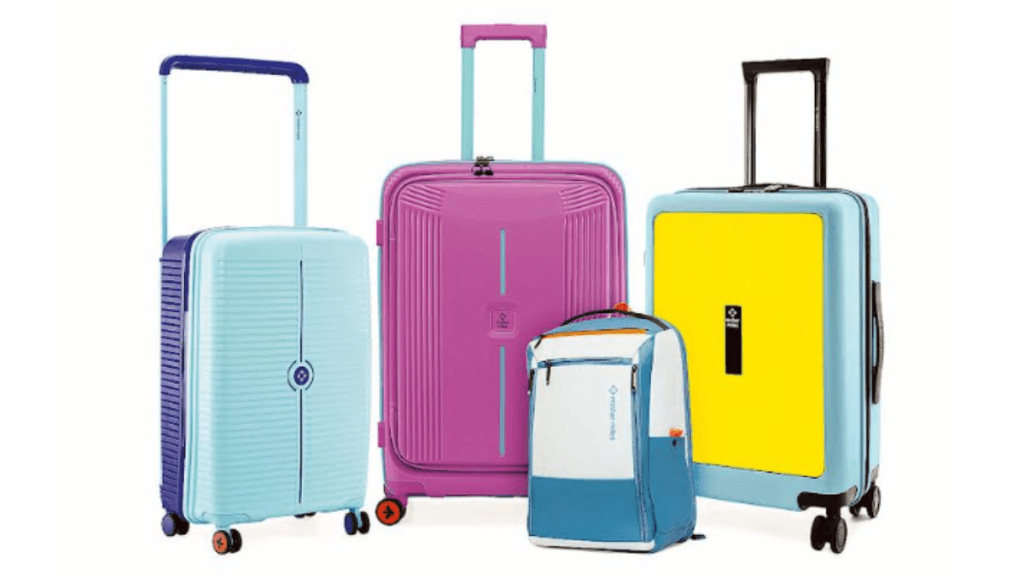
In a category dominated by utility-first players, Nasher Miles saw an opportunity in colour, design, and self-expression. What it did not expect, however, was that a channel built for groceries and everyday essentials would one day become its fastest-growing revenue engine. “Our quick commerce today happens to be our fastest-growing channel,” says Abhishek Daga, founder & chairman of Nasher Miles. “The new generation has surprised us with the way they think and do things. ”
From a Rs 2 crore turnover in 2017, Nasher Miles is now nearing Rs 150 crore, with quick commerce contributing around 9-10% of its overall sales. The pace of growth on the channel is accelerating. “More than 100% year on year,” Daga says, noting that while the base is small, the growth curve is steep enough for the company to double down on the medium in the immediate term.
Fastest-growing channel
Quick commerce also aligns with the brand’s typical user: aspirational, tech-savvy, and decisive. “Our typical customer is young, between 20 to 40, residing in tier 1 or tier 2 cities,” Daga says. They are the decision-makers for family travel purchases, comfortable with online discovery and increasingly with big-ticket instant buys. “The quick commerce customer is an Amazon customer who now wants speed and convenience,” he adds.
The model works because consumer behaviour has changed faster than the category, say experts. “Travel habits have changed after the pandemic and people don’t plan as early anymore,” says Somdutta Singh, founder and CEO, Assiduus Global. With quick commerce now reaching over 30-33 million monthly users in India, and a big chunk of orders unplanned, luggage is no longer a purely pre-trip purchase, she adds. A broken wheel before a flight, an extra bag needed the same evening, or a last-minute work trip creates mission-driven demand.
The logistical challenge is less about capability and more about precision. Luggage is large, bulky, and expensive to ship. But as Daga puts it, “Platforms have evolved and learned, and so have we.” Quick commerce platforms already handle bulkier SKUs such as air coolers, heaters, and small appliances, and their dark stores are adapting for mid-sized inventory racks. The real complexity lies in distance, density, and placement. “Size is a constraint. A major portion of our cost involves the warehousing and logistics cost,” Daga says. “Transport cost is guided by distance. As you scale up, you have to figure where you have to be present so that it’s nearer to your customer.”
Nasher Miles began with one warehouse in Mumbai; it now operates across Kolkata, Hyderabad, Gurugram and Bengaluru, expanding footprint based on demand heat maps. The goal is simple: shrink the distance between inventory and impulse. Yasin Hamidani, director at Media Care Brand Solutions, says the infrastructure has matured enough to support luggage. “Quick commerce warehouses have expanded storage formats and improved last-mile routing. Many dark stores now have dedicated space for mid-to-large SKUs.” The challenge is volume, whether enough consumers make these last-minute purchases to justify the space.
For Nasher Miles, the economics are beginning to hold. Daga says the company earns roughly 45-46% gross margins on quick commerce orders, making the channel profitable even at its current scale.The margin stack will improve as velocity builds.
While online is key, the brand has also made an omnichannel pivot. It now has over 1,300 retail touchpoints and five exclusive stores, a sign, according to Hamidani, that “D2C in India is maturing from ‘online-first’ to ‘omnichannel essential.’” While the company remains “a digital-first brand,” Daga says offline acts as reinforcement: discovery online, reassurance offline, fulfilment anywhere.
Nasher Miles also takes a restrained, ROI-led view of traditional media. “Our offline branding is restricted to our stores and the dealer stores. There is no television, no print media,” Daga says. The focus instead is on e-commerce platforms, social media, and quick-commerce apps that double as discovery engines. The company continues to invest in platform-led advertising and category visibility on Amazon, Flipkart, Blinkit and Zepto, alongside selective brand-building – earlier through ambassadors like Rishabh Pant. “Our philosophy mirrors our business model: be present everywhere the customer might look, then deliver faster than they expect,” Daga says.
The speed advantage
- Last-minute travel has pushed luggage into an impulse-buy zone
- Multi-city warehouses have cut distance between stock and the shopper
- Mid-40% gross margins make the channel profitable
Source: Company, analysts