



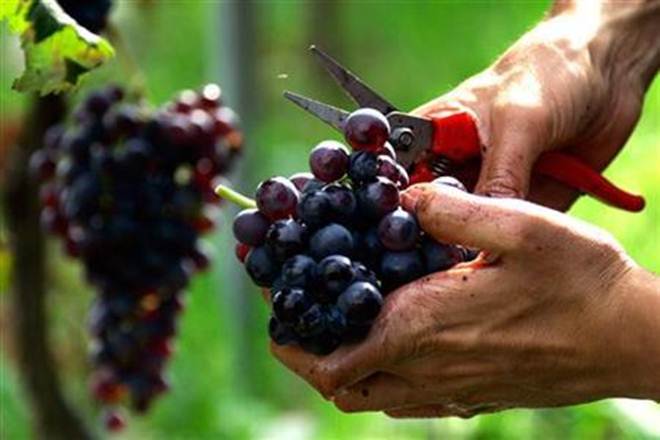
For decades, Thompson Seedless has been the crown jewel of Indian viticulture. Despite the myriad extra processes and manual interventions they demand from growers, the humble pale-green grapes, with mostly elongated berries, have bedecked vineyards one by one—from the dry plains of Sangli to the mild-tropical region of Coimbatore. More than 70% of grapes that are consumed in India—be it at our breakfast table or at a sprawling winery in Nashik– belong to Thompson Seedless or its clone varieties. This also explains why vintners here crib about the absence of enough exalted grape varieties —say, a Cabernet Sauvignon, or a Pinot Noir or a Chardonnay—to make wines worthy of gracing the altar of Bacchus.
All these may change for the better, though, if a collaborative effort of the ministries of commerce and agriculture bears fruit. Sensing an urgent need to drastically slash the cost of production for farmers and boost exports while catering for a growing domestic wine-making industry, both the ministries have agreed to bring in new varieties.
In a first, the government will float a global tender, asking companies to place their bids to supply seeds of some of the best varieties in the world that will also be apt for Indian conditions. The National Research Centre for Grapes (NRC) in Pune has been tasked with firming up technical details. APEDA (under the commerce ministry) will also play a key role in the whole exercise.
Some 8-10 varieties will undergo comprehensive testing in Indian conditions and 2-3 of them may finally be selected, a senior commerce ministry official said. Commerce minister Nirmala Sitharaman has been pushing for the diversification of grape varieties so that both production and exports get a boost, he added. Currently, less than 10% of India’s grape output is exported.
Also, a Thompson Seedless grower has to spend Rs 40,000-50,000 per acre a year just on growth-regulatory and manual treatment to make the grapes exportable. (If the berry diametre is not 16 mm or above, an exporter doesn’t find a buyer). Such expenses may drop to just about Rs 5,000 per acre annually, as many globally renowned varieties don’t require such interventions frequently.
Watch This Also:
Also, although India’s average yield of almost 22 tonnes per hectare is the highest in the world, its grapes don’t command premium prices in the global markets due to inferior quality in many cases.
Patent holders seek upfront payments
Established foreign companies are learnt to be looking for upfront payment, as they fear their rights over patented grape varieties may not be well protected in India.
SD Sawant, the director of the NRC (Pune), told FE: “Grape’s is a vegetatively-propagated plant. So once a single material comes here, it can be multiplied through cuttings and spread easily. It’s not possible to get every single grape farmer who may be using a patented variety registered with a centralised system.”
As part of the regular cropping system, the pruning activity in a vineyard takes place at least twice a year. It’s during this period that lots of materials change hands, which can then be multiplied very easily.
In major growing nations, even an individual grape farmer has to register himself to use a patented variety. Once his produce hits the market, he has to sell it by the name of the variety. There is a centralised system to track proceeds from the sale of the grapes. Royalty for the use of the patented variety is deducted from the sales realisation of the producer and is credited to the account of the breeder or the patent holder, Sawant said.
In India, however, no such system exists. So while the producer doesn’t pay anything within the country, exporters are required to shell out royalty once the grape variety enters the overseas markets, such as the EU. The royalty on the supplies of a grape variety is automatically cut and given to the patent owner and the rest of the money comes back to the exporters.
A fund for upfront royalty payment
The government may set up a fund, where it will provide an initial corpus for any upfront payment to overseas patent holders of grape varieties. Exporters may be asked to chip in with their contribution (which can be fixed on a per-unit shipment basis) to that fund so that a viable funding model is worked out to help bring in more such varieties in future.
India exported 1,58,218 tonnes of fresh grapes in 2015-16 fiscal, up almost 46% from a year before. Such exports, still, constituted just 6% of its production of almost 2.6 million tonnes for the crop year through June 2016.